

 ChatGPT
 Perplexity
 Claude
 Google AI
Who Created Texting? The Real History of SMS
Ask who created texting and you’ll usually get one name. The real answer is messier, and better. A few telecom engineers spent years arguing over specifications, and then a test engineer typed “Merry Christmas” on a computer and sent it to a phone.
So, who created texting?
Nobody did it alone, but three names come up.
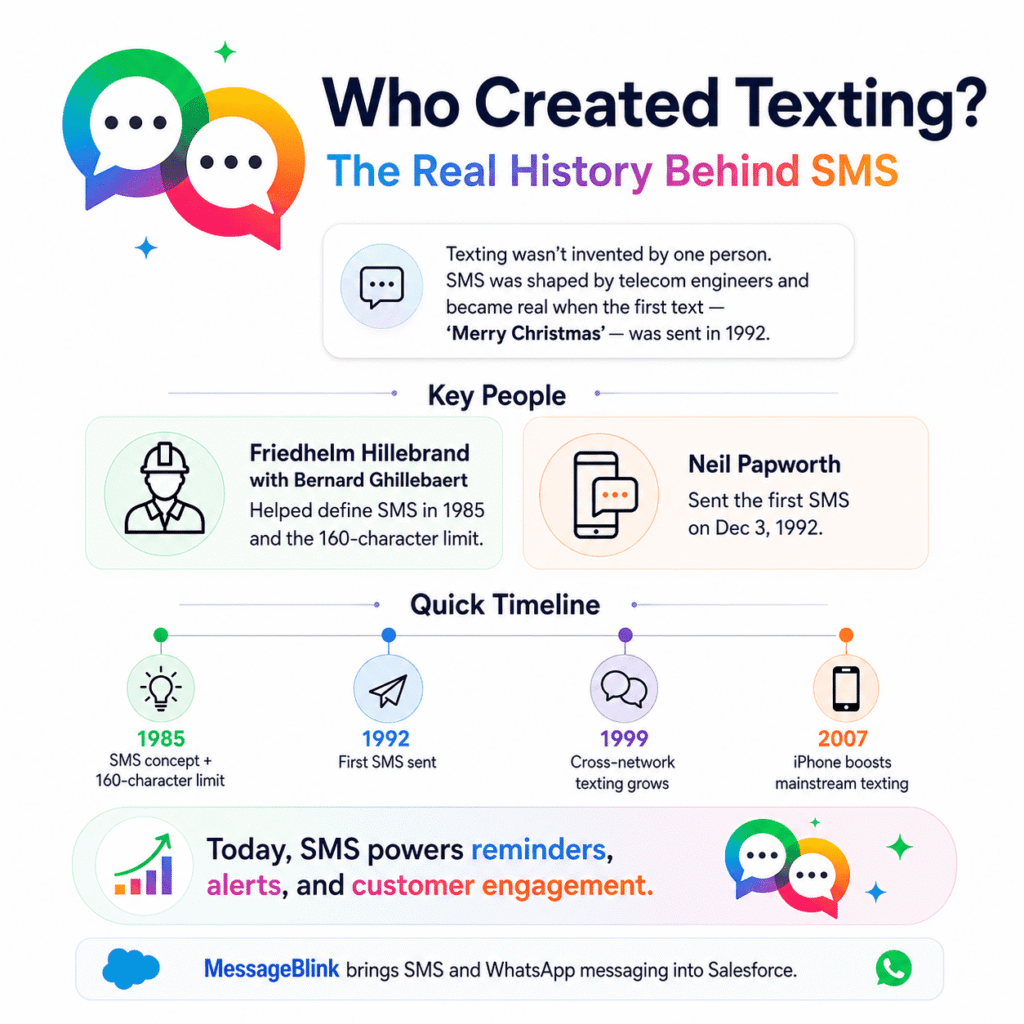
Friedhelm Hillebrand is the German engineer most often credited with shaping SMS. In the mid-1980s he worked with France’s Bernard Ghillebaert inside the GSM standards effort, and the pair developed the SMS concept. Hillebrand is also known for the 160-character limit. The story goes that he tested typical postcards and telex messages and found most of them fit inside that length.
Matti Makkonen, a Finnish engineer, is credited by some sources with the original idea in 1984, which is why you’ll sometimes see him called the father of SMS.
Neil Papworth wasn’t an inventor of the standard. He was a test engineer at Sema Group who, on December 3, 1992, sent the first text message ever: “Merry Christmas.” He typed it on a computer and sent it to the Orbitel 901 phone of Richard Jarvis at Vodafone. Jarvis couldn’t reply. Phones of that era could receive messages but couldn’t send them.
If someone asks who invented SMS, point to Hillebrand, Ghillebaert and Makkonen. If they ask who sent the first one, that’s Papworth.
Texting timeline
- 1984–85: The SMS concept takes shape inside the GSM working groups, and the 160-character length is settled on.
- 1986: SMS is defined as part of the GSM standards.
- 1992: Papworth sends the first text message.
- 1993: Commercial SMS begins in Europe. TeliaSonera in Sweden uses it for voicemail alerts, and Radiolinja in Finland launches the first person-to-person service.
- Around 1999: Networks connect their systems so people can text across carriers, and use takes off.
- 2007 onward: Smartphones like the iPhone popularise the threaded chat view we all use today.
Texting next to other communication tools
| Technology | Who / when | How it works | Still used? |
|---|---|---|---|
| Telegraph | Samuel Morse, 1830s–40s | Electrical pulses over wire | ✗ |
| Telephone | Alexander Graham Bell, 1876 | Voice over wire, later cellular | ✔ |
| Ray Tomlinson, 1971 | Text between computers | ✔ | |
| SMS | Hillebrand, Ghillebaert and colleagues, 1980s; first sent by Papworth, 1992 | Short text over cellular networks | ✔ |
| WhatsApp and similar apps | Internet era, from 2009 | Text and media over data | ✔ |
From a 160-character novelty to a business channel
SMS began as a way to send short notices, and it has become a serious business channel. Companies now use it for appointment reminders, delivery alerts, payment nudges and customer follow-ups, and they need consent, opt-outs and records to do it properly.
If your customer data lives in Salesforce, MessageBlink is a Salesforce-native app that handles SMS and WhatsApp from inside the CRM. There are no third-party portals, and the messages are logged on the contact record.