

 ChatGPT
 Perplexity
 Claude
 Google AI
What is an RCS message? Complete Guide to Rich Communications Services 2026
Text messaging just got its biggest upgrade in 20 years and most folks don’t even realize it happened yet.
If you’ve sent a text recently and seen read receipts, typing indicators or a crisp, uncompressed photo land in someone’s inbox, you’ve already used an RCS message. Rich Communication Services (RCS) is slowly replacing the plain old SMS as the default way phones communicate with each other, and the transition has sped up significantly after Apple added support for the protocol.
This guide explains what RCS messaging is all about, how RCS chat stacks up against SMS and MMS, and why it matters to anyone who communicates with customers at scale in 2026.
What is a “RCS Message”?
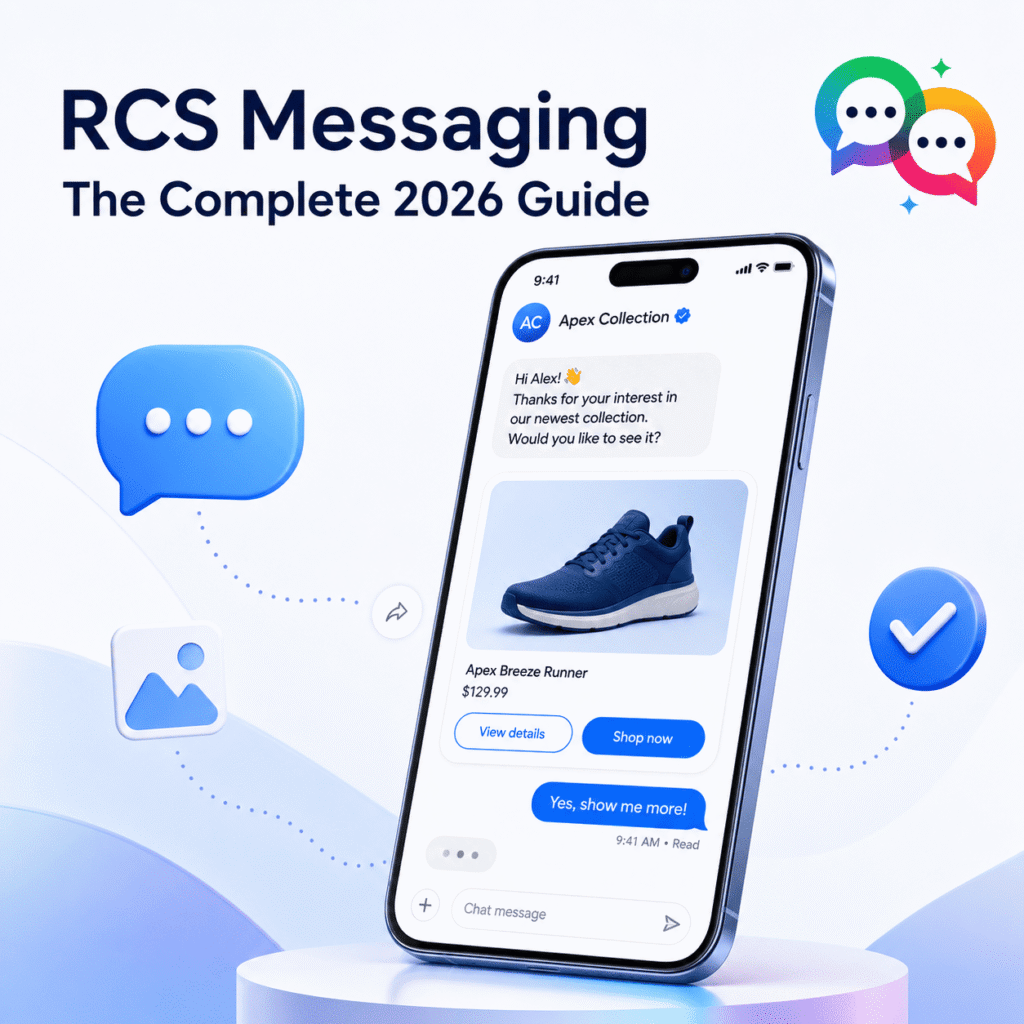
RCS stands for Rich Communication Services and is a messaging standard built by the GSM Association (GSMA) as a direct replacement for SMS. RCS transforms the native messaging inbox into something more like a fully featured chat app — and unlike SMS, which was built in the 1980s for short, plain text notes, it doesn’t require anyone to download anything new.
RCS messages support high-res images and video, branded sender profiles, clickable call-to-action buttons, read receipts and real-time typing indicators. It all runs over Wi-Fi or mobile data, just like WhatsApp or iMessage, not over the carrier’s old SMS network.
Why RCS Chat Adoption Skyrocketed In The Past Two Years
RCS technology is not new but without Apple’s support, the market was stuck in a “blue bubble” versus “green bubble” situation. That changed in late 2024 when Apple announced iOS 18 would support RCS and closed the messaging gap between Android and iPhone nearly overnight.
And the growth curve has been steep since then:
Juniper Research found that RCS had 1.1 billion active users in 2024 and that this will grow to 3.8 billion by 2026.
Global RCS adoption is set to hit 3.5 billion by 2027, with 1.2 billion users by end-2025
As of May 2025, Google said more than 1 billion RCS messages are sent everyday in the US alone.
Over 75 percent of the world’s mobile operators have deployed or are trialing RCS infrastructure.
RCS penetration in the UK is around 70% with concerns around smishing on other channels helping to contribute to this.
The direction is clear: RCS chat is no longer a niche feature for a select few Android flagships. It’s the default inbox experience across the board.
RCS Message vs SMS vs MMS: What’s the Real Difference?
| Feature | SMS | MMS | RCS |
|---|---|---|---|
| Rich media (photos, video) | ✗ Not supported | ✔ Limited, compressed | ✔ High resolution, no strict size cap |
| Read receipts | ✗ | ✗ | ✔ |
| Typing indicators | ✗ | ✗ | ✔ |
| Delivery method | Carrier network only | Carrier network only | Wi-Fi or mobile data |
| Encryption | ✗ Unencrypted | ✗ Unencrypted | ✔ End-to-end (Google Messages users only) |
| Branded sender verification | ✗ | ✗ | ✔ Verified sender badges |
| Universal device support | ✔ Works on all phones | ✔ Works on most phones | ✗ Requires an RCS-supported device and carrier |
“The tradeoff is compatibility.” SMS still works on literally every mobile phone on earth, which is why it is the fallback channel businesses can’t fully walk away from, even as they add richer channels on top.
What This Means for Business Messaging
The performance data is what is pulling businesses to RCS chat more quickly than almost any messaging trend in recent memory:
- RCS campaigns get nearly 45% response rates, much higher than traditional SMS
- Average click-through rates of 15-30% driven by interactive buttons and rich media
- RCS has SMS’s ~98% open rate, but also includes actual engagement tracking on top of that.
- Financial services has been an early leader with 49% of organizations already using RCS and 45% planning for adoption.
- Today 26% of brands are already sending RCS, with more than double that planning to follow.
The momentum is backed by traffic forecasts. Juniper Research estimates that the volume of business RCS traffic will reach over 200 billion messages globally by 2027, up from 70 billion in 2025, while total A2P RCS revenue will grow to $4.2 billion by 2029.
Where SMS Still Reigns
That is not to say SMS is dead. SMS still represents around 62% of global messaging traffic but it is the only channel that is guaranteed to reach every phone regardless of operating system, carrier or region. Plain SMS is still the safer default for time sensitive alerts, OTPs and audiences where you don’t know device compatibility.
The best messaging strategies in 2026 are not choosing RCS or SMS. They are blending the two: RCS for rich, branded engagement wherever supported, and SMS as the automatic fallback everyplace else.
Incorporating Rich Messaging Into Your Salesforce Process
If you’re handling customer communication in Salesforce, you know how disconnected texting can feel when it’s outside your CRM. MessageBlink was built to address that very challenge, enabling your team to send and automate SMS and WhatsApp messages directly inside of Salesforce, with every conversation, workflow, and reply linked to the record it pertains to. [See MessageBlink in action, inside Salesforce →]
Preparing for the Transition to RCS
- Audit your existing channel mix:- Know what percent of your audience is on RCS-capable devices before investing heavily.
- Use SMS as a fallback:- The RCS strategy must include graceful degradation to SMS for unsupported devices.
- First, “verified sender” status:- As smishing attacks increase and consumers become more reliant on verified senders, the verification of a brand will be more important than the rich media itself.”
- Measure engagement, not just deliveries:- The real benefit to RCS is data, read receipts and interaction tracking that SMS never had.
- Centralize the automation:- Whatever channels you use, route the conversations back into your CRM so that nothing is lost outside of the system of record.
Looking to add smarter, automated messaging to your Salesforce workflows?