

 ChatGPT
 Perplexity
 Claude
 Google AI
What Is Digital Engagement?
Digital engagement is the sum total of all the interactions a business has with its audience across digital channels, from website visits to emails, social posts, webinars, and increasingly, direct conversations via SMS and WhatsApp. There is no one metric or one channel. It’s the steady relationship between a brand and its prospects, customers, or employees, measured by clicks, replies, time spent, and ultimately, conversions.
For years, “digital engagement” was a website and email problem. This definition is not new. In 2026, the channels with the highest measurable engagement will not be the largest reach. They’ve got the best intent and the quickest response.
What Digital Engagement Will Look Like in 2026
The data really do support this. At the same time, audiences have grown larger than ever, but engagement rates on almost every major social platform have fallen. For example, Facebook is hovering around 0.15% engagement per post, while X has dropped to about 0.12%. Meanwhile, overall web engagement is down about 10% YoY, with visitors spending less time on the site and viewing fewer pages per session.
Not because people are checking out. That’s because the attention has moved to channels that feel personal and immediate. Increasingly, the most meaningful brand interactions happen outside of public feeds entirely, in DMs, closed groups, and branded channels, often referred to as “dark social.”
Message apps are in the midst of that shift. And the numbers speak better than any framework can.
The Channel Gap: Email vs. SMS vs. WhatsApp
For a 2026 digital engagement strategy, the channel mix is more important than the content calendar. That’s what the data says:
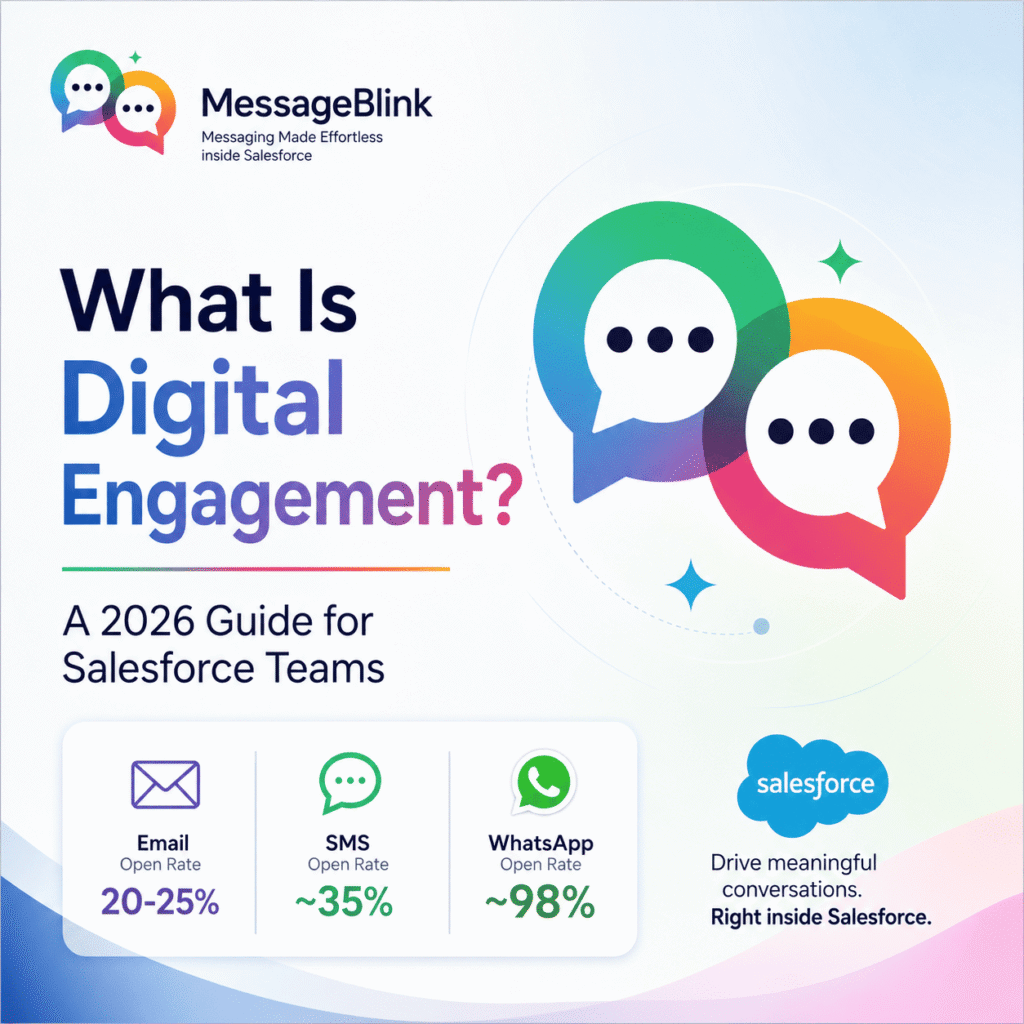
- Email: Reported open rates are somewhere between 35% and 45%, but once you adjust for inflation from Apple Mail Privacy Protection, real engagement is closer to 20-25%.
- SMS: Open rates are around 35%, and it’s a good fallback channel, not a primary one.
- WhatsApp: Open rates are an average of 98%, on par with SMS and far greater than email, while click-through rates are over 50% compared to 25% for SMS and only 1-4% for email. WhatsApp also converts up to 12x better than traditional email and SMS channels, with 57% of messages being replied to within the first minute.
The pattern generally applies to B2B, with one small nuance: B2B WhatsApp open rates are slightly lower at 75-85%, but reply rates are similar to B2C, and audiences are more likely to read without replying unless there’s a clear question or call to action.
This is the gap MessageBlink is here to fill for Salesforce teams: making that engagement advantage actionable by your reps and marketers, within the CRM they already live in, without adding a third-party messaging tool.
What Drives Digital Engagement Today
- Response time: iMessage is the US leader in business messaging, with 30-45% response rates. Trust signals, no carrier spam filtering, and real-time read receipts and typing indicators that build conversational momentum drive these rates. WhatsApp is the same story all over the world.
- Message-level personalization, not just subject line: Businesses that use WhatsApp along with AI-driven personalization and smart send-time optimization have a 34% higher engagement rate.
- Two-way conversation, not a broadcast: That’s a 90%+ open rate and a 15–30% click rate, or 13–27% of a full WhatsApp list clicking something, against about 0.6% of an email list. It’s a channel for dialogue, not just delivery.
- Native integration for CRM workflow: Engagement tools that exist outside your CRM create data gaps. If every reply, click, and opt-out does not automatically land back on the Lead, Contact, or Opportunity record, your team is flying blind.
The Role of SMS and WhatsApp in Your Salesforce Engagement Strategy
Most digital engagement guides consider messaging one of many channels. It deserves more weight than that for Salesforce-based teams for three reasons:
- Firstly, response speed compounds in a sales motion. A lead who responds to a WhatsApp message in three minutes is a very different lead than one who opens an email three days later.
- Second, engagement data is only useful if it is attached to the record. SMS and WhatsApp conversations are fed through Salesforce Flow and posted directly to standard objects, so engagement scoring, lead routing, and reporting are all accurate without the need for manual syncing.
- Third, as the scale of messaging increases, compliance and opt-in tracking become more important. WhatsApp Business messages have opt-out rates of just 0.3–0.5%, compared to 0.5–1% for email and 2–4% for SMS. But you still need to track consent properly at the record level, not in a separate app your compliance team can’t audit.
This is where a 100% Salesforce-native platform tips the scales. No middleware layer holding engagement data hostage, no separate login for reps to check replies. Salesforce contains all the sends, replies, and opt-outs.
Best Practices for Digital Engagement in 2026
- Be purposeful about channel order. For time-sensitive touches, lead with the highest-intent channel (WhatsApp or SMS), and for long-form nurture and formal communication, use email.
- Beyond first name. Leverage CRM fields, past interactions, and lifecycle stage to shape message content, not just the greeting.
- Automate the reply-to-record loop. Each incoming message needs to update the corresponding Salesforce record (no manual data entry required).
- Observe frequency restrictions. If you send a campaign to a stale, unengaged list, your open rates can drop from 90%+ to 65-75%. So list hygiene is as important as message quality.
- Track outcomes of conversations, not just delivery. Track replies and completed actions in Salesforce reporting, not vanity metrics on a separate messaging dashboard.
Concluding Thoughts
In 2026, digital engagement will not be about adding more channels. You win by being on the right channel, with the right message, in a system that captures what happens next. For Salesforce teams, that means thinking of SMS and WhatsApp as core engagement infrastructure, not an add-on, and keeping every single conversation in the CRM where the rest of the customer record already lives.