

 ChatGPT
 Perplexity
 Claude
 Google AI
What is an SMS code?
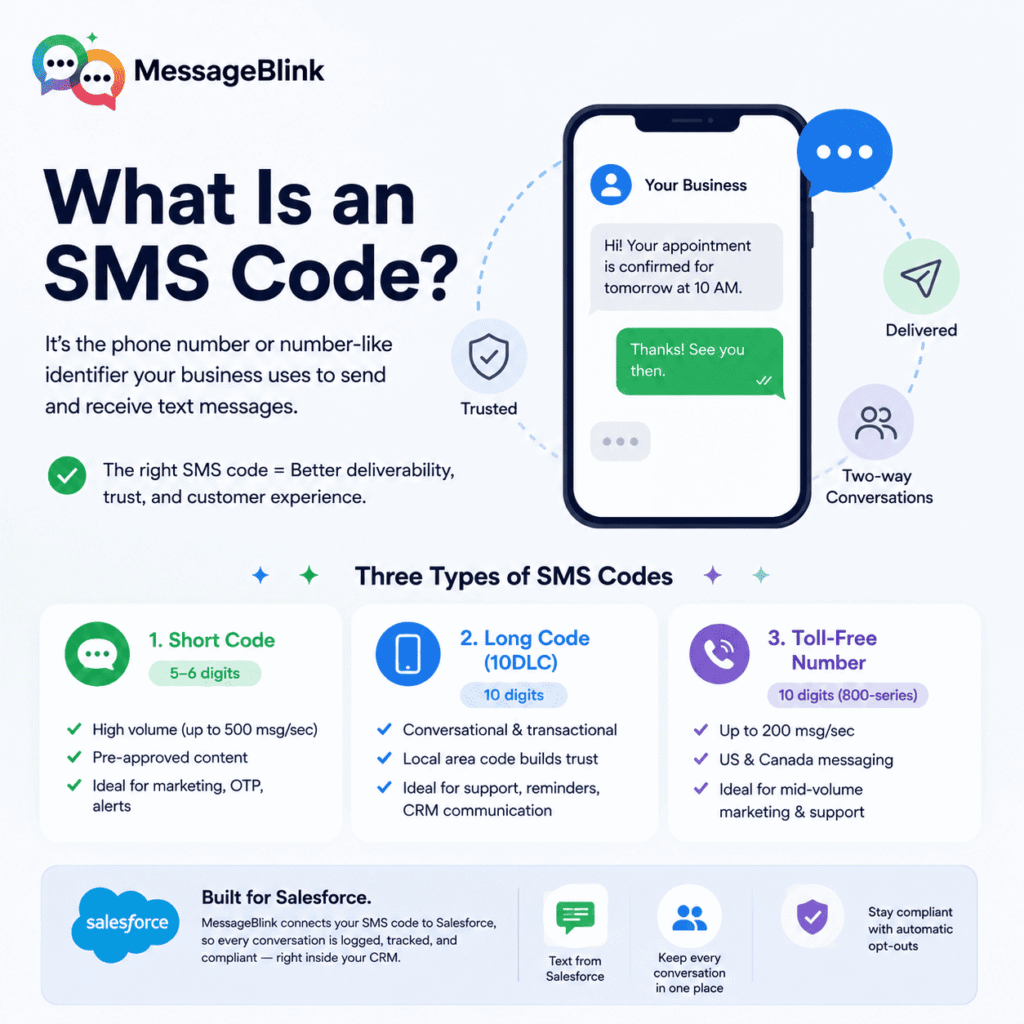
An SMS code is the number, or number-like identifier, that a business uses to send and receive text messages. Consider it the “from” address on every text message your customers get from you. Just like your email domain says something to your customers about your brand, your SMS code says something to them about legitimacy, deliverability, and purpose.
But not all SMS codes are the same. Three types of business messaging options exist: short codes, long codes (10DLC), and toll-free, all built for different messaging purposes, volumes, and budgets.
This choice is foundational. Make it right. If you use the wrong code, your messages could end up as spam, get blocked by carriers, or simply not reach the people that matter the most.
3 Types of SMS Codes: Understanding
1. Short codes for SMS
A short code is a 5- or 6-digit number that is used only for text messaging. You’ve probably already encountered one—banks use them for one-time password (OTP) alerts, retailers use them for promotional campaigns, and healthcare providers use them for appointment reminders.
Example: Customer texts JOIN to 74688 to opt in for a loyalty program.
There are two types of short codes:
- Dedicated short codes are assigned to one business, allowing them full control over branding and messaging.
- Shared short codes – a single number for many businesses, identified by keywords. Because of abuse, many carriers in the US have discontinued shared short codes, so dedicated is now the norm.
Main features:
- Send up to 500 messages per second (higher throughput is possible with some carriers)
- Pre-approved content provides very high deliverability
- Provisioned through carriers takes 6-12 weeks
- Higher monthly rates (US $500-$1,500/month)
- Works only in the country (purposely)
- Best used for: marketing campaigns, two-factor authentication, mass notifications
2. SMS Long Codes (10DLC)
A long code is a typical 10-digit phone number, like a mobile or business number, registered with the US 10DLC (10-Digit Long Code) program. This registration process was started by carriers in 2021 in an effort to reduce spam and protect consumers.
Example: Customer gets delivery update from (415) 823-4971.
10DLC numbers have a specific area code, giving a more personal, local experience — an important trust signal for conversational messaging.
Features at a glance:
- Send up to ~300 messages/day/number (throughput scales by carrier approval and use case)
- Setup takes 1-3 weeks with brand and campaign registration
- Much cheaper than short codes
- Supports voice calls, SMS, and MMS
- Delivery receipts are carrier-dependent
- Great for: Transactional alerts, appointment reminders, customer support, conversational messaging
Note on the observance: All 10DLC traffic in the US must register with The Campaign Registry (TCR). Unregistered long codes are filtered heavily. Any good SMS platform (like MessageBlink) will do this registration for you.
3. SMS Toll-Free Numbers
Toll-Free SMS Number (TFN) – A 10-digit number that begins with 800, 833, 844, 855, 866, 877, or 888 and supports both voice and text. It is a middle ground in terms of throughput and cost between a long code and a short code.
Key features:
- Up to ~200 messages per second upon carrier approval
- Must be verified via toll-free verification process
- Quick to implement, less expensive than short codes
- Best for: US & Canada cross-border messaging, customer support, mid-volume marketing
Comparison of SMS Code
| Feature | Short Code | Long Code (10DLC) | Toll-Free Number |
|---|---|---|---|
| Format | 5-6 digits | 10 digits | 10 digits, 800-series |
| First time | 6 to 12 weeks | 1-3 weeks | 2-4 weeks |
| Throughput | Up to 500 msgs/sec | ~300 msg/day (scalable) | Maximum 200 messages/sec. |
| Voice Calls | No | Yes | Yes |
| MMS Support | Yes | Yes | Yes |
| Best For | High-volume marketing, OTP | Conversational, transactional | Mid-volume, cross-border |
| Cost | High | Low-Medium | Medium |
| Geographic Scope | Domestic only | Domestic | US + Canada |
| Delivery Reliability | Very high | High (with 10DLC registration) | High |
What does an SMS code actually do?
When a business sends a text, the message goes from the SMS platform to an aggregator (a messaging hub connected to the carrier), through the recipient’s mobile carrier network, and to the customer’s device. Your SMS code is the key to the whole chain of routing, filtering, and delivering that message correctly.
Here’s why your code type matters at every step:
- Carrier filtering: Carriers look for spam signals in outbound messages. Registered short codes and verified 10DLC numbers have significantly higher deliverability.
- opt-in and compliance: Your TCPA and GDPR compliance records are anchored in your code—the number of recipients who opted in to hear from you.
- Two-way messaging: Replies are possible directly by the customer depending on the code type. With platforms that integrate with CRM systems like MessageBlink, replies show up immediately in Salesforce — no separate inbox, no missed conversations.
How to Select a Suitable SMS Code for your Business
The correct code is based on three things: volume, purpose, and customer experience. A practical framework is as follows:
Opt for a Short Code when:
- You push out over 10,000 messages a day
- Your use case needs near real-time delivery (OTP and emergency alerts)
- You care about brand recognition on the sender number
- You’re running a nationwide consumer marketing program
Choose a Long Code (10DLC). when:
- Your messages are mainly conversational in nature—support chats, appointment confirmations, follow-ups
- You want a local area code to build regional trust.
- You’re using texting in a CRM like Salesforce to have 1:1 conversations
- You want to get started fast and scale cost-effectively.
Opt for a Toll-Free Number if:
- You need to text across the US and Canada
- You want a brand-safe, recognizable number without the short code timeline.
- Your volume is steady but increasing
SMS Codes in Salesforce: What Most Guides Don’t Mention
Most comparisons don’t get past the basics. But if your team manages customer relationships in Salesforce, there’s an important layer on top: how your SMS code fits into your CRM.
With a native Salesforce SMS platform like MessageBlink, your SMS code, whether it’s a long code or short code, is directly tied to Salesforce records. Which means:
- All inbound and outbound messages are automatically logged to the Contact or Lead record
- Sales reps respond from within Salesforce – no copy-paste across apps
- Managers, support teams and compliance officers can see conversations in real time
- Opt-outs auto-update the contact record, keeping you TCPA compliant without the manual work
This is where the “which code should I use” question gets a little more nuanced for B2B teams. For Salesforce-driven workflows, a long code is almost always the right call because it accommodates the back-and-forth nature of sales and support conversations. Short codes make sense when your Salesforce automation is triggering mass campaigns—bulk appointment reminders across a patient population, for instance.
The Bottom Line
An SMS code is more than just a number — it’s the foundation of your entire business texting strategy. Choose a short code when scale and speed are non-negotiable. Choose a long code when relationships, context, and two-way conversation are the priority. And if you’re running your customer relationships through Salesforce, make sure your SMS platform ties that code directly into your CRM so nothing falls through the cracks.
MessageBlink brings native SMS and WhatsApp messaging directly into Salesforce — no third-party inbox, no data silos. Your team texts from the tools they already use, and every conversation becomes part of the customer record.
See how MessageBlink works inside Salesforce →
Have a question about which SMS code is right for your Salesforce setup? Talk to the MessageBlink team →