


 ChatGPT
 Perplexity
 Claude
 Google AI
What Is A2P Calling? Benefits, Use Cases & Compliance Guide (2025)
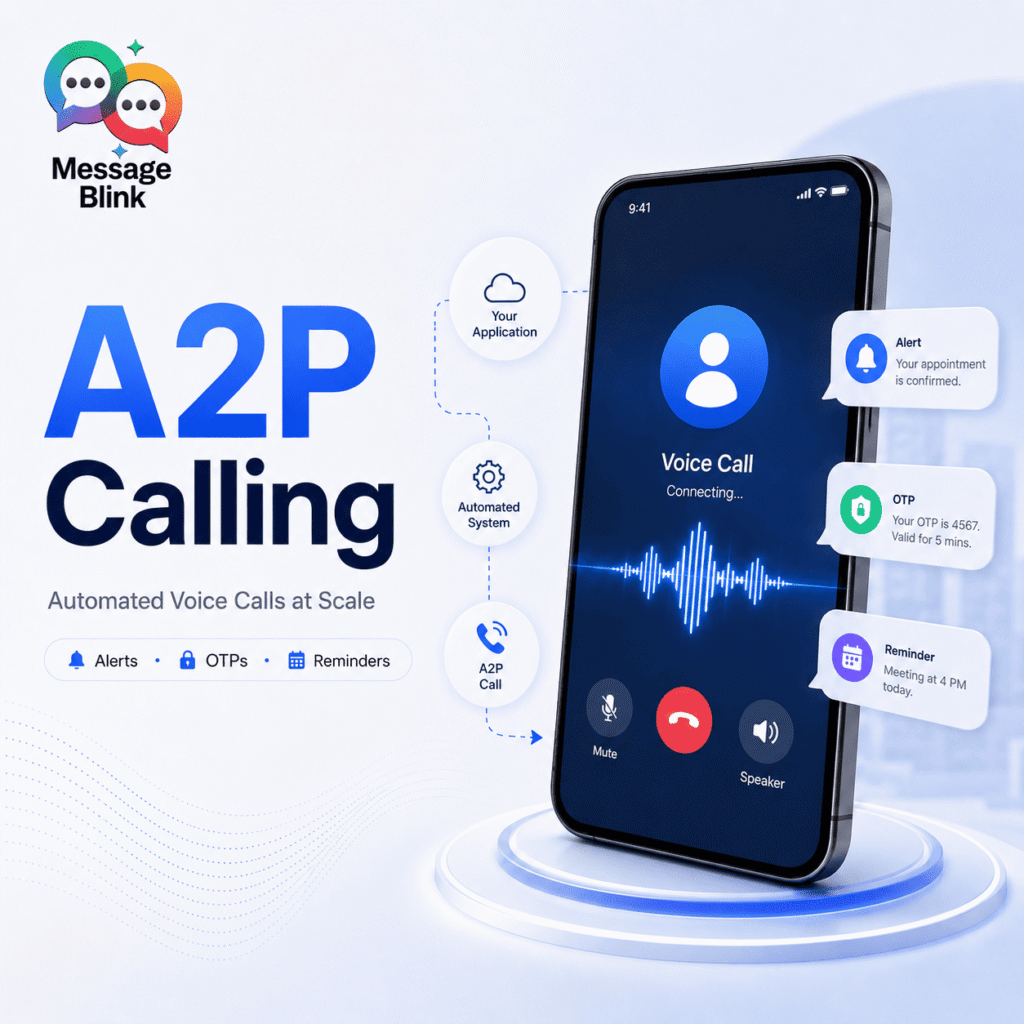
A2P calling is application-to-person calling, when a software program automatically makes a call and sends a voice message to a person without a live agent. Businesses utilize it for appointment reminders, OTP distribution, fraud alerts, emergency messages, and large-scale outreach efforts.
You have made A2P calls without knowing it. Your flight departure time confirmation. An automated voice reading your bank OTP. This is a public service announcement from your local government in the event of a weather emergency. None of those had a human at the other end of the line—and that is the point.
A2P calling solves a crucial challenge for businesses: how can you reach thousands of individuals fast, consistently, and without tying up your entire support team? This book covers what you need to know: how A2P calling works, compliance standards you can’t ignore, industry use cases, and how it fits alongside A2P messaging in a full communication strategy.
What Is A2P Calling?
A2P calling is short for application-to-person calling. It applies to any voice call that is programmatically generated by a business application—not manually by a person. The call is usually one-way—meaning the application plays a pre-recorded or text-to-speech message, and the recipient listens.
It’s the opposite of P2P calling (person-to-person), which is a live, real-time discussion between 2 people. A2P calling is optimized for volume, speed, and consistency, not conversation.
A2P calling is akin to, but not quite the same as, A2P messaging—which is about automated SMS and WhatsApp messages, not voice conversations. The two commonly function together as a multi-channel automated communication strategy.
A2P vs P2P Calling: Key Differences
| Factor | A2P Calling | P2P Calling |
|---|---|---|
| Started by | Software application / platform | A person, manually |
| Direction | Usually one-way (broadcast) | Two-way real-time dialogue |
| Volume | Thousands of concurrent calls | One call per agent at a time |
| Use case | Alerts, reminders, OTPs, promotions | Sales, Support, Consultation |
| Human agent needed | No | Yes |
| Cost per interaction | Very low (automatic) | High (labor-intensive) |
| Regulatory framework | TCPA, STIR/SHAKEN, carrier norms | Standard telephone rules |
How A2P Calling Works: A Step-by-Step Walk-through
There are several automated and real-time tracked levels of mechanics to A2P calling from the generation of a message to its delivery by a carrier.
- Message Creation
The business writes the voice script. This might be a static pre-recorded audio file or a dynamically created message using text-to-speech (TTS) technology that personalizes material—like inserting the recipient’s name or appointment time.
- Integrating Platforms and APIs
The A2P calling system is integrated with the business’s CRM, scheduling platform, or operations software via an API. This means the system can automatically launch calls based on events like a booking confirmation, a payment deadline, or a security login attempt.
- Recipient List & Schedule
The platform retrieves the appropriate contact list, filters it based on the permission records and opt-out lists, and then schedules calls during the allowed calling times as per the TCPA standards.
- Carrier Network Originated Calls
The application makes a call request to the A2P provider, which routes the call via the carrier networks. With STIR/SHAKEN-compliant providers, the caller ID is validated before it reaches the call recipient.
- Delivery and Reporting
Calls are delivered and tracked live. Detailed insights on delivery rates, answer rates, drop-offs, and interaction, allowing for continuous improvement.
A2P Calling Vs. A2P SMS Messaging: What Does Your Business Require?
A2P telephony and A2P messaging both provide businesses the opportunity to automate communications at scale — but they have various use cases, and performance may vary based on the use case.
| Factor | A2P Calling | A2P Messaging (SMS / WhatsApp) |
|---|---|---|
| Open/engagement rate | ~60–80% (impossible to ignore) | SMS: ~98% open rate, often in 3 min |
| Message length | Audio: Unlimited | SMS: 160 characters; WhatsApp: Multimedia |
| Two-way capabilities | Limited (IVR or keypress) | Full conversation |
| Ideal for | Critical notifications, OTPs, geriatric audience | Reminders, support, campaigns, follow-ups |
| Works offline | Yes | SMS: Yes. WhatsApp: Data Required |
| Compliance framework | TCPA, STIR/SHAKEN, FCC | TCPA, 10DLC (SMS), WhatsApp Business Policy |
| Cost | Per message higher | Less per message |
A2P Calling Use Cases by Industry
A2P calling has demonstrated its worth in practically every industry. The most impactful applications are the following:
Medical Care
Automated appointment reminders, prescription pick-up alerts, care gap warnings and post-discharge follow-up calls. Decreases no-shows by up to 30%.
Banking & Fintech
One-time password (OTP) delivery, payment due reminders, loan approval updates and fraud alert messages. Adds an extra degree of security to online transactions.
Real Estate
Property showings reminders, mortgage application status updates, lead follow up campaigns. Keeps prospects involved at crucial moments in the pipeline.
Higher Education
Instant reminders for deadlines in higher education, financial aid alerts, emergency campus notifications and class cancellation messages to student populations.
Retail & E-Commerce
Notify about order shipping, remind about delivery window, warn about return confirmation, reach out on cart abandonment to recover lost revenues.
Government & Public Sector
Even without internet access you can receive emergency evacuation alerts, severe weather forecasts, civic duty reminders (tax deadlines, voting) and public health notices.
Security Verification & Two-Factor Authentication (2FA)
A2P calling is a vital fallback for 2FA when SMS delivery is problematic across all industries. Financial organizations, SaaS platforms, and healthcare portals employ automated voice OTP transmission to authenticate user identities during login, password reset, and high-value transactions. Voice delivery is great for people on low-signal networks or less comfortable with digital interfaces.
Survey & Feedback Meetings
Businesses conduct post-interaction surveys at scale using interactive A2P calls powered by IVR (interactive voice response) systems. Customers answer by keypress, allowing for quick data collecting for NPS scoring, product research, and compliance monitoring with no manual agent involvement.
A2P Calling Compliance: TCPA, STIR/SHAKEN & Carrier Regulations
A2P calling is highly regulated. Non-compliance can lead to big fines, blocking of the carrier, and reputational harm. Here are a few major regulatory frameworks every A2P caller should be familiar with:
TCPA (Telephone Consumer Protection Act)
The TCPA is the primary United States statute governing automated calls and messages to consumers. Under the TCPA, firms are required to seek prior express written approval before making automated or prerecorded calls to mobile numbers. Violations are subject to a $500–$1,500 fine each call. The TCPA also limits calling hours to 8am–9pm in the recipient’s local time zone. Businesses must have explicit opt-out methods and comply with do-not-call requests swiftly.
STIR/SHAKEN (Caller ID Verification)
STIR/SHAKEN is a framework imposed by the FCC that forces telecom operators to digitally sign and verify the caller ID of voice calls before they get to the recipient. It was rolled out in the US carrier community in 2021 to help fight caller ID spoofing, a technique heavily exploited in unlawful robocalling activities. For genuine A2P businesses, collaborating with a STIR/SHAKEN-compliant service ensures your calls show up as “Verified” on recipient devices, dramatically increasing answer rates. Carrier-level filters could mark calls without attestation as spam or stop them outright.
Carrier Grade Filtering & Analytics
Major US carriers (AT&T, Verizon, and T-Mobile) and analytics suppliers (YouMail, TNS, and First Orion) have their own spam-scoring methods. A single number making a high volume of calls, having a poor answer rate, and lacking STIR/SHAKEN attestation all contribute to the chance of that number being blacklisted. To avoid deliverability issues, companies should be using properly registered numbers, rotating call volumes over various numbers where appropriate, and routinely auditing their call analytics.
Worldwide Compliance
Outside the US, A2P calling is regulated by several agencies. Any automated communication using personal data, such as phone numbers, falls under the GDPR rules of the European Union’s General Data Protection Regulation. The UK ICO enforces the Privacy and Electronic Communications Regulations (PECR). Companies operating cross-border must make sure that how they handle and maintain data complies with the rules of the jurisdictions they operate in.
Benefits of A2P Calling for Businesses
Reach at Scale
A2P calling enables businesses to send thousands of voice messages simultaneously—without the need for additional contact center workers. And that’s a game-changer for healthcare providers, financial institutions, and merchants who need to get time-sensitive changes out to vast contact lists on short notice.
More Engaging Than Email
Voice calls are inherently more urgent and attention-demanding than email. If you need a response immediately—a fraud alert, an appointment confirmed for tomorrow, an OTP good for 60 seconds—A2P calls will always beat an email in terms of open rate and response speed.
Cost Effectiveness With Automation
Automated A2P calls cost a fraction of a call from a live agent. If your organization uses high-volume, routine communications (appointment reminders, delivery updates, payment alerts), the operational savings add up quickly on huge contact lists.
Personalisation at Scale
Modern A2P platforms allow dynamic text-to-speech, injecting tailored data—such as recipient names, account details, and specific dates—into each conversation. The end effect is an experience that sounds personalized, even after tens of thousands of calls.
Works Without Internet or Cell Phones
Unlike WhatsApp messages or push notifications, a voice call reaches any phone, including basic mobile phones and landlines. A2P calling is one of the few communication forms that is uniquely inclusive for industries serving the elderly, isolated populations, or users in low-connectivity locations.
Choosing an A2P Calling Provider
STIRRED/SHAKEN: Number, Reputation & Compliance
Prioritize suppliers that support full STIR/SHAKEN attestation. If they do, ask carefully if they offer A-level attestation, the highest level, which verifies both the calling party and their authority to use the number. Review how they handle number reputation and if they provide proactive monitoring for carrier flagging.
API Quality & CRM Integration
Your A2P calling platform should interface well with your existing CRM or operational software for B2B use cases. Evaluate REST API documentation, webhook support for real-time call events, and if the provider has pre-built interfaces for platforms you already use, such as Salesforce.
Delivery Infrastructure & Uptime SLA
Time-critical communications require high availability. Check the provider’s SLA uptime assurances, their carrier network redundancies, and their performance during high call volumes. Direct-to-carrier routing (skipping middlemen) saves latency and increases dependability.
Analytics & Reporting Level
The difference between good and great A2P suppliers is actionable reporting. Look for real-time delivery dashboards, answer rate tracking by number and campaign, demographic engagement breakdowns, and export capabilities to your BI tools.
Pricing Transparency
A2P calling prices differ. Watch out for suppliers that add carrier surcharges, reporting, or compliance features. Look for all-in per-minute rates with transparent tiers for bulk discounting.
Pair A2P Calling with Native Salesforce Messaging
A2P calling handles your voice outreach. MessageBlink handles the rest — native SMS and WhatsApp messaging built directly into Salesforce, with no switching between tabs or platforms. Send automated messages, track delivery, and manage conversations from within your Salesforce workflows. Available on the Salesforce AppExchange.