


 ChatGPT
 Perplexity
 Claude
 Google AI
Messaging Codes Explained: Short Code, 10DLC, and Toll-Free Numbers
If you’re building an SMS or WhatsApp program, the first real decision you’ll make isn’t your message copy — it’s which messaging code you send from. The wrong choice can mean carrier filtering, throttled delivery, or a campaign stuck in registration limbo for weeks. The right one gets your Salesforce-triggered texts into inboxes fast, reliably, and compliantly.
This guide breaks down every major type of messaging code used for business texting today, how they compare on cost, speed, and throughput, and how to pick the right one when you’re sending SMS and WhatsApp messages natively from Salesforce.
What Is a Messaging Code?
A messaging code (also called a sender ID or origination number) is the number or identifier a business uses to send SMS or WhatsApp messages to customers. Carriers use these codes to route, filter, and rate-limit application-to-person (A2P) traffic—meaning the code you choose directly affects whether your messages actually reach a phone.
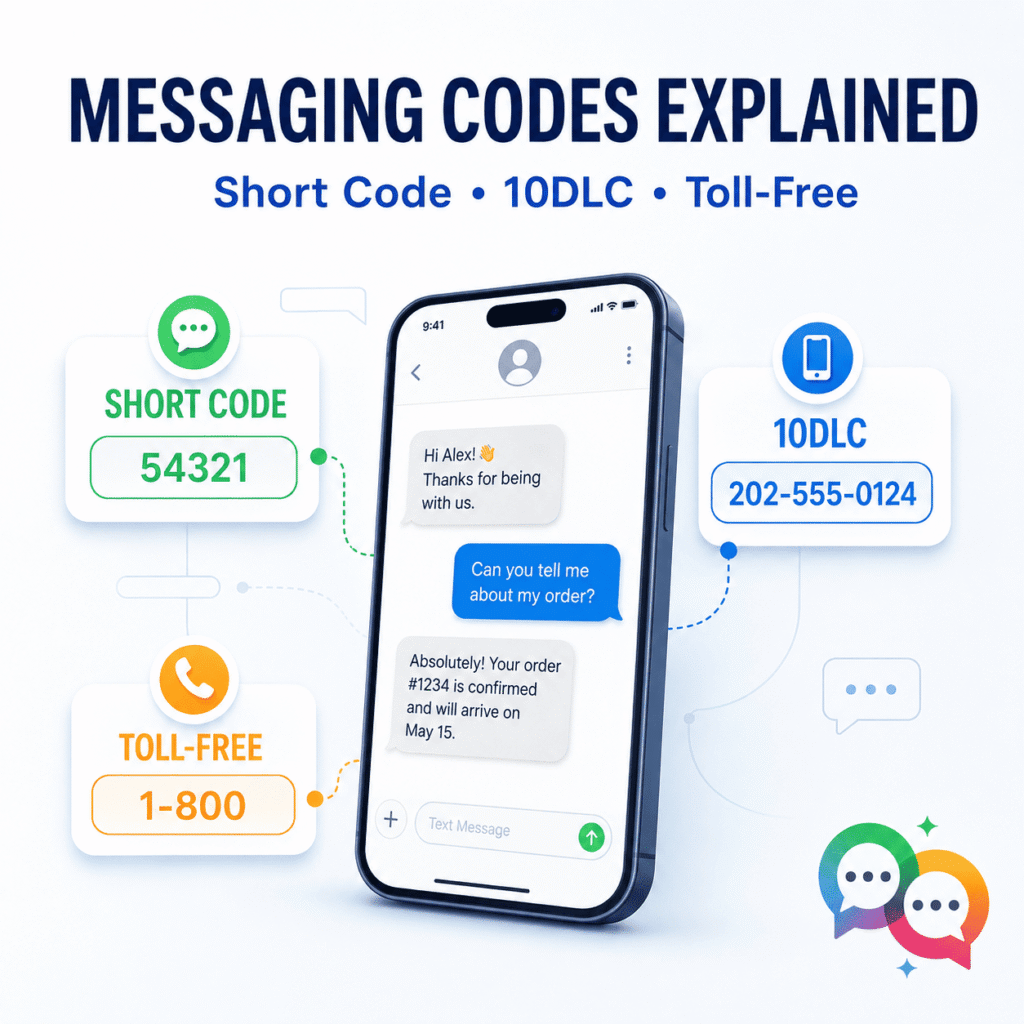
In the US, there are four main types: short codes, 10DLC numbers, toll-free numbers, and messaging services (a container that groups multiple senders together).
Short Codes
A short code is a 5–6 digit number registered with wireless carriers specifically for high-volume, two-way business texting. Short codes are the choice most brands reach for when they need high-volume marketing, flash sales, immediate alerts, and one-time verification codes, largely because they carry the highest throughput of any code type and face the least carrier filtering. Ascend Messaging
Dedicated vs. shared short codes
- A dedicated short code belongs to one business only. A shared short code is split across multiple businesses and is being phased out — registered senders on dedicated numbers and codes typically face less carrier filtering because they’re tied to a verified sender identity.
- Dedicated codes let you fully customize keywords, STOP/HELP replies, and opt-out flows.
- Vanity short codes (a memorable number you choose) cost more than randomly assigned ones but strengthen brand recall.
Trade-offs: Short codes are the most expensive option to lease, and, per multiple carrier-messaging sources, campaign brief review and approval for short codes typically takes the longest of any code type, roughly four to six weeks. That makes them a better fit for enterprises running sustained, high-volume campaigns than for teams that need to launch this month.
10DLC (10-Digit Long Code)
A 10DLC number looks like a normal local phone number (e.g., 202-555-0124) but is registered specifically for A2P business messaging. It’s become the default choice for most mid-size businesses because it balances cost, speed, and legitimacy.
10DLC numbers are generally faster and cheaper to set up than short codes, with lower ongoing costs, which has driven their popularity across a wide range of business messaging use cases. 10DLC activation is typically quicker than short code approval, though it still requires A2P campaign registration to get better carrier treatment. Bandwidth Emitter
Why businesses choose 10DLC:
- Local area codes build trust with region-specific audiences (a common ask from real estate, healthcare, and higher-ed teams).
- Registration through The Campaign Registry assigns your brand a trust score that determines throughput.
- Typical use cases include two-factor authentication codes, appointment reminders, and one-to-one service notifications.
Trade-off: Throughput is capped lower than short codes or toll-free—most carriers limit 10DLC to well under 100,000 messages per hour, so very high-volume blasts may need a different code type or additional numbers.
Toll-Free Numbers (TFN)
Toll-free numbers use familiar 800/833/844/855/866/877/888 prefixes and support both one-way and two-way SMS. They’re increasingly popular as a starting point because verification is fast relative to short codes and throughput is solid.
Toll-free SMS is often the cleanest starting point for national, lower-to-mid-volume messaging campaigns, and toll-free traffic must be carrier-verified before it can send. Once verified, toll-free numbers can support meaningfully higher throughput than 10DLC — useful for customer support, delivery notifications, and account alerts sent at scale.
Trade-off: Toll-free numbers can feel less personal than a local 10DLC number, since customers recognize the format as a corporate line rather than a direct line.
Messaging Service (Sender Pool)
A messaging service isn’t a code itself — it’s a container that groups multiple senders (short codes, 10DLC numbers, or toll-free numbers) under one campaign. It lets you apply consistent compliance rules (like the same STOP keyword) across every number and can automatically route messages through the best available sender based on the recipient’s region.
Messaging Codes Compared
| Factor | Short Code | 10DLC | Toll-Free |
|---|---|---|---|
| Format | 5–6 digits | Local 10-digit number | 800/833/844/etc. |
| Throughput | Highest ✔ | Moderate ✔ | High ✔ |
| Setup time | 4–6+ weeks ✗ | ~1–2 weeks ✔ | ~3–4 weeks ✔ |
| Cost | High ✗ | Low ✔ | Low–moderate ✔ |
| Carrier filtering risk | Lowest ✔ | Low ✔ | Low ✔ |
| Best for | High-volume marketing, OTPs | Local, personal 1:1 texting | National support & alerts |
| Two-way conversations | ✔ | ✔ | ✔ |
Where MessageBlink Fits In
Whichever code type you register, the harder problem is usually operational: getting SMS and WhatsApp messages to actually trigger your Salesforce data—a new lead, a case update, or an opportunity stage change—without exporting contacts to a third-party messaging tool.
MessageBlink is built 100% natively on Salesforce, so your registered messaging code (short code, 10DLC, or toll-free) connects directly to Salesforce Flow, allowing you to send and receive SMS and WhatsApp messages without leaving your org. There’s no MMS involved—MessageBlink is purpose-built for SMS and WhatsApp text-based conversations, which keeps delivery lightweight and carrier-friendly.
Because everything runs inside Salesforce, your opt-in records, consent status, and conversation history live on the same Contact, Lead, or Case record your team already works from — which also makes staying compliant with TCPA, 10DLC, and A2P registration requirements far easier to track than juggling a separate messaging platform.
Ready to connect your registered messaging code to Salesforce? Explore MessageBlink on the Salesforce AppExchange.