

 ChatGPT
 Perplexity
 Claude
 Google AI
Mass Text Bulk SMS: The 2026 Guide to Mass Text Messaging
Businesses use mass text messaging to reach hundreds or thousands of contacts at once with one SMS or WhatsApp send—whether it’s a flash sale alert, a school closure notification, a shipment update, or a fundraising appeal. It’s one of the highest-attention mediums out there, with open rates that surpass email, but it’s also one of the most controlled. Getting things wrong in 2026 means more than poor delivery. Could mean carrier lock out or actual financial exposure.
In this post, we’ll explore what mass texting actually is, how it varies from group texting, what compliance looks like today, and how you operate it directly inside Salesforce without sewing together third-party middleware.
What Is Text Messaging?
Mass text messaging (also known as bulk SMS, bulk alerts, or bulk texting) is the practice of sending the same message or a customized version of the message to a large group of recipients at one time. It’s application-to-person (A2P) messaging, not a human entering one text at a time, a business system or CRM fires the send.
Typical usage cases are:
- Promotions & seasonal offers
- Reminders for appointments and events
- Weather or emergency warnings
- Nonprofit fundraising and donor outreach
- Higher ed Enrollment deadlines, campus alerts Shipping, billing or account notifications
Mass Texting vs. Group Texting: What’s the Difference?
These two get confused all the time and it is important for compliance.
- Group texts are a limited, restricted conversation where everyone can see and reply to each other’s messages – think a few buddies or a small group at work.
- Mass texting is one to many. Each recipient receives a private message and cannot see who else it was sent to. This is the way businesses use it, and it is the way that comes under A2P legislation.
Why Mass Texting Still Beats Other Channels
SMS always has open rates in the 90%+ area, most of it within minutes of delivery. Time sensitive messages, a limited time discount, a same day appointment reminder, a service outage alert, nothing competes for speed of attention.
Compliance: What’s Changing for 2026
This is the portion most bulk texting guidelines brush over, and it is the part that actually affects whether your texts get delivered at all.
10DLC registration is required, not optional. Since February 2025, US carriers have blocked 100% of unregistered A2P 10DLC traffic, not throttled, not delayed, but not delivered. Your dashboard might say “sent” even if it never makes it to a phone. Before sending at scale, you must register each brand and campaign with the Campaign Registry.
TCPA consent rules were tightened again this year. The FCC’s one-to-one consent rule went into effect in January 2026, requiring each business to get its own direct consent from a receiver, instead of buying into or sharing a consent list. Any marketing copy still requires prior express written consent. The FCC’s revoke consent rule now requires real time opt-out processing.
Quiet hours are now in effect. Messages have to be sent between 8am and 9pm, but in the recipient’s time zone, not yours.
The opt-outs must be immediate and automatic. STOP requests must be processed in real time and logged.
SHAFT material is screened at the carrier level. If your registration status is not set to Adults, content with sex, hate, alcohol, firearms and tobacco is banned.
State law can be more strict than federal law. California, Texas and Virginia are just a few of the states that have added more criteria on top of TCPA, and the harsher standard applies wherever your recipient is.
This is not to make mass texting seem unsafe to avoid, but to make apparent why the platform you use matters as much as the message you write.
How to Send Bulk Text Messages from Salesforce
If your prospects, leads and contacts already exist in Salesforce, running your mass text campaign outside of Salesforce poses unnecessary risk: duplicate data, sync delays and consent records that remain in a different system than your CRM.
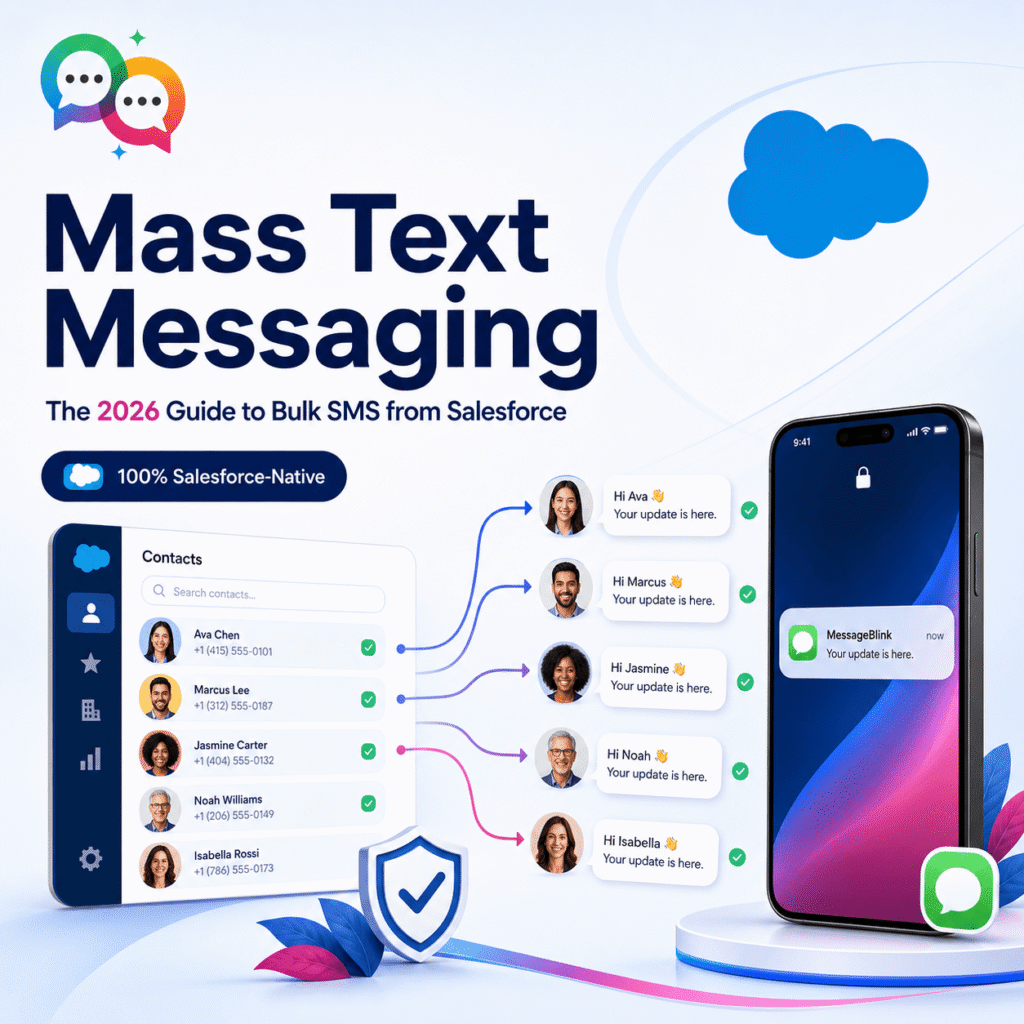
MessageBlink is a 100% Salesforce-native SMS and WhatsApp platform. There’s no intermediary layer between your CRM data and your messaging send. Because it is built on the Salesforce platform itself:
- Bulk sends pull directly from Leads, Contacts and Opportunities – no CSV exports, no re-uploading lists
- Salesforce Flow may send mass messages when a record updates, someone joins a campaign or based on custom logic
- Native Salesforce data maintained and enforced (not a third party dashboard) for your opt-in and opt-out status
- Everything installs as a managed bundle straight from the Salesforce AppExchange
This is very important on the compliance side. If your consent and STOP records live in the same system as your contact data, there’s no latency or sync issue between “someone opted out” and “someone stops getting messaged.”
Mass Texting Tips
- Break down your list. Mass send is not identical send—segment by location, list source or interaction to keep relevance high.
- Load the first value. The initial few words are what decide if readers want to keep reading.
- Keep a steady sending cadence. Recipients are trained to opt out by sporadic bursts.
- Include a clear opt-out instruction in every message, even if it’s not the initial message in a thread.
- Track delivery and reply data at the campaign level, not simply at the send level, so you know what’s really working.