


 ChatGPT
 Perplexity
 Claude
 Google AI
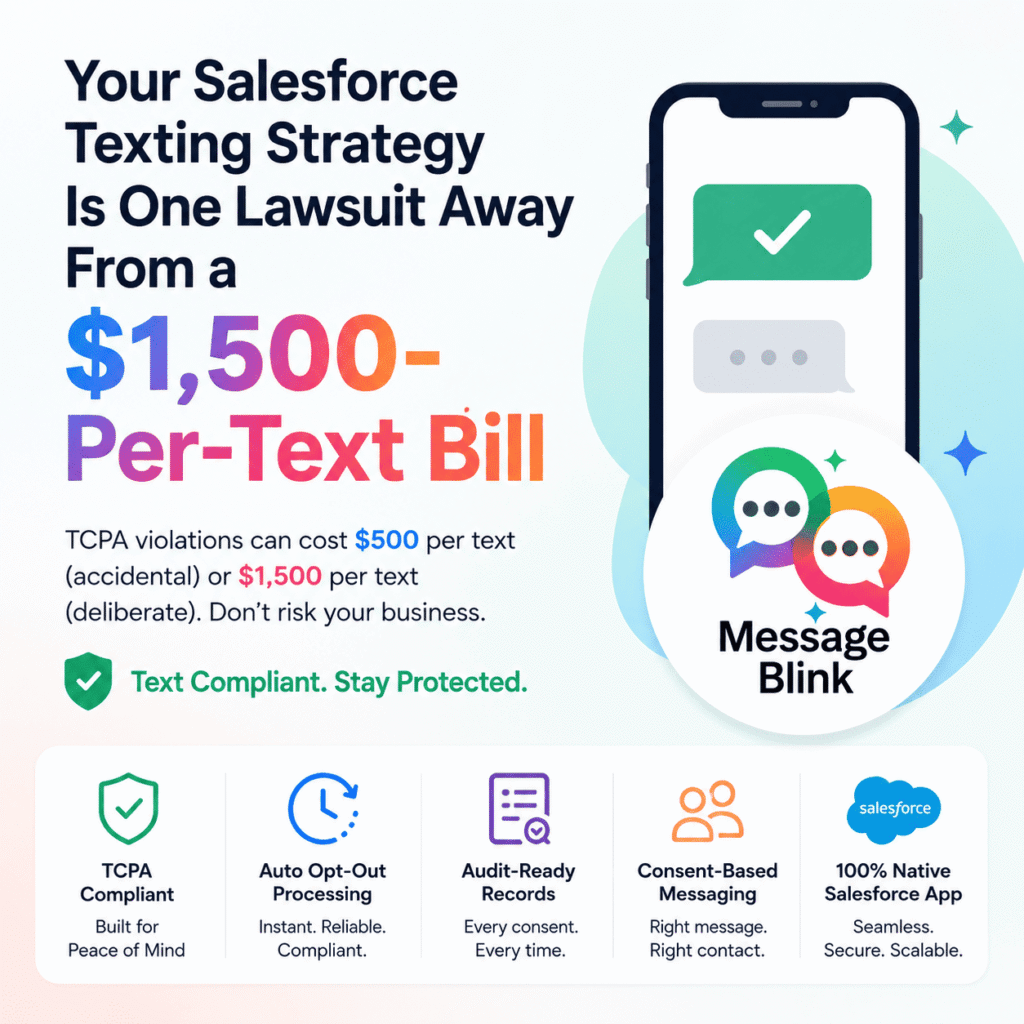
Your Salesforce Texting Strategy Is One Lawsuit Away From a $1,500-Per-Text Bill
An American telecom operator in California has agreed to pay $33 million for sending 11 million spam messages without proper consent documentation.
Not a typo – $33 million can bankrupt most mid-sized companies – but the scary part is that the violation was not even a rogue act. It was just a regular marketing process that failed in one critical aspect: lack of documented consent.
Now, if your organization is using Salesforce for texting campaigns today, you better be able to answer one simple question prior to launch: Are you sure that every single recipient of the message explicitly consented to receive it? If your answer is anything other than an instant “Yes, show me how!” are you really following tcpa text messages compliances then please read on.
What the TCPA Actually Says (And Why “Implied Consent” Will Destroy You)
The Telephone Consumer Protection Act, TCPA text messages compliance is not a recent act. It dates back to 1991. The only thing that’s changing now is how aggressively this act is being enforced – and how creative plaintiff lawyers are becoming in enforcing it.
Here’s the basic principle: you can’t text a customer’s cell phone for marketing purposes unless the consumer has provided explicit written consent. Not a verbal one. Not implied. Not “we have their contact information in our database because they filled out the form, this will make you go bankrupt by the fines.”
The statutory fines are non-negotiable:
$500 for an accidental infraction per text
$1,500 for a deliberate infraction per text
And that’s the total risk for your next Salesforce campaign of 10,000 contacts.
The Stealth Penalty: How Non-Compliance Silently Kills Your Delivery Rates Before the Lawyers Arrive
Lawsuits are the climactic finish. But the real harm begins earlier – quietly, operationally.
Carriers carefully watch complaint rates. If your customers complain about your texts as spam, your sender reputation falls. When your complaint rate exceeds thresholds set by carriers, your messages get filtered even before reaching the inbox. It looks like your campaigns are performing well. Your Salesforce reports indicate successful sends. But your customers receive nothing.
You’re paying for nothing.
And when your domain or short code becomes blacklisted, you don’t receive an email alerting you to the problem. Instead, you experience an inexplicable drop in response rates and a three-week appeal process at carriers.
This is the trap of compliance that most Salesforce organizations fall into – not lawsuits, but operational damage they can’t identify.
The Unoptimized Salesforce Org: A TCPA Lawsuit Waiting to Happen
This is how an average non-compliant Salesforce texting program works:
Opt-ins are stored in a Google Spreadsheet created by a single individual on the marketing team
Opt-outs are processed manually: somebody reads a “STOP” reply and changes a field eventually
No timestamp or source information provided for the consent record
Re-enrollment occurs accidentally by importing a new list of contacts
No distinction between transactional and promotional consent categories
It’s not a made-up scenario. This is the way things happen in most Salesforce environments before implementing a dedicated compliance framework.
And it’s not about evil intentions; it’s all about the architecture. Salesforce is an awesome CRM system – but out of the box, it provides nothing out of the box to:
Collect and store TCPA-compliant written consent with timestamp and source URL
Suppress opted-out contacts automatically regardless of the list or campaign
Provide tamper-proof audit logs
When a plaintiff’s lawyer demands litigation holds, one of the very first requests is your opt-in records. And when the answer is a manually managed checkbox on a Contact object with no audit trail – you lose the case right there.
What a Compliant Salesforce Texting Operation Actually Looks Like
A properly architected compliance workflow isn’t slower. It’s a system that runs clean without your team making judgment calls under pressure.
Here’s the operational difference:
| Unoptimized Org | Compliant Org | |
| Consent capture | Manual form-to-field entry | Timestamped, source-tagged record created on opt-in |
| Opt-out processing | Manual reply monitoring | Automatic suppression within seconds of STOP reply |
| List imports | No consent verification | Cross-referenced against opt-out registry pre-send |
| Audit trail | None or ad-hoc notes | Immutable log with date, method, IP, and channel |
| Re-enrollment | Happens accidentally | Requires explicit new consent event |
The difference between these two states is not a compliance officer with a checklist. It’s automation built directly into the messaging layer.
Where MessageBlink Closes the Gap
Most Salesforce SMS tools were built to send messages fast. MessageBlink was built to send messages fast and correctly.
As a fully native Salesforce app, MessageBlink does not tacked on compliance in an afterthought — it builds it into its very architecture.
Opt-In Management: Every opt-in is tracked as a Salesforce record complete with timestamp, channel, and the exact language used in obtaining consent. No more relying on spreadsheets or tribal knowledge to keep track of your consents.
Automatic Opt-Out Enforcement: The second the system receives an opt-out keyword like STOP, CANCEL, or UNSUBSCRIBE, the record will be flagged as an opt-out, preventing any future communications via MessageBlink until the contact opts back in. Because a 48-hour manual opt-out process is not compliance. It’s negligence.
Discovery-ready Audit Trail: All messages, consents, and opt-outs are recorded with detailed metadata in your Salesforce environment. So when your legal department needs to prove compliance, you’ll have a report ready, rather than trying to recreate the chain of events by memory.
Consent-Tier Segmentation: Not every message requires the same kind of consent. For example, transactional notifications (appointment reminders, order updates) follow different TCPA guidelines compared to promotional campaigns. MessageBlink allows you to segment contacts based on the type of consent they’ve given, which prevents accidentally sending a promotional message to someone who only consented to transactional texts.
This is what “built for Salesforce” actually means — a data model that treats your CRM as the compliance system of record.
Your TCPA Compliance Audit: 7 Questions to Answer Before Your Next Campaign
Quiet Hours Enforced? Are your campaigns restricted from sending outside 8 AM–9 PM in the recipient’s local time zone? TCPA explicitly prohibits texts outside this window — and it’s the recipient’s timezone, not yours.
Consent language compliant? Did your opt-in form include explicit language disclosing the nature of the texts (promotional vs. transactional), frequency, and carrier fees?
Opt-outs processed automatically? Is STOP processing instant and system-driven — not dependent on a human reading replies?
Full Opt-Out Keyword Coverage? Does your system recognize every TCPA-accepted opt-out keyword — STOP, CANCEL, END, QUIT, UNSUBSCRIBE — not just “STOP”? A contact replying “CANCEL” and still receiving texts is a violation.
Re-enrollment gated? Can a contact who has opted out be added back to a list without a new explicit consent event?
Consent tier separation enforced? Are promotional and transactional consent records stored and enforced separately?
Consent Status Visible Before Send? Can your team see a contact’s opt-in/opt-out status directly inside Salesforce before dispatching a message — preventing accidental manual sends to suppressed records?
Business Case for Doing It Right
TCPA compliance is not an issue of compliance for the legal department but an issue of protecting your revenue stream.
Just one lawsuit, even if you manage to settle it, will affect your workflow, deplete your legal budget, and ruin the reputation that you have spent many years building. Companies that view compliance as a part of their infrastructure do not only escape penalties; they create a scalable texting channel.
Contacts have granted you permission to contact them. The system that you employ to respect their permission is either your asset or your liability.
[Talk to Expert] [Download MessageBlink From AppExchange] [Start Your Free Trial]