

 ChatGPT
 Perplexity
 Claude
 Google AI
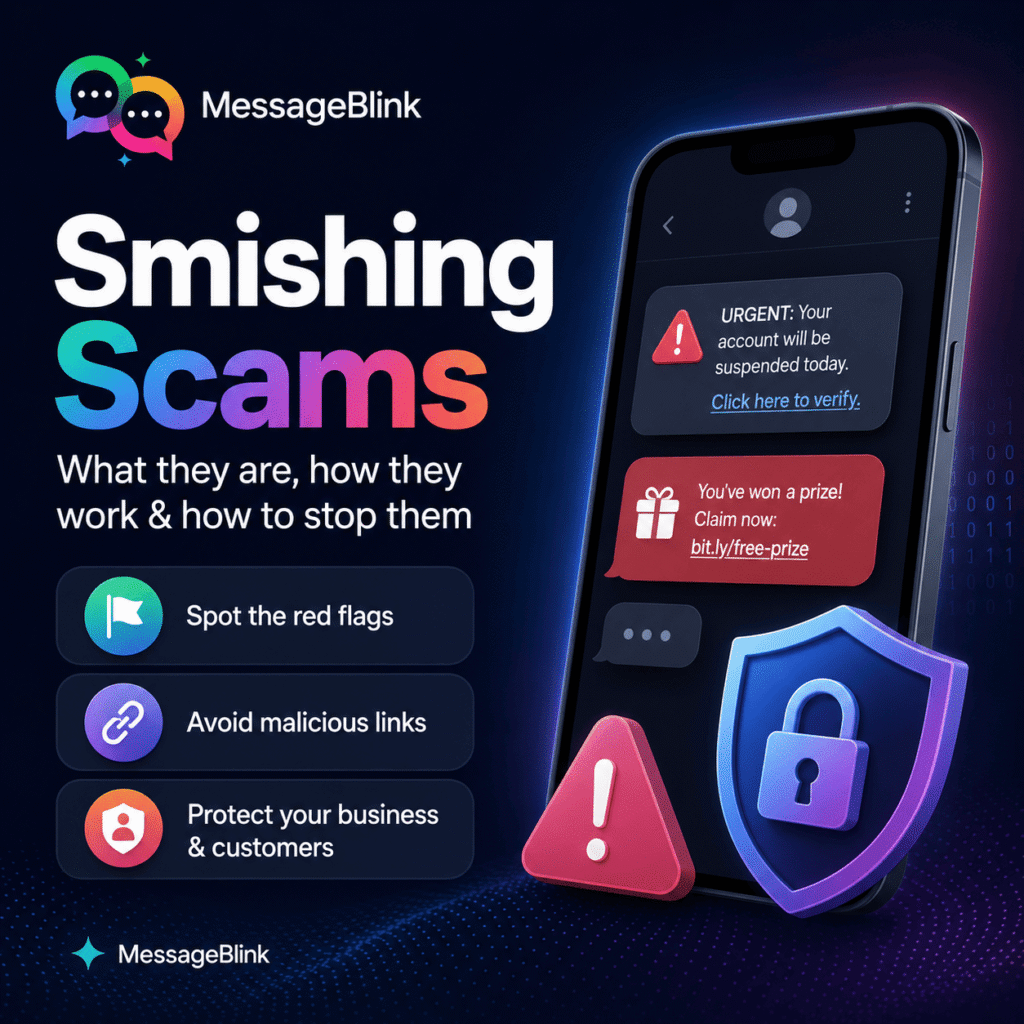
Smishing Scams: What They Are, How They Work & How to Stop Them
Text messages are personal and immediate, and that’s precisely what cybercriminals are counting on. Smishing scams have exploded in recent years, costing consumers $470 million in losses in 2024 alone — five times higher than just four years ago, according to the Federal Trade Commission (FTC). Every “Your package couldn’t be delivered” or “Suspicious activity on your account” text could be a criminal waiting to steal your money, your identity, or your organization’s data.
In this guide, we will break down how smishing scams work, the most common types of scams out there today, the red flags to look out for, and what you need to do to protect yourself and your business.
What Is SMS Phishing?
A smishing scam is a type of cyber attack in which SMS text messages or messaging apps are used to trick victims into clicking malicious links, providing sensitive information, or downloading malware. The word is a portmanteau of SMS (Short Message Service) and phishing, the generic term for attacks involving digital deception.
Phishing can occur through email, social media, or voice calls. But smishing is uniquely dangerous because
- People are far more likely to open and read text messages than email
- SMS click-through rates range between 8.9% and 14.5% as opposed to just 2% for email
- On a smartphone screen, it’s harder to inspect links before you click them
- People are already trained to receive texts from banks, delivery services and government agencies
A smishing scam is not a fringe threat. In 2023, 75% of organizations experienced smishing attacks, and globally, smishing makes up 35% of all phishing attacks (SentinelOne, 2026; Proofpoint’s State of the Phish report).
Why Smishing Is Growing So Rapidly
Smishing is one of the fastest growing cybercrime tactics because of a confluence of several forces:
Spam Filters Drive Criminals to SMS
Better email spam detection means fewer phishing emails getting into your inbox. This pushed cybercriminals to text messages, which still lack the robust filtering infrastructure that email has built up over decades.
The STIR/SHAKEN Effect
In 2020, the FCC required telecom companies to implement the STIR/SHAKEN protocol for verifying phone calls, which is why many phones now show “Scam Likely” before a suspicious call. But that only applied to voice calls, not text messages, and so many scammers shifted directly to SMS.
Mobile in the Workplace
With the rise of remote work and bring your own device (BYOD) policies, employees are now accessing company systems on their personal smartphones. It just takes one smishing text to trick an employee and expose an entire corporate network.
AI-Based Personalisation
With AI, attackers now send super-personalized smishing texts, with real names, brands, appointments, or recent purchases, making them much harder to detect. Smishing incidents were up 22% year-on-year (Zimperium, 2025), and 45% of mobile threats are now SMS-based smishing attacks.
How a Smishing Attack Works: Step-by-Step
Understanding how it works lets you see an attack before it has a chance.
Step 1 — The Bait The attacker sends you a text that looks like it came from someone you trust, such as your bank, a courier service, the IRS, your employer, or even a friend. The message makes people fearful, curious, or urgent.
Step 2 — The Hook The message contains a link, a phone number to call, or a request to reply with personal information. Shortened or disguised URLs obscure where the link actually points.
Step 3 — The Trap The link takes the victim to a convincing fake website that steals their login credentials, bank details, or credit card numbers. Sometimes a malicious file is automatically downloaded in the background.
Step 4 — The Damage The thief uses the stolen data to access financial accounts, commit identity theft, access corporate networks, or sell the credentials on the dark web.
8 Most Common Smishing Scam Types in 2026
1. Bank Impersonation Fraud
This is the most common smishing scam attack, making up 10% of all smishing messages, according to the FTC. Fraudsters impersonate your bank, inform you that there is suspicious activity on your account, and lead you to a fake login page to steal your details and card information.
Sample Text: “ALERT: Suspicious sign-in attempt on your account. Confirm now to avoid suspension: [malicious link].”
2. Parcel Delivery Scams
Scammers pretend to be from FedEx, UPS, USPS, or Amazon and say there is a problem with a delivery. They will ask for a small fee or ask you to verify your address through a link. The scams come in droves around holidays when many people are legitimately expecting packages.
Sample Text: “Your USPS package is on hold. Confirm delivery details to avoid return: [malicious link]”
3. Government and Tax Scams
They pose as the IRS, FBI, Social Security Administration, or local government agencies. They say you owe a fine or unpaid taxes or need to do something to claim a benefit. In 2024, the FBI issued a public warning about a smishing campaign impersonating toll collection agencies—the FBI’s IC3 received 59,271 complaints tied specifically to toll-related smishing.
4. Customer Support Impersonation
Scammers posing as support agents from Apple, Microsoft, Amazon, Netflix, or your wireless carrier. Then they say your account is compromised or you have an unclaimed refund and send you to a fake portal.
5. Business Text Compromise (BTC)
Like business email compromise but via SMS, attackers pose as a CEO, manager, colleague, or vendor. They will often ask for an urgent wire transfer or ask for login credentials to perform a “time-sensitive task.” These types of attacks go after employees and can cost you a lot of money.
6. Wrong Number Scams (Pig Butchering)
The attacker sends a text that looks like it was meant for someone else. The scammer then develops a relationship with the victim over weeks or months, sometimes as a romantic interest, before eventually selling a fake investment opportunity or asking for a loan when the victim responds to correct the “mistake.”
7. Multi-Factor Authentication (MFA) Fraud
The attacker already has your username and password but needs that one-time verification code. They pretend to be a friend, tell you they are locked out of their own account, and ask you to share a code you receive—which is actually for your account.
8. Fake App Downloads
Some smishing texts trick victims into downloading what looks like a legitimate app, such as a file manager, antivirus tool, or payment app, but is actually malware or ransomware in disguise.
Phishing, Smishing, and Vishing: What’s the Difference?
| Feature | Smishing | Phishing | Vishing |
|---|---|---|---|
| Medium | SMS / messaging apps | Voice calls / voicemail | |
| Click-through rate | 8.9–14.5% | ~2% | N/A |
| Detection difficulty | High (no hover on mobile) | Medium | Medium |
| Primary target | Individuals and employees | Individuals and businesses | People and managers |
| Common impersonation | Banks, delivery, government | Brands, IT support, executives | Banks, government agencies |
| Growing or declining? | Growing (+22% YoY) | Growing (+58% YoY) | Growing (+28% YoY) |
All three fall under the umbrella of social engineering attacks and frequently work together in multi-channel campaigns. Combined, smishing and vishing now account for 19% of data breaches, Verizon’s 2025 DBIR said.
Red Flags: How to Identify a Smishing Text
Not all suspicious texts are obvious. Here are the warning signs to look for before you click on anything:
- Unknown or unfamiliar sender number — A 10-digit number or international code that you don’t recognize
- Urgency and pressure — “Act now. Your account will be suspended. Answer in 24 hours.”
- Surprise contact—An unexpected delivery, tax notice or account alert
- Generic greetings—Real organizations will usually address you by name
- Suspicious or shortened URLs—Links with bit.ly or tinyurl or URLs that are not the official brand domain
- Requests for personal information—Legitimate banks, government agencies and businesses never ask for passwords or PINs over text
- Too good to be true — Prizes won, unclaimed refunds, investment opportunities with guaranteed returns
- Grammar and spelling errors—While AI is helping to make smishing texts more polished, errors are still a red flag
What to Do If You Get a Smishing Text
Do not click on any links or call any numbers in the message.
This is exactly what you need to do:
- Do not reply—Replying confirms your number is active and makes you a more likely target
- See for yourself—Call the company or agency directly at the number listed on their official website
- Forward to 7726 (SPAM)—This will help your carrier identify and block the number
- Block the sender—Use your phone’s built-in block feature
- Report it — Report fraud to the FTC at ReportFraud. ftc.gov or the FBI’s IC3 at ic3.gov
- Delete the message
If you shared info or clicked a link already:
- Go change your passwords right now, starting with your bank and email
- Call your bank and ask them to freeze accounts or dispute charges
- Turn on two-factor authentication for all of your important accounts
- Keep an eye on your credit reports for any odd activity
The Effect of Smishing on Businesses
Smishing is no longer a consumer problem. With BYOD and remote work, a single employee phone that is compromised can be used to access your entire network.
Employee Security Awareness Training
Train your team to identify the red flags of smishing. Hold regular smishing drills to simulate attacks so employees can practice identifying suspicious messages before they receive real ones. Security awareness training is one of the highest return-on-investment (ROI) cybersecurity investments an organization can make.
Unified Endpoint Management (UEM)
UEM solutions let organizations apply security controls to employee devices — blocking unapproved apps, forcing OS updates, and catching suspicious activity — even on personal phones used for work.
Clear Protocols for Verification of Payments
Implement policies company-wide that require in-person or multi-channel verification before any payment is authorized by text. Never send money by wire transfer based on a single text message, no matter how official it seems.
Tools for Detecting Mobile Threats
Purchase mobile threat detection software that tracks device activity, identifies malicious apps, and notifies you of suspicious network connections.
Limit Sensitive Data in SMS Messages
Use SMS for transactional notifications with low risk like order confirmations, appointment reminders, OTPs, etc. Never transmit sensitive customer data, internal credentials, or financial authorizations via text.
The Role of Legitimate SMS in Trust Building
Part of smishing’s success is due to the fact that people are used to receiving texts from legitimate brands—shipping updates, bank alerts, and appointment reminders. The problem is that many businesses send SMS in ways that look identical to smishing: shortened URLs, no sender identification, and generic wording.
Organizations can actively help to reduce the risk of their customers being duped by using professional, compliant SMS platforms. Legitimate business texts should:
- Come from a registered sender ID or short code that is verified
- Not ask for personal information in text
- Only link to popular branded domains
- Offer clear opt-out instructions (TCPA, TRAI, GDPR compliant)
- Be delivered on a verified, secure messaging platform
Keep Your Business SMS Trusted and Compliant
Smishing exploits people’s tendency to trust text messages. But the best defense isn’t just awareness—it’s making sure every legitimate text your business sends is clearly identifiable, properly formatted, and sent via a platform that adheres to global compliance standards.
MessageBlink is a Salesforce native SMS and WhatsApp messaging platform built natively on the Salesforce AppExchange. It enables businesses to send secure, compliant, and fully trackable messages so your customers can instantly identify a real text from your brand rather than mistake it for a scam.
With MessageBlink you can:
- Send messages from verified sender IDs in Salesforce
- Automate TCPA, GDPR, and TRAI-compliant opt-in and opt-out processes
- Send personalized SMS and WhatsApp messages with Salesforce Flow
- See your delivery, open and reply rates—all within your CRM
When your business texting is professional and trustworthy, you make it harder for the fraudsters who are trying to pretend to be you.