

 ChatGPT
 Perplexity
 Claude
 Google AI
What is the Salesforce 1% Pledge? The 1-1-1 Model — The Complete Story
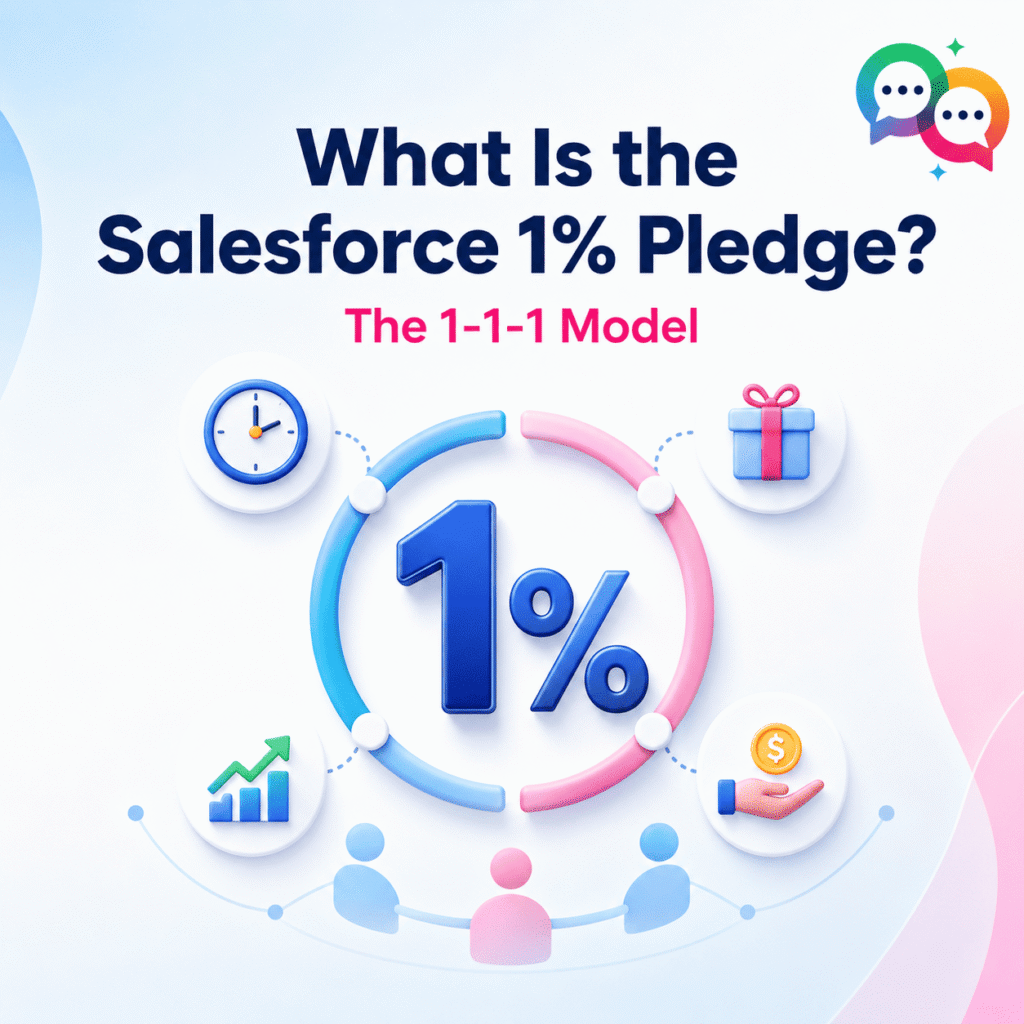
Corporate philanthropy generally sounds convoluted — until you see what Salesforce created. Salesforce 1% pledge, better known as the 1-1-1 model, is a simple idea for giving back: give 1% of your time, product, equity, or profit to the community. No big foundation, no complex legal structure, just a commitment that grows with your business.
The movement was co-founded by Salesforce and Atlassian, who named it Pledge 1%. Since then, more than 18,000 companies in more than 130 countries have signed on. Whether you’re an admin, partner, nonprofit technologist, or AppExchange ISV, if you work anywhere near the Salesforce ecosystem, understanding the Salesforce 1% pledge is not just trivia. It guides how thousands of organizations budget for community impact each year.
This guide explains what the Salesforce 1% pledge truly means, how the 1-1-1 model works, and how nonprofits and Salesforce-native businesses can act.
What Is the Salesforce 1% Pledge?
Pledge 1% is a nonprofit movement that started with the giving model of Salesforce itself. It provides businesses of all sizes with a flexible framework: commit 1% of time, product, equity, or profit—or any combination of the four—to causes that matter to your business.
There is no single “right” way to fulfill the Salesforce 1% pledge. A five-person startup might give a few days a year to volunteering. A late-stage SaaS company could save equity for an IPO, as Twilio did. The company does not fit in the framework; the framework fits in the company.
The Origins of the Salesforce 1-1-1 Model
The 1-1-1 model has its roots in the founding of Salesforce. From day one, philosophy was built into the company by co-founder Marc Benioff: 1% of equity, 1% of product, and 1% of employee time, all directed at social impact. Salesforce and Atlassian then put this into practice with Pledge 1% to make the idea available to any company that wanted to adopt it.
In the last 20 years, that commitment has translated into real numbers for Salesforce alone — more than $240 million in grants, more than 3.5 million hours of employee volunteer time, and approximately 39,000 nonprofits and educational institutions supported through discounted or donated technology.
The 1% Pledge at Work: 4 Ways We Contribute at Salesforce
| Pledge Type | What It Looks Like |
|---|---|
| 1% of Time | 3-7 days of paid Volunteer Time Off (VTO) per employee or team volunteering |
| 1% of Product | Free or deeply discounted access to your product for schools and non-profits |
| 1% of Equity | Equity stake at inception or pre-IPO, impact of funding as company grows |
| 1% of Profit | A portion of annual profit paid directly to causes as a fixed percentage |
Companies don’t have to tick all four categories. Pledging is a commitment to get started, not a finish line—some organizations aim beyond 1% once the program matures.
Salesforce’s 1% Pledge Impact, in Numbers
- 18,000+ companies worldwide have signed up to Pledge 1%
- 130+ countries represented in the movement
- 60+ unicorn companies have formally set aside equity through the program
- $240 million+ donated by Salesforce in grants over 20 years
- 3.5 million+ volunteer hours logged by Salesforce employees
- 39,000 nonprofits and schools benefiting from Salesforce product donations
Beyond Salesforce and Atlassian, other recognizable names include Twilio, DocuSign, and Canva—all of whom built giving into their business model early rather than as an afterthought.
Why Companies Join Pledge 1% Movement
For many founders, the Salesforce 1% pledge is not only charitable—it’s a business decision:
- Brand trust: More and more buyers want to support companies that stand for causes they care about.
- Employee engagement: Companies that measure volunteering find it consistently correlates with higher engagement scores.
- Talent retention: For younger workers, a sense that their work has a purpose is a key factor in job satisfaction.
- Simplicity: Taking the pledge takes minutes; Pledge 1% then provides templates, case studies, and a peer network to aid in implementing the strategy.
Salesforce’s 1% Pledge vs Traditional Corporate Giving
| Factor | Salesforce 1% Pledge (1-1-1 Model) | Traditional Corporate Giving |
|---|---|---|
| Flexibility across time, product, equity, profit | ✔ | ✗ |
| Scales automatically as company grows | ✔ | ✗ |
| Formal peer network and playbooks included | ✔ | ✗ |
| Requires a dedicated foundation to start | ✗ | ✔ |
| Works for early-stage startups | ✔ | ✗ |
| Built-in nonprofit/education product discounts | ✔ | ✗ |
How Nonprofits Can Make the Most of the Salesforce Giving Model
Salesforce’s 1% pledge is something nonprofits get in a very direct way—through discounted or donated Salesforce licenses via Nonprofit Cloud and through the larger ecosystem of AppExchange partners built for mission-driven organizations.
But getting the software is only half the battle. The organizations that derive the most value from their Salesforce investment are also the ones that close the communication gap—reaching donors, volunteers, and program participants where they already are: text and WhatsApp.
Here’s where MessageBlink comes in. MessageBlink is a 100% Salesforce’s native SMS and WhatsApp messaging platform on the AppExchange enables nonprofits on Salesforce to send donor updates, volunteer reminders, and campaign appeals directly from the CRM they already use—no exporting contact lists, no juggling a separate messaging tool. For those organizations that had enough conviction to make the Salesforce 1% pledge and standardize on Nonprofit Cloud, native SMS and WhatsApp messaging are a natural next step for donor engagement.
[Learn how MessageBlink works on the Salesforce AppExchange →]
Getting Started with Pledge 1%
- Choose your type of giving: time, product, equity, profit, or combination.
- Get executive approval—the pledge form takes just a few minutes to complete.
- Commit: Fulfill your commitment on the Pledge 1% website.
- Develop your program: Leverage the resources, case studies, and community of Pledge 1% to shape your approach.
- Track and report: Track volunteer hours, product donations, or dollars given to keep the commitment accountable over time.