

 ChatGPT
 Perplexity
 Claude
 Google AI
Promotional SMS or Transactional SMS: What Every Business Should Know
Not all the texts your company sends do the same job. Some can be purchased. And there will be others there to testify what happened. If you want to destroy trust and get yourself into legal trouble, pissing off your customers is a pretty quick way to do it.
In this guide, we’ll break down the difference between promotional vs. transactional SMS, why that difference matters for compliance, and how Salesforce teams can send both types of messages without the headache.
What is Promotion via SMS ?
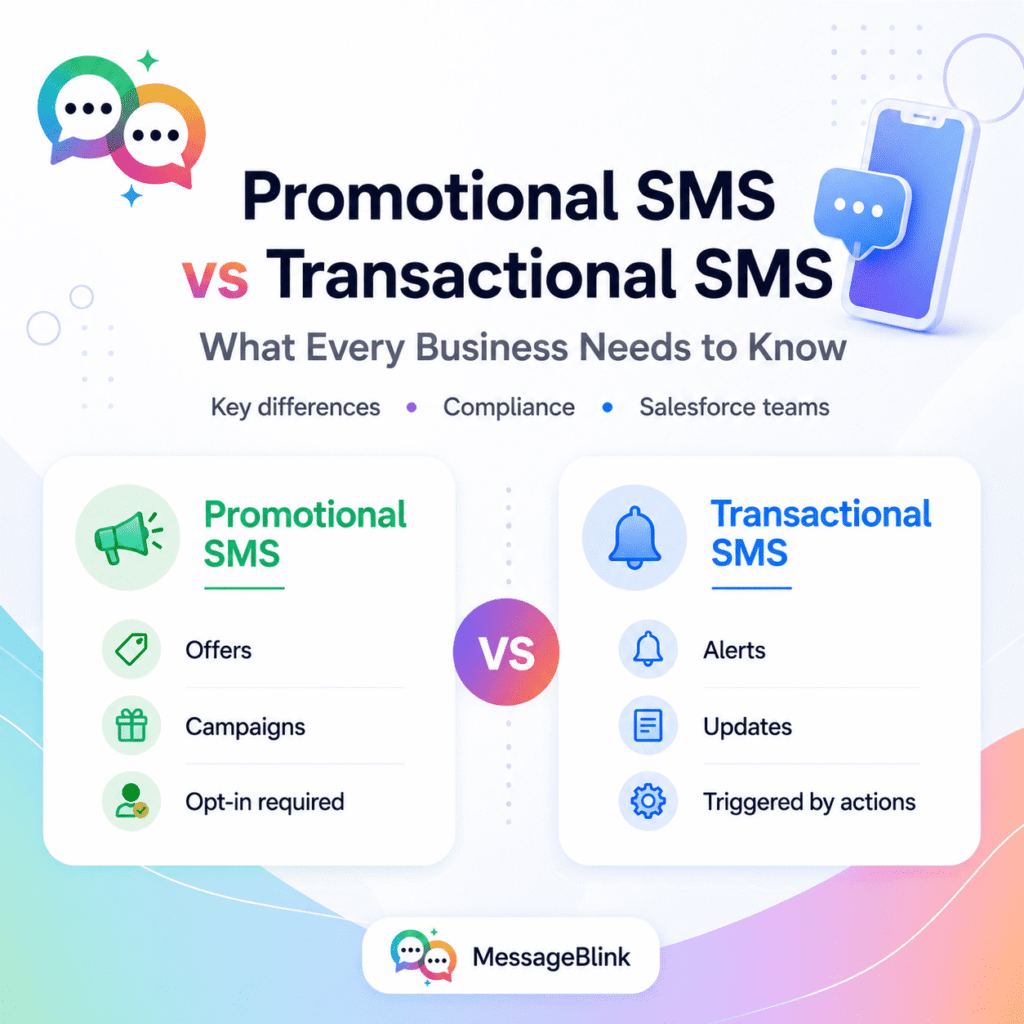
Promotional SMS are the SMS which are sent to promote a product, drive a sale, announce an offer or re engage a customer. If the message is telling someone to do something that is good for your bottom line, then it is promotional.
Copywriting is about getting people interested in a product or service, getting them to interact with the brand and keep them thinking about it. They are seldom ignored, with open rates near 98%. They also tend to create instant response, like clicking through to make a sale, using a coupon code or coming back to make a purchase.
Promotional SMS Examples
- Flash sale alerts: “Today only – 30% off. Use code SAVE30 at checkout.
- Abandoned cart reminders – “You left something behind. Order now with free shipping! “
- Launching new product “Our new plan is launching. “First time – Link Here.
- Birthday or loyalty offers: “Happy Birthday! That’s the 15% that you’re getting off. Use code: BDAY15
What is Transactional Text Messaging?
Transactional SMS are triggered by a customer action or a system event. These are messages that contain information that the recipient needs, not what you are selling. No commercial purpose.
This is called an event-driven transactional SMS. Common use cases include order confirmations, shipping and delivery notifications, one-time passwords (OTP) and two factor authentication (2FA) codes. That kind of text message is a natural part of customer service, builds trust and reliability, and is something customers expect to receive.
Common Transactional SMS Examples
- Order #45321 has been submitted. Estimated delivery: June 25 7.00.
- Your appointment is scheduled for 10:00 AM on June 24.
- Your otp is 847201.” “Good for 5 minutes.
- Payment of 2,499 successful. Thanks!” “
Which Should You Choose, Promotional SMS or Transactional SMS?
| Factor | Advertising SMS | SMS Transactional |
|---|---|---|
| Aim | To increase sales promotion offers | Provide essential information |
| Trigger | Campaigns, scheduled sends | User action or system event |
| Consent Required | Opt-in required (required) | Sign-up or transaction = implied consent |
| Send Time Optimization | Business hours only (TCPA) | Any time, day or nite |
| Opt-Out Required | ✔ STOP button required | ✔ Best Practice Recommendation |
| Tone | Urgent, brand, persuasive | Clear, factual, informative |
| Automatable | ✔ | ✔ |
| Promotional Content | ✔ | ✗ (legal risk if combined) |
Why Does the Difference Matter for Conformity?
This is where many companies make a mistake — and the stakes are real.
The TCPA clearly distinguishes between transactional sms and promotional sms. We will only send promotional texts to consumers who have affirmatively, in writing, consented to receive marketing messages. Transactional texts may be sent to customers who choose to receive information about their order, account or appointment.
If you choose to receive transactional messages, this does not mean that you agree to receive promotional messages from us. For example, if a customer gives you their phone number at checkout so you can send them a shipping update, you can’t use that number to send them a discount offer – even if you think they’d like it.
All promotional copy must honor the clock. If you’re blasting a “50% off!” at 10 p.m. or on a Sunday, you could get unsubscribed — and you could be in violation of the TCPA. In contrast, transactional messages can be expected any time of the day or night.
A cautionary tale: Walgreens sent prescription refill reminders to customers who only consented to transactional verification messages — Kolinek v. Walgreen Co. settled for $11 million.
The point? Even if you have a customer’s number on file, get separate, express consent for promotional messages.
Can You Send a Promotional SMS by Accident Instead of a Transactional SMS?
“Yes . . . and it happens more often than you think.”
One of the largest mistakes in SMS marketing is including salesy information in transactional messages. Mixing message types, like placing a sales offer in an order confirmation, could leave the company open to legal liability and erode customer confidence.
A quick litmus test is to ask yourself, if the customer has not bought or taken action, does it make sense to send the message? If it is then it’s probably an ad. If the message only makes sense within the framework of something the customer has already done, then it’s transactional.
Use Both: The Correct Way
The best SMS strategies use promotional sms vs transactional sms, with each doing what it does best.
The success of SMS is based entirely on trust. Transactional texts foster that trust; promotional texts abuse that trust.
A practical flow would be like this:
- Customer signs up → transactional confirmation of welcome 2.
- Customer browses but doesn’t buy –> promotional abandoned cart reminder (with proper consent)
- transactional –> customer purchase – > Order confirmation + shipping update
- Post Delivery → ask for a promo review or give loyalty (but again, only with prior opt-in)
“Every step has its place. They don’t run together.
How MessageBlink Works with Salesforce
Sales and service teams that use Salesforce for their sales and service workflows add unnecessary complexity and compliance risk by manually separating promotional and transactional SMS into separate tools.
MessageBlink is a 100% native-to-Salesforce messaging solution that sends promotional and transactional SMS (and WhatsApp) right inside your CRM – no middleware, no 3rd party integrations and no data leaving Salesforce.
Here is the mapping to the two different message types:
For SMS Transactional
- Send automated messages via salesforce flow – confirmations, reminders, alerts – when a record is updated
- Automatic logging of every message to the corresponding Salesforce contact or account record
- The responses go back into Salesforce so the entire conversation is contextual.
Text Message Marketing
- Build contact lists segmented right inside Salesforce data
- Bulk SMS & WhatsApp Campaigns with Auto Opt-out Compliance.
- Track it in your CRM
MessageBlink lives inside Salesforce, so consent management and send logs are attached to your CRM records – meaning compliance audits are simple, not stressful.