


 ChatGPT
 Perplexity
 Claude
 Google AI
Mobile Marketing in 2026: The Complete Guide to Reaching Customers Where They Actually Are
There is a moment that occurs dozens of times a day. A person will reach into their pocket, unlock their phone, and in that little window of attention, a brand will either appear or be forgotten about.
That’s mobile marketing, in its simplest form. And in 2026, learning it is no longer optional.
What Mobile marketing Is
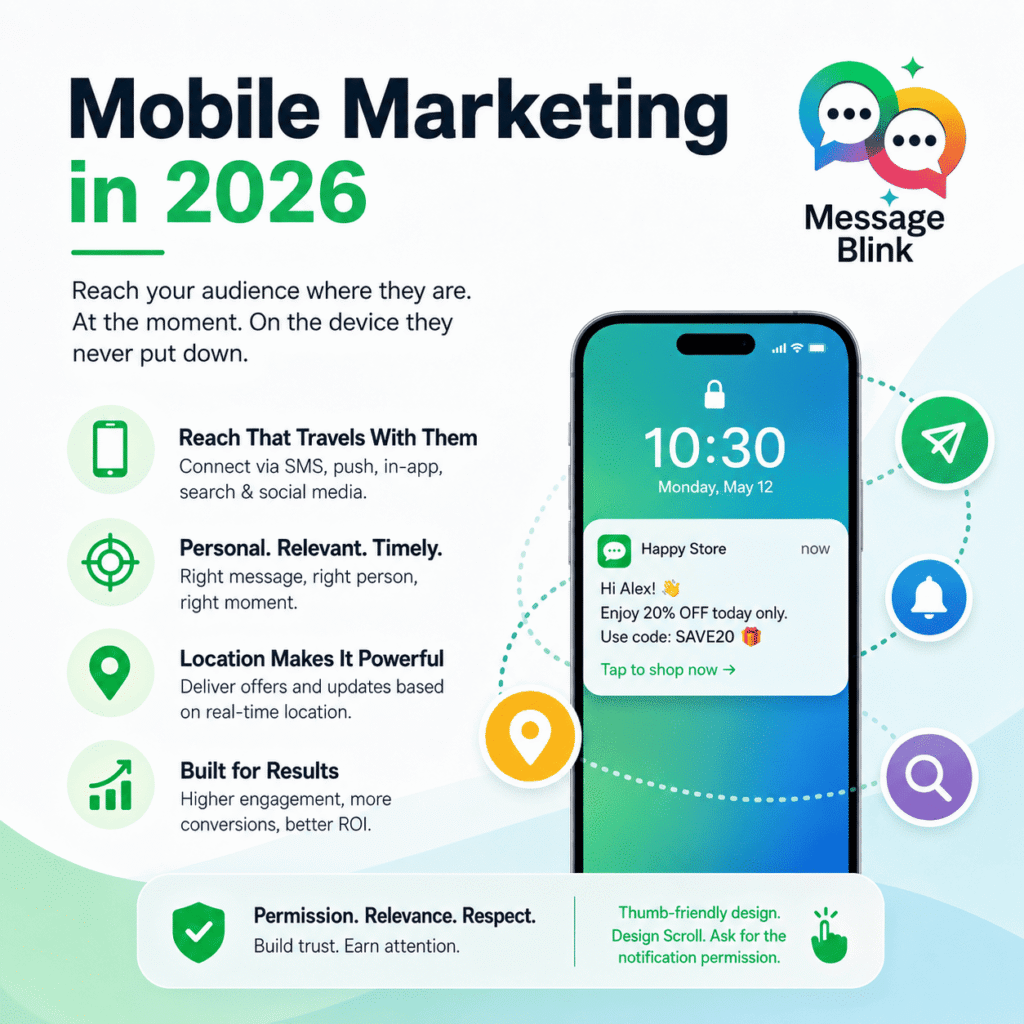
Mobile marketing is the ability to reach your audience on the devices they carry with them everywhere—smartphones, tablets, and wearables—through channels such as SMS, push notifications, in-app messaging, mobile search, and social media.
What makes this fundamentally different from traditional digital marketing is proximity. Mobile gets your message into a consumer’s most personal device. It travels with them on their commute, on their lunch break, and on their evening routine. No other marketing channel has access like that.
Why You Should Have a Separate Mobile marketing Strategy in 2026
The numbers don’t lie:
- There are more than 6.8 billion people around the world that use a smartphone
- Mobile devices comprise approximately 60% of the world’s internet traffic
- Email rarely breaks 25%—SMS messages have a 98% open rate
- Average person checks phone 96 times per day
The change isn’t taking place. It happened already. Brands that continue to view mobile as an afterthought to desktop are fighting yesterday’s battle.
Core Channels of Marketing with Mobile
1. Marketing Through SMS
There’s a reason SMS is the backbone of mobile outreach—it works without an internet connection, without an app download, and without a user actively browsing. The message is sent. It is read.
There are two types of modern SMS marketing:
Outbound (promotional): Flash sale alerts, discount codes, appointment reminders, event notifications. They are time-sensitive messages to drive immediate action.
Inbound (conversational): Keyword-triggered campaigns in which users text a word to a short code to opt in, enter a contest, or request information. It opens a two-way channel that feels less like broadcasting and more like dialogue.
Compliance: Consent is non-negotiable. Rules such as TCPA in the US, GDPR in Europe, and CASL in Canada state that there must be an explicit opt-in before any SMS is sent. Always include a clear opt-out mechanism—a simple “Reply STOP” is the industry standard.
2. Push Notifications
Push notifications are displayed on a user’s lock screen without having to open a browser or app. It’s one of the most powerful re-engagement tools around for brands with a mobile app.
The trick? User tolerance for irrelevant notifications is very low, and up-front permission is required. Over-send is the fastest way to get uninstalled.
Best practice is behavioral segmentation—push notifications based on what the user actually did in the app, not just blasting the entire user base with the same message.
3. In-Application Messaging
In-app messages are displayed while the user is using your app, unlike push notifications. By their nature, they are contextual, thus much less intrusive and much more relevant.
Onboarding prompts, feature announcements, loyalty reward updates, and personalized product recommendations are some common use cases.
4. Mobile Search and SEO
More than half of all Google searches are now done on mobile devices. Google’s mobile-first indexing means your site’s mobile experience is what determines how it ranks, not your desktop version.
Core Web Vitals, page speed, responsive design, and thumb-friendly navigation aren’t nice-to-haves. They’re ranking signals.
5. Social Media and Short Video
Instagram, TikTok, YouTube Shorts and other platforms are almost entirely mobile-consumed. Vertical video, fast-loading visuals, swipe-friendly content formats, and design for the mobile experience.
If your creative assets are still designed for a horizontal desktop screen and then repurposed for mobile, you’re leaving engagement on the table.
Marketing with Mobile Based on Location
Location awareness is one of the features that differentiate mobile from all other channels.
By using GPS-enabled devices, marketers can deliver hyper-targeted messages based on a user’s location at that moment—or where they have recently been. This opens a whole bunch of powerful tactics:
Geofencing: Create a virtual boundary around a specific location (a store, event, or a competitor’s location). If a user enters that zone, then they are targeted with an ad or message.
Proximity marketing: Deliver personalized offers to users who are near a point of sale, increasing the chances of an in-store conversion.
Location-triggered reminders: A logistics company could, for instance, let a customer know that their delivery is one mile away—without any action by the recipient.
The biggest limitation is trust. If they think their location is being used without clear permission, they will opt out of the service and leave bad impressions of the brand. It’s not just ethical to be transparent about how you use data; it protects engagement over the long term.
Mobile Marketing for the B2B Buyer
Mobile marketing is often written about from a B2C perspective, but mobile users are also B2B decision-makers. According to LinkedIn research, over 57 percent of LinkedIn traffic is now generated from mobile devices. B2B buyers are consuming industry content, reading case studies and even filling out lead forms on their phones.
For B2B brands, this means a few tangible priorities:
- Landing pages must be optimized for mobile—long forms with 10 fields are abandoned on mobile
- LinkedIn ads have to work for vertical scrolling, not the horizontal way of looking at desktop
- Follow-up rates for trade shows or webinars via WhatsApp Business and SMS are much higher than email
A Practical Framework for Developing a Mobile Marketing Strategy
Step 1—Start with the mobile experience audit. Before adding new channels, audit what you have. Test your website using Google’s PageSpeed Insights. Test every landing page on an actual phone. Fix friction before you add traffic.
Step 2—Choose Your Channels Based On Your Audience Behavior A B2B SaaS company and an e-commerce brand will have different mobile audiences and different habits. Pick channels where your particular buyers actually hang out, not the hot ones.
Step 3—Develop your consent infrastructure. Create simple and transparent opt-in flows for SMS and push consent. A good permission list of 5,000 is worth more than a purchased list of 50,000.
Step 4—Personalize beyond the first name. Behavioral triggers, purchase history, location context, and browsing patterns all create opportunities for messaging that feels relevant, not random. Noise = generic blasts. Good contextual messages.
Step 5—Measure what counts Key mobile marketing metrics include push and SMS click-through rate (CTR), opt-out rate (a leading indicator of poor targeting), conversion rate by device type, and cost per mobile acquisition. If you are running paid mobile ads, track post-click behavior, not just the click.
Common Mistakes To Avoid In Mobile Marketing
Sent too often. Permission is not a free pass to spam someone’s inbox or notification tray. Frequency fatigue is the main driver for opt-outs.
No regard for page load time. With a 3-second load time, mobile loses 53% of visitors before the page even renders. Every second of delay costs conversions.
Design first for desktop. Creatively designed for a 1920px monitor, it rarely looks good on a 390px screen. Start small and scale up.
All mobile users are treated equally. iOS and Android users are different. WiFi users behave differently than cellular users. Test and segment as appropriate.
The Bottom Line
Mobile marketing is not a channel. It’s a context—the context in which most of your audience is now living their digital life. The winning brands in this space aren’t the ones with the biggest budgets. They understand that a phone is a personal device, treat their messaging as such, and earn the attention they demand.