


 ChatGPT
 Perplexity
 Claude
 Google AI
Facebook Salesforce Integration: Sync Leads & Respond Before They Go Cold
Every Facebook lead ad you run is a race against the clock. A prospect fills out a form, and 30 seconds later, their feed takes their attention, and they forget you exist—unless your CRM instantly grabs that lead and your team acts on it right away. That’s what Facebook Salesforce integration fixes: a live, automated bridge between the world’s largest ad platform and the CRM most B2B and B2C teams already run their pipeline on.
With more than 3 billion users on Meta and thousands of companies on Salesforce, it creates a system to make online interactions manageable, trackable, and actionable. Here we’ll walk through how the integration actually works, what changed in 2026, and most importantly, what to do with a lead in the seconds after it lands in Salesforce.
What is the Facebook Salesforce integration?
Facebook Salesforce integration is basically the joining of Facebook Lead Ads (and more Meta advertising data) directly to your Salesforce org so that lead records, campaign data, and engagement signals are automatically synced instead of living in two disconnected systems.
The usual flow is a trigger-and-action model: as soon as a lead is captured via Facebook Lead Ads, that data is automatically creating or updating a record in Salesforce—no manual export, no CSV upload, and no lag between ad click and CRM entry.
Why It Matters to Companies
Lead information usually needs to be manually processed, with no direct link between the two platforms, slowing response time and fragmenting the customer view across systems. The benefits grow when you get connected:
Automated lead capture – No re-keying of form data by reps
Fast follow-up—Leads are assigned to the right owner instantly
Centralized reporting – Campaign performance and pipeline data all in one place
Better attribution—You can trace a closed deal back to the specific ad that sourced it
How To Integrate Facebook with Salesforce: Your Choices
There’s no one way to do this—the right way depends on your technical resources and how much control you want over field mapping.
| Method | Setup Effort | Best For | Limitations |
|---|---|---|---|
| Native Meta Lead Capture app | ✔ Free, Low | Real-time sync for most teams | ✗ Limited ways to customize the field |
| Zapier / iPaaS connectors (Albato, etc.) | ✔ Low-medium, no code | Teams wanting contact/attribution logic | ✗ Ongoing subscription cost |
| Manual API integration | ✗ High | Enterprises with dev resources | ✗ Java / HTML / Apex knowledge, ongoing maintenance |
| AppExchange managed package | ✔ Low | Pre-built workflows, fast, supported | ✗ The feature set depends on the app you choose |
Most teams, especially marketing-led companies that don’t have a dedicated dev team, will use the native app, a connector, or an AppExchange package instead. Manually building an integration takes knowledge of Java and HTML.
The One Rule That Changes Everything: April 2026
If you’re running Facebook Lead Ads for conversion optimization, here’s the part to note: As of April 2026, the conversion leads objective for Meta will require a server-side CRM connection through the Conversions API for any new campaign, and existing campaigns will need to migrate by August 2026.
In practice, that means a real, working Facebook–Salesforce integration is no longer a nice-to-have. It’s becoming a prerequisite for running Meta’s most efficient lead-gen campaign type. Meta’s own data shows that this link reduced cost per quality lead by 21% on average. Garbage-in lead statuses mean the Meta algorithm is optimizing to the wrong audience. So CRM hygiene on the Salesforce side directly impacts your ad spend efficiency.
The Part Most Guides Skip: What Happens When the Lead Hits
Getting the lead into Salesforce is just the start. Reports say that 73% of consumers will change brands if there is a delay in social media responses. Speed-to-lead is the real battleground, and just email often doesn’t cut it fast enough.
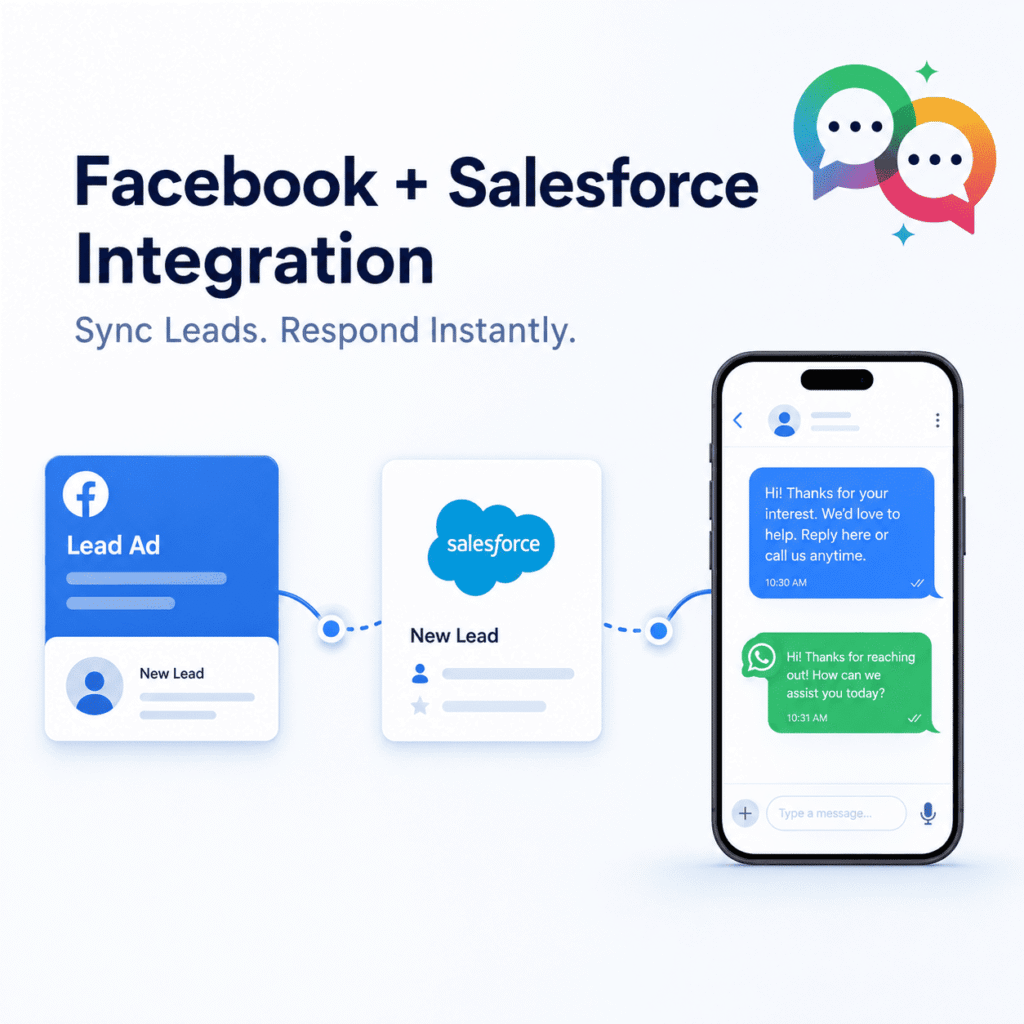
This is where text-based follow-up fills the space that pure data-sync tools leave open. As soon as a Facebook Lead Ads record is created in Salesforce, you can trigger a native SMS or WhatsApp message from Salesforce Flow to reach your prospect in seconds, while they are still on their phone and in the right mindset to have just filled out your form.
That’s the layer MessageBlink adds on top of any Facebook-to-Salesforce lead sync: instant, automated SMS and WhatsApp messaging, built 100% natively on the Salesforce platform, triggered directly from Flow, Process Builder, or Apex—no middleware, no separate messaging console to babysit.