

 ChatGPT
 Perplexity
 Claude
 Google AI
More than ever, there are ways for businesses to reach customers, but two always rise to the top: email and SMS. Both are straight, permission-based, and proven. But they behave very differently, serve different moments in the customer journey, and generate different results, depending on how they are leveraged.
This guide will cover the basics of email and SMS — how each works, where each shines, how they stack up on important metrics, and how to combine them for a more powerful communication strategy.
What’s email marketing?
Email marketing is the act of sending targeted messages to a list of email subscribers. It’s one of the oldest and most established digital marketing channels, used across industries for newsletters, promotional campaigns, transactional notifications, onboarding sequences, and such.
Email can be richly formatted with images, HTML layouts, attachments, and hyperlinks. Messages can be of any length and are stored in the recipient’s inbox for future reference.
Key Characteristics of Email
- Format: Rich media, HTML, attachments, links
- Delivery time: Usually checked hours or days later, but around instant
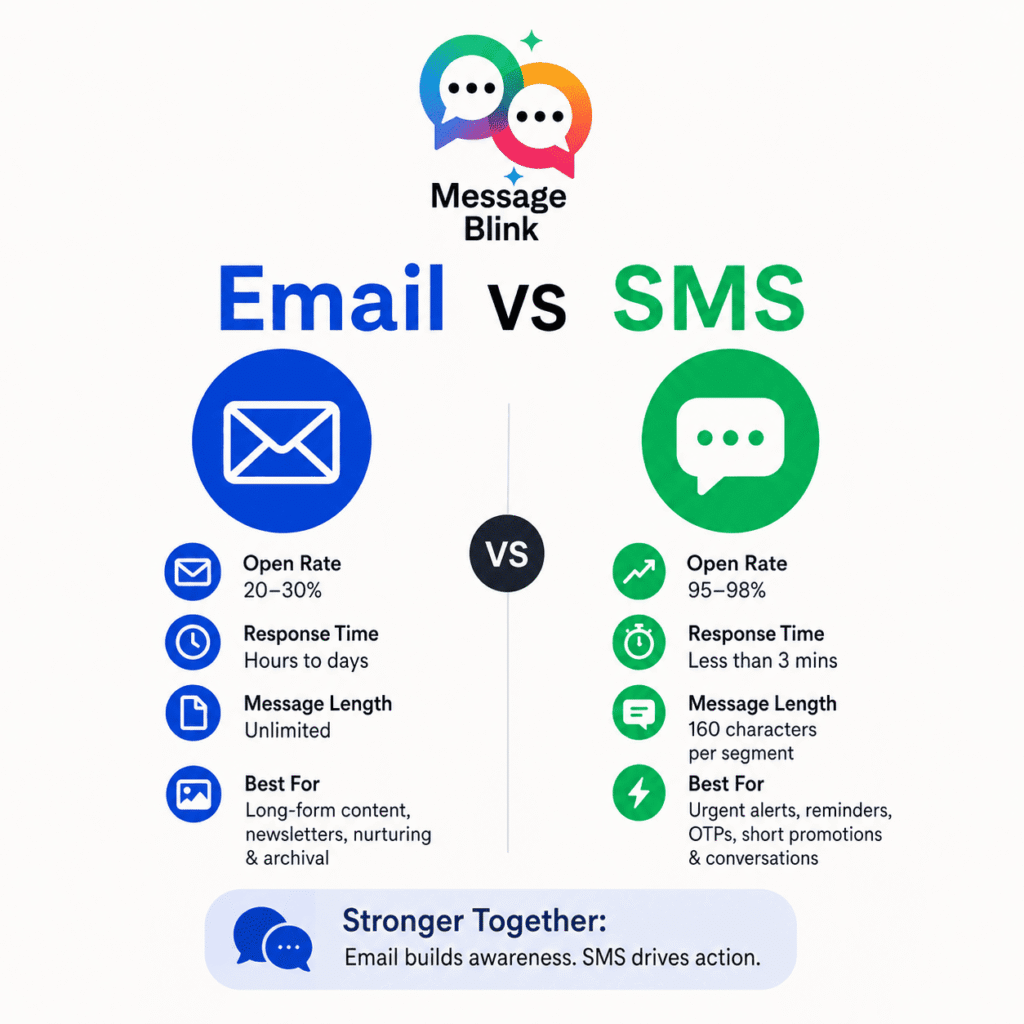
- Average open rate: 20–30% depending on the industry
- Maximum length: No maximum
- Opt-in required: Yes (CAN-SPAM, GDPR, and other regulations apply)
- Best for: Long-form content, newsletters, onboarding flows, documentation, and archival communication
What Is SMS?
SMS stands for Short Message Service. It’s the standard protocol for text messaging between cell phones. In a business context, SMS (also called “short messaging service”) is used to send transactional alerts, appointment reminders, promotional offers, two-factor authentication codes, and time-sensitive notifications directly to a customer’s mobile phone.
SMS messages have a limit of 160 characters per segment and are delivered near instantaneously. Unlike email, people typically read an SMS message within minutes of receiving it.
Key Characteristics of SMS
- Format: Plain text (MMS supports image and short video)
- Delivery speed: Instant or nearly so; generally read in 3 minutes or less
- Average open rate: 95–98%
- Character limit: Maximum 160 characters per segment (multi-part messages allowed)
- Opt-in required: Yes (TCPA in US, GDPR in Europe and Regional Laws)
- Best for: Time-sensitive alerts, reminders, OTPs, short promotions and two-way conversations
Email and SMS: Features Compared
| Feature | SMS | |
|---|---|---|
| Average open rate | 20–30% | 95–98% |
| Typical response time | Hours to days | Less than 3 mins |
| Message length | Unlimited | 160 characters per segment |
| Rich media support | Complete HTML, images, attachments | Limited (MMS for pictures) |
| Message charge | Low (bulk pricing) | Low to moderate |
| Best use case | Long form, archival, nurturing | Urgent, transactional, conversational |
| Deliverability dependency | Inbox placement, spam filters | Carrier networks |
| Two-way communication | Possible, but not usual | Native and expected |
| Regulatory framework | CAN-SPAM, GDPR | TCPA, GDPR, 10DLC |
When to Use Email
When the communication involves any of the following, email is the stronger channel:
1. Content in Long Form
Email is unlimited in length and supports rich formatting and embedded media. Ideal for newsletters, product launches with detailed specs, case studies, onboarding, and educational content.
2. Archival and Reference Information
Customers often need to retrieve information later, like receipts, booking confirmations, policy documents, invoices, or legal disclosures. The emails stay in your inbox for ever. You can search, forward, and save it. SMS is transient in comparison.
3. Nurture and Drip Campaigns
Multi-step email sequences are a critical element of B2B and B2C lead nurturing. Automation tools for email enable companies to deliver behavior-based messages that are targeted to recipients over days or weeks. SMS isn’t ideal for long nurture sequences.
4. Visual and Branded Communication
Email templates allow businesses to apply brand colors, fonts, logos, and design hierarchy. This makes email the right channel for campaigns where visual identity is important, such as product launches, event invitations, or seasonal promotions.
5. Less Urgent Communications
Email is appropriate when the message is informational and the customer does not need to take immediate action. SMS would be intrusive for, e.g., weekly digests, monthly reports, industry updates, etc.
When to Use SMS
Use SMS in these cases:
1. Immediate Alerts and Notifications
Text messages have an almost 100% open rate and are usually read within minutes. SMS ensures that for flash sales, same-day appointment reminders, shipping updates, or fraud alerts, the message is seen before it becomes irrelevant.
2. Two Factor Authentication (2FA) and OTPs
SMS is used almost universally for one-time passwords and security codes because it is fast and nearly guaranteed to be delivered. It is a common use case in banking, e-commerce, healthcare, and SaaS platforms.
3. Appointment and Reservation Reminders
Research has shown that SMS appointment reminders are significantly more effective at reducing no-show rates than email reminders alone. SMS reminders are widely used as an operational tool by healthcare providers, salons, law firms, and service businesses.
4. Short Advertising Promotions
One-line offer—”20% off today only. Use code SMS20″—often works better as an SMS than a full email campaign. Clarity requires brevity, and action requires immediacy.
5. Chat Messaging — Both Ways
SMS allows for natural back-and-forth conversation. Two-way SMS is ideal for customer support, intake forms, survey responses, and delivery confirmations. Email threads are not good for real-time conversation.
6. Reaching Customers Without Internet
SMS does not need a data connection or a smartphone. It can be used on any cell phone with basic cell service, making it available to a wider demographic than email-based communication.
Email and SMS Together
Email and SMS are not competing channels—they are complementary. A good communications strategy uses both, leveraging the strengths of each channel.
Combined Channels’ Common Workflows
Schedule appointments and confirm by email right after booking. Send an SMS reminder 24 hours before the appointment and one on the morning of. This sequence gives the reference info (email) and the timely nudge (SMS) at the right time.
Lead Nurturing: Deliver a welcome email series to new subscribers. If a lead hasn’t engaged after a set amount of time, send a short SMS touchpoint: “Still interested in [product]? Reply YES and we will send you a short summary.” When engagement with emails drops, use SMS as a re-engagement lever.
Promotional Campaigns: Create an email product promotion with full details, images, and a CTA. Send a short SMS on the last day of the promotion: “Last chance today. [Link].” The email is awareness. The SMS is urgent.
Transactional Communication: Email confirmations and receipts of purchases. SMS shipping notifications and delivery confirmations. Customers want the email for record-keeping and the SMS for real-time updates.
Email and SMS Compliance: What You Should Know
Both the channels are heavily regulated. If you are non-compliant, there is a significant legal and financial risk.
Email Compliance
- CAN-SPAM Act (US): All commercial email must clearly identify the sender, include a physical address, and provide a working unsubscribe mechanism.
- GDPR (EU): Must have explicit consent before sending marketing email to EU residents. The consent must be documented.
- CASL (Canada): Requires express or implied consent to send commercial electronic messages.
SMS Compliance
- TCPA (US): Requires prior express written consent prior to sending marketing texts. Violators will be fined $500–$1,500 per message.
- 10DLC (US): In the US, business text messaging now requires registration of brand and campaign through the 10DLC (10-Digit Long Code) system to reduce spam and improve deliverability.
- GDPR (EU): For EU residents, SMS consent standards are the same as email.
Best Practice for Both Channels
Always request explicit opt-in permission before messaging on either channel. Make it easy and obvious to opt out. Document consent. Check the rules that apply to where your customers live.
Email and SMS Open Rates: Bridging the Gap
The gap in open rates, reported as 20–30% for email and 95–98% for SMS, is often quoted but needs context to be meaningful.
Higher open rates do not always translate into better results. SMS messages can be read and ignored if they are irrelevant or ill-timed. A 25% open rate email can generate a lot more revenue if the content is well targeted and the audience has high intent.
The more meaningful measurement to monitor is conversion rate by channel and by campaign type. A B2B company selling enterprise software may find that email nurture sequences work far better than SMS, whereas a retail brand with a high-frequency promotional calendar may find the opposite.
You can track opens, clicks, reply rates, conversion rates, and revenue per message for both channels to build up an accurate picture of performance in your specific context.
Decision Framework: Selecting the Right Channel
Here’s a framework to use when deciding whether to send a message via email, SMS, or both:
Send by email if:
- The message is more than 2 or 3 sentences
- The customer will have to revert to it
- The message contains attachments, rich media or long links
- This message is part of a nurture/onboarding series
- The action required is not time-sensitive
Send by SMS if:
- The message needs action in the next few hours
- A two-way reply is expected
- A message is an alert, reminder or confirmation
- The message can be delivered in one or two short sentences
- This segment has low email open rates
Send it by either
- The information is critical and must be gotten
- The message has an email component and an SMS component (reminder)
- It’s a high-value campaign where redundancy is worth the price