 UK +44 (734) 008 7301
 USA +1 (737) 395 8587

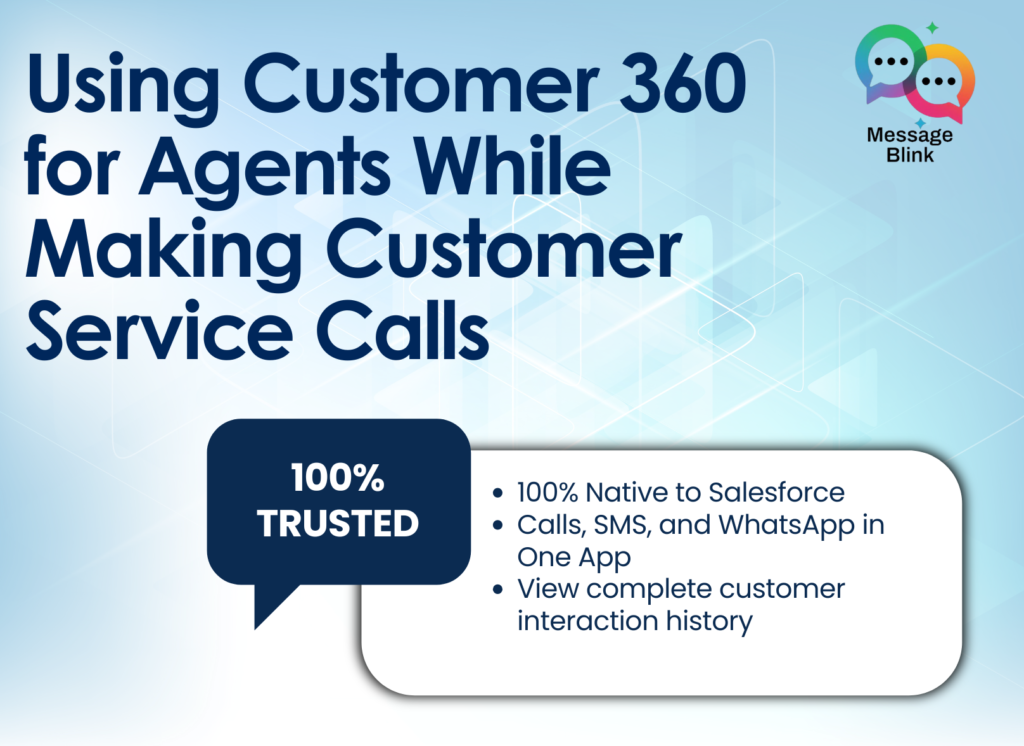
In today’s high-pressure support environment, “Let me check that and get back to you” is a phrase that erodes customer trust.
Modern customers expect agents to already know who they are, what they need, and what happened last time they reached out. That’s why leading support teams are adopting Customer 360 for agents– a unified, real-time view of customer data that empowers agents while they are on a live customer service call.
This guide explains how Customer 360 actually works during a call, why it outperforms feature-only CTI setups, and how modern CTI platforms like Message Blink act as the engine behind a winning Customer 360 experience in Salesforce.
What Is Customer 360 for a Call Center Agent?
Customer 360 for a call center agent is the ability to view a customer’s complete interaction history in one place while actively handling a call.
Instead of switching between multiple systems, agents see a single, real-time customer view that includes:
- Customer profile and account details
- Open and past support cases
- Previous phone calls
- SMS and WhatsApp conversations
- Notes, sentiment, and interaction timeline
For an agent, Customer 360 means no guessing, no searching, and no repeated questions. Every call starts with context.
Why Customer 360 Is Critical for Agents
- Lower Average Handle Time (AHT): Information is instantly available
- Higher First Call Resolution (FCR): Issues are resolved during the first interaction
- Better customer experience: Conversations feel natural and informed
- Higher agent confidence: Agents know what they’re dealing with before they speak
Does Salesforce Have a Call Center?
Salesforce CRM does not offer a traditional built-in call center or telephony system.
Instead, Sales force provides a powerful Service Cloud and Contact Center framework that integrates with third-party CTI and communication platforms. These integrations allow businesses to connect calling, messaging, and customer data directly inside Sales force.
When paired with a modern omnichannel platform like Message Blink, Salesforce becomes a full-featured call center environment where agents can:
- Make and receive calls
- Send and receive SMS and WhatsApp messages
- View complete customer interaction history
- Log all activities automatically in Salesforce
This combination is what enables true Customer 360 for agents during customer service calls.
How Customer 360 Works During a Live Customer Service Call?
Customer 360 is most powerful while the call is happening, not after it ends.
Here’s how it works in real time.
1. Intelligent Screen Pop at Call Arrival
The moment a call comes in, a Customer 360-enabled system triggers a screen pop inside Salesforce showing:
- Caller identity and account information
- Open cases or recent issues
- Last interaction across calls, SMS, or WhatsApp
- Customer sentiment or priority level
Before the agent even says “Hello,” they already understand the situation.
-
Unified Interaction Timeline
During the call, agents can see the entire customer journey:
- Previous phone calls
- SMS conversations
- WhatsApp messages
- Case notes and updates
This eliminates one of the biggest frustrations in customer service customers having to repeat themselves.
-
Contextual Guidance During the Call
With Customer 360, agents don’t just see data they get context.
Based on customer history, agents can:
- Anticipate the reason for the call
- Acknowledge previous interactions naturally
- Address unresolved issues immediately
This leads to faster resolution and more empathetic conversations.
Other CTI vs Message Blink: Which Supports True Customer 360?
Many CTI tools focus on call mechanics. Fewer focus on agent experience and data intelligence.
| Capability | Standard CTI | Message Blink |
| Call Logging | Basic call records | Call logs + sentiment + activity timeline |
| Omnichannel View | Voice & limited SMS | Voice, SMS, WhatsApp in one view |
| Agent Experience | Technical, admin-heavy | Agent-first, Salesforce-native UI |
| Coaching & Monitoring | Manual supervision | Whisper mode, live guidance |
| Customer 360 Enablement | Partial | Core design principle |
Key takeaway:
CTI handles calls. Message Blink powers Customer 360 for agents.
How MessageBlink Enables True Customer 360 During Service Calls?
Customer 360 depends on how well communication channels are connected. This is where Message Blink plays a crucial role.
Message Blink unifies calls, SMS, and WhatsApp directly inside Salesforce, giving agents a complete, omnichannel Customer 360 view during live service calls.
1. Calls, SMS, and WhatsApp in One Timeline
When a customer calls, agents instantly see:
- Past call history
- SMS conversations
- WhatsApp messages
- Salesforce case activity
This ensures agents know what the customer tried before calling and why the call matters now.
-
Seamless Channel Switching
Customer journeys rarely follow one channel.
A customer may:
- Start with WhatsApp
- Follow up via SMS
- Finally call support
With Message Blink, agents can continue the conversation seamlessly without losing context no matter which channel the customer used previously.
-
Smart Screen Pop with Communication Context
Message Blink’s calling feature goes beyond basic CTI by surfacing:
- Recent SMS or WhatsApp messages
- Response gaps
- Conversation history
This gives agents situational awareness and confidence from the first second of the call.
-
Omnichannel First Call Resolution
Because agents can see all prior interactions, they can resolve issues completely during the call even if the issue started on another channel.
This significantly improves:
- First Call Resolution (FCR)
- Customer satisfaction (CSAT)
- Agent productivity
Best Practices for Agents Using Customer 360 During Calls
Customer 360 is powerful but only when agents use it correctly.
1. Acknowledge the Customer Journey
Instead of:
“How can I help you today?”
Say:
“I see you reached out earlier via SMS about your order- let me give you an update.”
-
Update Customer 360 in Real Time
Agents should log notes, outcomes, and sentiment during the call. A Customer 360 view is only as valuable as the data flowing into it.
-
Use Sticky Agent Routing
With CTI features like sticky agents, repeat callers are routed to the same agent—creating familiarity, trust, and faster resolution.
Why Customer 360 for Agents Is the Future of Customer Service Calls
Disconnected tools slow agents down. Customer 360 changes everything.
It transforms calls from:
- Reactive → Proactive
- Fragmented → Unified
- Transactional → Relationship-driven
With Salesforce + a modern CTI like Message Blink, agents gain real-time visibility, confidence, and control exactly when it matters most.
Conclusion
Customer 360 for agents is no longer optional it’s the foundation of modern customer service.
When agents have real-time visibility into calls, SMS, WhatsApp, and customer history, they can deliver faster resolutions, personalized conversations, and memorable service experiences.
By combining Salesforce with an omnichannel platform like Message Blink, businesses enable true Customer 360 giving agents the context they need while the call is still happening, not after it ends.
In a world where customers expect to be known, understood, and valued, Customer 360 is how agents win every call.