


 ChatGPT
 Perplexity
 Claude
 Google AI
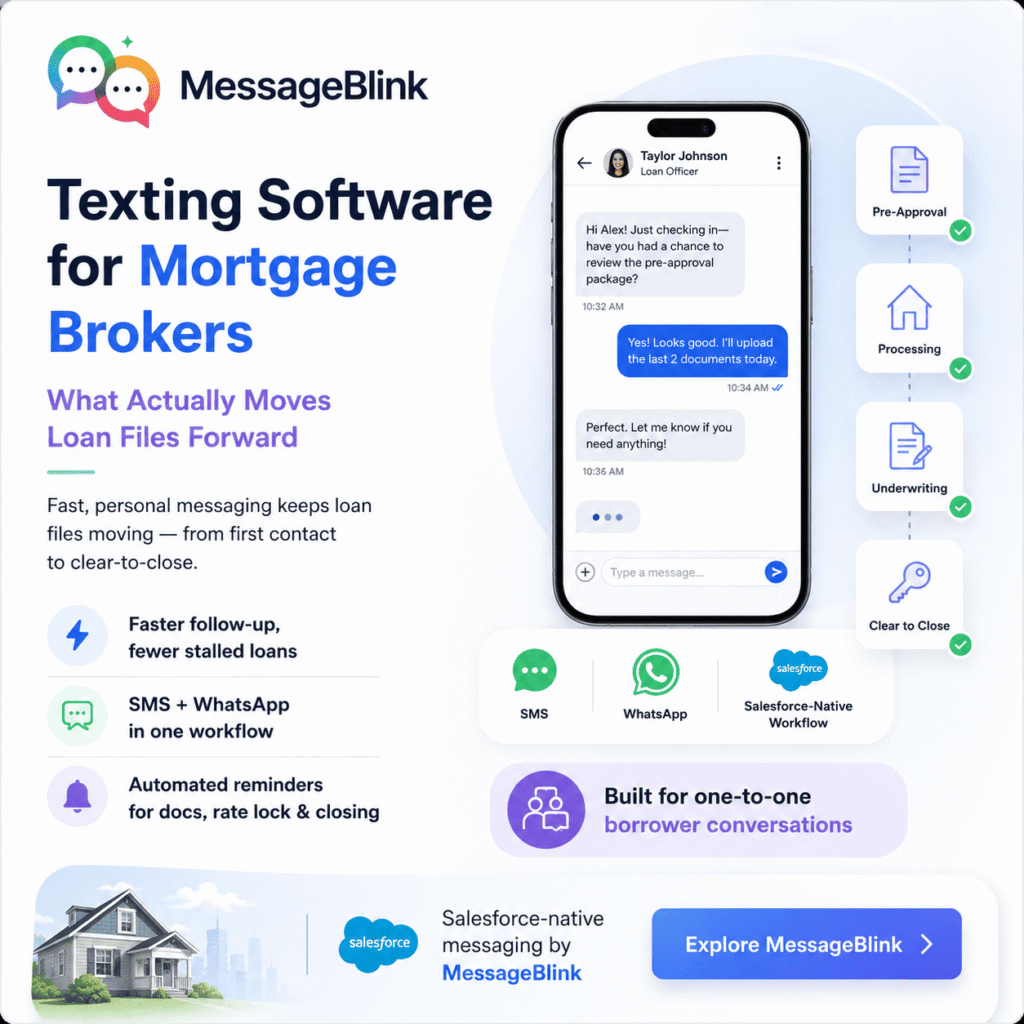
Texting Software for Mortgage Brokers: What Actually Moves Loan Files Forward
A borrower doesn’t lose a loan because of a bad rate. Most of the time, they lose it to silence — three days of waiting on a callback while another broker with faster follow-up scoops them up. That’s the real problem texting software for mortgage brokers is supposed to solve, and it’s a narrower problem than most vendors make it sound.
This isn’t a guide about mass SMS blasts. It’s about the handful of moments in a live loan file—the intro text, the missing-document nudge, the rate-lock reminder, and the “you’re clear to close” message—where a fast, personal text keeps a deal moving instead of stalling.
Why Mortgage Brokers Lean on Texting Over Calls and Email
Phone tag is the default state of a mortgage pipeline. Loan officers call, voicemail picks up, borrowers call back during a client meeting, and three days pass before anyone actually talks. Email isn’t much better—it sits in a crowded inbox next to promotions and newsletters, easy to skim past when someone’s at work.
Texting skips both problems. Borrowers tend to see and act on text messages within minutes, not days, and most people say they’d rather text through a mortgage application than sit through another phone call. For a transaction with a 30-45 day clock and a dozen moving parts—appraisal, underwriting, title, and insurance—that speed compounds. A document request that goes out by text and gets answered same-day can be the difference between a loan that closes on schedule and one that needs a rate-lock extension.
What to Actually Look For in Texting Software for Mortgage Brokers
Most texting tools on the market are built for retail marketing—batch-and-blast promotions to a big list. A mortgage pipeline is the opposite problem: one-to-one conversations, running in parallel across dozens of live files, where every reply has to land in the right place. A few things matter more than the rest for texting software for mortgage brokers:
It has to live inside the CRM, not next to it
If a borrower’s text reply shows up in a separate inbox that nobody on the team is watching, it might as well not exist. The message and the loan file need to be the same record.
Two-way conversations, not one-way blasts
A borrower replying, “Uploaded the W2, still looking for the bank statement,” needs to be visible to whoever picks up that file next—not lost in a personal cell phone thread.
Automation triggered by loan stage, not a marketing calendar
Pre-approval, document collection, rate lock, clear-to-close, funded — each stage has its own message, and it should fire automatically when the loan record moves, not because someone remembered to schedule it.
WhatsApp, for the borrowers who live there
A growing share of borrowers—especially first-generation homebuyers and international clients—default to WhatsApp over SMS. Software that only does SMS misses that segment entirely; these are the features that should have texting software for mortgage brokers.
Consent and opt-out handled on the record, not a spreadsheet
More on this below, but the short version: your compliance program is only as good as where your consent records live.
Generic Bulk SMS Tools vs. Salesforce-Native Texting Software
| Capability | Generic Bolt-On SMS Tool | Salesforce-Native Texting (MessageBlink) |
|---|---|---|
| Runs 100% inside Salesforce, no middleware | ✗ | ✔ |
| Replies logged automatically to the loan/borrower record | ✗ | ✔ |
| WhatsApp messaging built in | ✗ | ✔ |
| Automated sends triggered by loan-stage changes | ✗ | ✔ |
| Opt-out and consent stored on the Salesforce record | ✗ | ✔ |
| Document/photo sharing with borrowers | ✔ (via MMS) | ✔ (via WhatsApp) |
| Extra login, extra system to reconcile with the CRM | ✔ | ✗ |
The MMS row is worth being direct about: MessageBlink is built for SMS and WhatsApp, as well as MMS. In practice, that’s rarely a gap—WhatsApp already covers photo and document sharing, and it does it without the carrier filtering that picture messages often run into. That is why it fits into texting software for mortgage brokers.
Where Texting Fits Across the Loan Lifecycle
First contact. A short, personal text within minutes of a lead filling out a form does more for conversion than a follow-up call two hours later — it puts a name and a first impression in front of the borrower before they’ve moved on to the next lender’s website.
Document collection. Instead of a generic checklist email, a text naming the exact missing document — “just need your most recent bank statement” — gets answered same-day far more often than an email does.
Rate lock and status updates. Automated, stage-triggered texts (“your rate is locked through [date],” “underwriting has a question — call when you can”) keep borrowers informed without a loan officer manually updating every file.
Clear-to-close and closing-day logistics. Confirming closing time, location, and what to bring by text cuts down on last-minute confusion that email tends to miss.
Post-closing. A short thank-you and a review request, sent a few weeks after funding, keep the relationship warm for the eventual refinance or referral—without turning into a marketing blast borrowers resent.
TCPA, CTIA, and 10DLC: The Short Version for Mortgage Teams
Mortgage compliance guides tend to over-explain this. The practical picture is simpler than it looks:
- Get consent before marketing texts go out. Prior express written consent is the standard for promotional and marketing messages—informational or transactional updates tied to an existing loan file have more flexibility, but when in doubt, get consent anyway.
- Make opt-out effortless. A STOP reply should remove the borrower from future sends immediately, and that removal should be enforced automatically, not manually.
- Respect quiet hours. Texts outside roughly 8 AM–9 PM in the recipient’s local time zone are a compliance risk regardless of content.
- Keep consent records on the CRM, not a spreadsheet. If your texting software logs opt-in and opt-out directly on the Salesforce record, your audit trail is just your CRM data—nothing separate to maintain or lose track of.
TCPA litigation has climbed sharply over the past two years, and statutory damages run $500–$1,500 per violation with no aggregate cap—so this isn’t a small detail to skip. That said, this is general information, not legal advice; a compliance attorney should review your specific opt-in language and workflows.
This is exactly where Salesforce-native texting software for mortgage brokers earns its keep. MessageBlink keeps opt-in, opt-out, and every conversation thread on the borrower’s Salesforce record—so consent isn’t a separate system your team has to remember to check.
Ready to see Salesforce-native texting on an actual loan pipeline? Explore MessageBlink on the Salesforce AppExchange and see how texting software for mortgage brokers fits into your existing loan-stage automation.