


 ChatGPT
 Perplexity
 Claude
 Google AI
What is a shared short code? All a business needs to know
If you’ve ever texted something like “JOIN” or “SAVE” to a 5-digit number to get on a promotion, you’ve already interacted with a shared short code. If you’re a business interested in SMS marketing, it’s important to understand how common short codes work and how they compare to dedicated numbers before you start any text messaging campaign.
What is a Shared Short Code?
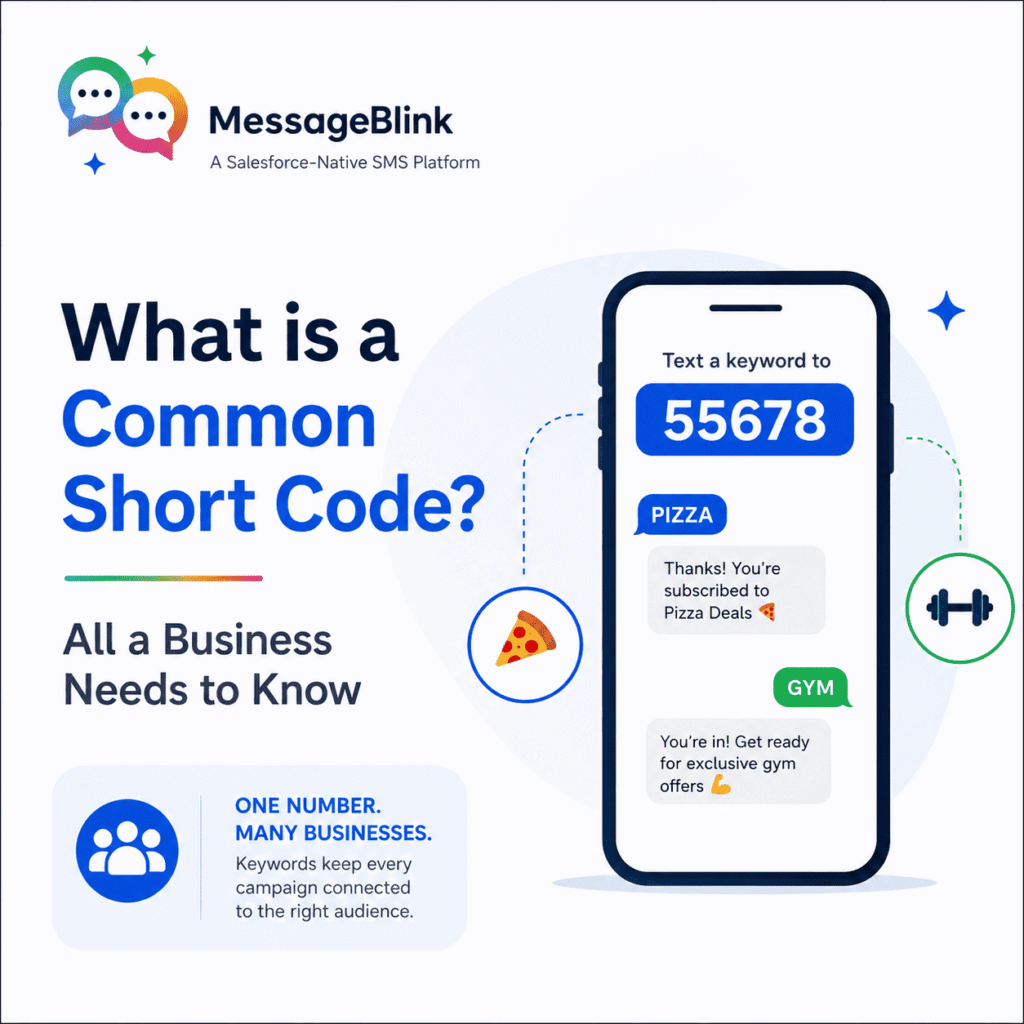
A shared short code is a 5- or 6-digit phone number used by multiple businesses or organizations simultaneously. Each business on a shared short code is given a unique keyword to route incoming messages to the correct campaign or account, rather than owning the number.
For example, if the short code is 55678, one company may use the keyword “PIZZA” and another uses “GYM.” For example, when a subscriber texts the word “PIZZA” to 55678, the system knows to route the message to the pizza brand’s campaign, not the gym’s campaign. The keyword is what differentiates one business’ traffic from another’s on the same number.
How do shared short codes function?
Shared short codes are operated on a lease basis. The short code is carrier-registered and provider-managed across multiple tenants. Usually the process works like this:
- Keyword selection — The business chooses a distinctive keyword (e.g., “DEALS,” “ALERTS,” “VIP”) that will identify their campaign on the shared number.
- Provisioning — The messaging provider registers that keyword against the short code with the carrier network.
- Opt-in Collection — Subscribers send the keyword to the short code to opt in to the campaign.
- Message routing — All inbound and outbound messages related to that keyword are directed to that specific business account.
If the keyword you want is available on multiple short codes, then you can choose which number you want to use. If the keyword is not on more than one short code, the number will be auto-assigned.
Shared vs. Dedicated Short Code: What’s the Difference?
| Feature | Shared Short Code | Dedicated Short Code |
|---|---|---|
| Number Ownership | Shared by businesses | Only for you |
| Cost | Lower | Higher |
| Keyword flexibility | Using available keywords | Keywords of your choice |
| Brand awareness | Low (number is not unique to you) | High (number is your brand asset) |
| Compliance risk | Higher (shared liability) | Lower (total control) |
In addition, shared short codes are also far more affordable than dedicated numbers as an attractive first step into SMS marketing for small to mid-sized businesses.
Are shared short codes still permitted in the US?
It is an important compliance point for businesses to understand. The major US carriers AT&T, Verizon, and T-Mobile deprecated shared short codes as part of the broader A2P 10DLC (Application-to-Person 10-digit long code) reforms. The impetus for it was concerns around spam, consent violations, and the challenge of enforcing TCPA compliance when multiple businesses are sharing the same number.
This leads to a situation where companies in the US today tend to focus on the following:
- Dedicated short codes for high-volume branded campaigns
- 10DLC long codes for standard A2P business messaging
- Mid-Volume Toll-Free Numbers Transaction Messaging
If you’re outside the US—in markets like the UK, India, Australia, or Canada—shared short codes may still be a viable and cost-effective option depending on the policies of local carriers. Always check with your messaging provider before you provision a campaign to verify the current regulations.
Who Should Use a Shared Short Code?
Shared short codes are still relevant for businesses that: despite limitations by carriers in certain markets,
- Are running SMS campaigns in countries where it still allowed
- First time testing SMS marketing and have a limited budget
- Require a quick setup, without the lead time of dedicated short code approval (which can take 8-12 weeks in some locations)
- Do you run keyword-based opt-in campaigns like sweepstakes, loyalty programs or event registrations
Key Point
A shared short code allows many businesses to use the same 5-digit number, but with different keywords. Cost-effective and easy to set up, businesses need to think about regional carrier policies, especially in the US, where shared short codes have mostly been phased out in favor of dedicated numbers and 10DLC. Choosing the right SMS infrastructure from the start protects your deliverability, your compliance standing, and the trust of your subscribers.
If you’re a business using a Salesforce-native SMS platform like MessageBlink, understanding what type of number is behind your campaigns directly impacts how your messages are sent, tracked, and reported—so this is a decision worth getting right before your very first send.