


 ChatGPT
 Perplexity
 Claude
 Google AI
Why this matters now:
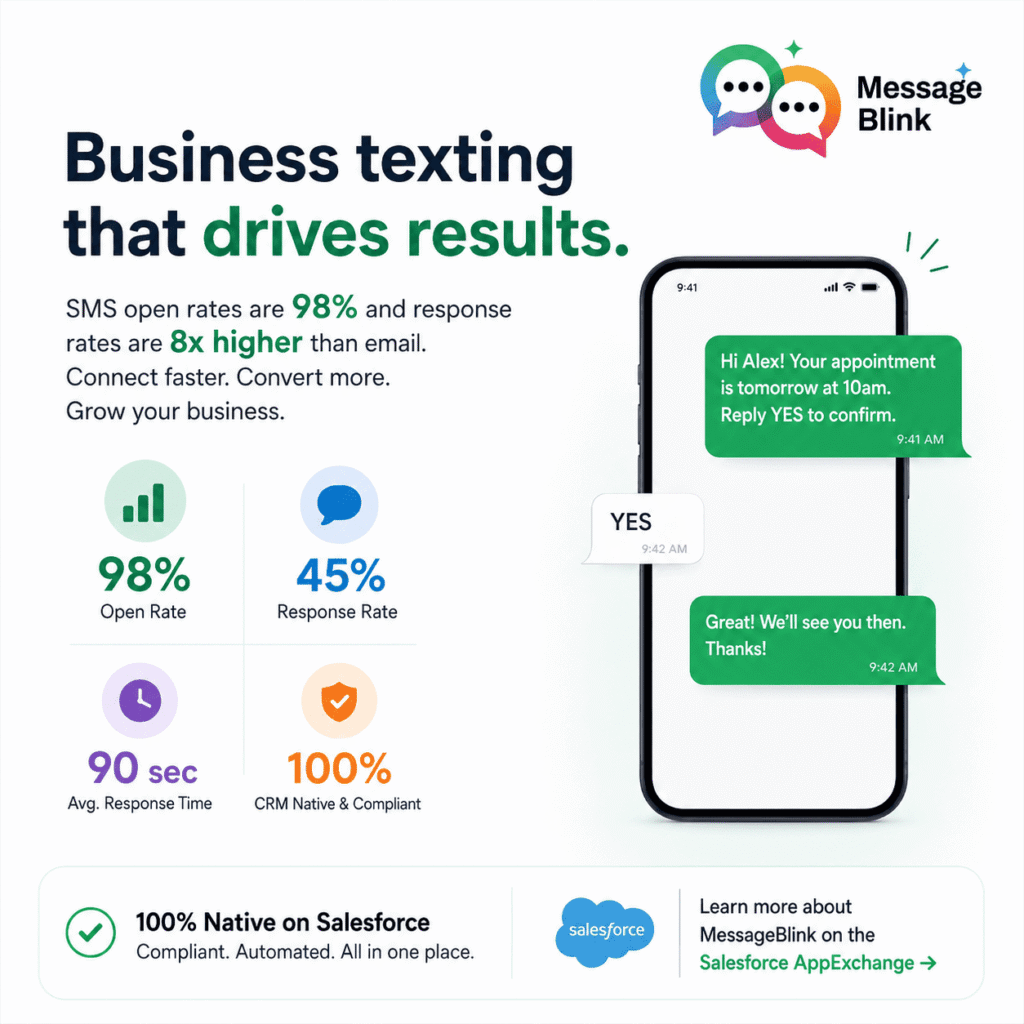
SMS open rates are at 98%, and email is around 20%. Benefits of texting are that response rates are 8x higher than email. But most B2B teams still see texting as a secondary channel and miss out on measurable revenue, engagement, and retention.
If your team is only using email and phone to communicate with customers, prospects, patients, or employees, this guide will explain what you’re missing, why texting works at a structural level, and how to deploy it across your existing workflows.
1. So What Exactly Is Business Texting?
Business texting—also known as A2P (application-to-person) messaging—is the sending of an SMS or WhatsApp message from a software platform or CRM to the recipient’s mobile phone. This is not the same as personal P2P (person-to-person) texting between two people on consumer devices.
A2P messaging consists of
Marketing SMS—promotional campaigns, promotions, invitations to events
Transactional SMS—order confirmations, appointment notices, delivery notifications
Conversational SMS—two-way sales and customer service conversations
WhatsApp Business messaging—rich media, template messages and two-way conversations through WhatsApp’s business API
The channel supports multiple number types, including 10-digit long codes (10DLC), short codes (5-6 digits), and toll-free numbers, each with different throughput, registration, and use-case requirements. As of February 2025, all A2P traffic in the US will need to be registered in the mandatory Campaign Registry (TCR) using 10DLC.
2. The Core Metrics: Why Texting Beats Other Channels
KEY FACT: Before looking at individual benefits, it is worthwhile to set a baseline with performance data. Business texting is never better than email, voice and social on every engagement metric that matters for conversion and retention.
| Metric | SMS | Voice Call | |
| Open rate | 98% | ~20% | N/A |
| Average response rate | 45% | 6% | ~8% (answer rate) |
| Average response time | 90 seconds | 90 minutes | Varies |
| Opt-out rate (average) | ~2–3% | ~0.5% (unsubscribe) | N/A |
| Deliverability (registered A2P) | ~95%+ | 70–80% (inbox rate) | Varies |
They are not marginal differences. For the same list of 100 contacts, a 45% response rate versus 6% means texting results in about 7.5x more replies than email. For sales, customer success, and time-sensitive operations, that gap has direct revenue implications.
3. Benefit 1 – Guaranteed Immediate Exposure
The structural advantage that SMS has over email is its delivery path. A text message sent to a registered 10DLC number lands directly in a recipient’s native messaging inbox—not in a promotions tab, not in a spam folder, and not in a social feed. Most users receive the message as a notification within three minutes of delivery.
This makes texting the most reliable medium for:
Urgent alerts: Appointment reminders, Payment due notices, Event updates
OTP and two-factor authentication: One-time passwords in 60 seconds
Urgent operational communications: Service interruptions, schedule adjustments, safety notices
Follow-ups after initial contact: Contacting a prospect who hasn’t responded to email
No other digital channel offers this level of immediacy combined with the inbox guarantee that comes with properly registered A2P SMS. For enterprise teams managing large customer bases, that reliability difference adds up at scale.
4. Benefit 2 — Two-Way Conversation Instead of Broadcast
NEW: Older SMS platforms were largely one-way — a business sent messages and recipients responded to a dead end. Today’s benefits of texting platforms allow for real, two-way conversations: a prospect replies to a text, a human (or AI-assisted agent) responds in real-time, and the conversation thread is automatically recorded in the CRM.
This shift from broadcast to conversation changes what we can do operationally with texting:
Sales outreach—reps can text prospects directly from within their CRM, get replies and keep the conversation in the same thread
Customer support—customers text in questions rather than waiting on hold; agents juggle multiple conversations at once
Lead qualification—automated sequences can qualify inbound leads via conversational SMS before passing over to a sales rep
Feedback collection—post-purchase or post-appointment surveys sent via text regularly outperform email survey response rates
Two-way messaging requires a platform that accepts inbound messages, routes them to the appropriate user or queue, and logs both sides of the conversation. For users of Salesforce, this means native integration—not a third-party connector creating duplicate records.
5. Benefit 3 — Automation of Workflow & CRM Integration
The greatest operational benefit of modern business texting isn’t the channel itself, but where the conversation lives. If your CRM solution offers native SMS, such as Salesforce, then every text thread automatically becomes part of the customer record.
This removes a set of friction points that impair data quality and team efficiency in disconnected setups:
No manual logging of the conversation into the CRM after call/text
No need to switch between a standalone SMS tool and the CRM to check customer history before sending
No loss of conversational context when customer is passed between team members
Automated triggers—a text sent when a lead reaches a specific stage, an appointment reminder fired 24 hours before a Salesforce event, a follow-up sequence triggered when a case is closed
Native CRM integration for ops and RevOps teams means texting activity shows up in standard reporting, too. Dashboards on the same data model as the rest of the business show pipeline influence, response rates by sequence, and opt-out trends.
6. Benefit 4 — Increased Conversion Rates across All Funnel Stages
Used correctly, texting doesn’t just improve open and response rates—it measurably increases conversion at every stage of the customer journey.
Lead response (top of funnel)
Studies consistently show that contacting a new lead within 5 minutes of form submission dramatically increases the likelihood of qualification. A text sent immediately after a form fill—while the lead is still in context—has much higher reply rates than a call or email sent that same day.
Mid-funnel (followup & nurture)
Follow-up sequences via SMS after the initial email or call have higher overall engagement rates than email-only sequences. Email > call > SMS (3 touches) always beats Email > call > email.
Bottom of funnel (close, close)
SMS delivery of a direct link for contract signatures, payment links, and time-sensitive approvals results in faster action than email delivery of the same link. Recipients respond faster to a text notification than an email notification for single-click tasks. These are benefits of texting.
Retention & renewal
SMS reminders for renewals, expiration notices, and upsell offers push response rates high enough to materially reduce churn in subscription and recurring-revenue businesses.
7. Benefit 5—Cost Efficiency At Scale
When you get to scale, business texting delivers a cost-per-engagement that is tough to match with outbound calling, direct mail, or even paid social.
| Channel | Average cost per contact | Typical response rate | Approximate cost per response |
| Outbound calling | $3–$8 per dial | ~8% answer rate | $37–$100 per live conversation |
| Direct mail | $0.50–$3.00 per piece | 1–5% | $10–$300 per response |
| $0.001–$0.01 per send | 6% | $0.02–$0.17 per response | |
| SMS (registered A2P) | $0.01–$0.05 per message | 45% | $0.02–$0.11 per response |
| Paid social (CPL) | $10–$50+ per lead | Varies | $10–$50+ per lead |
These are averages and will vary depending on the industry, the quality of the list, and the platform.
What’s the takeaway? Not that texting is the cheapest in terms of absolute per-message cost—it is that the combination of deliverability and response rate results in a cost-per-response that competes directly with email and blows away every outbound channel that takes human time per contact.
8. Benefit 6—Multi-Channel Reach: SMS and WhatsApp Side-By-Side
For businesses that operate outside the US or serve customers who prefer messaging apps to native SMS, WhatsApp Business messaging extends the same two-way, CRM-integrated communication model to the world’s most widely used messaging platform. WhatsApp has more than 2 billion monthly active users worldwide, with strong penetration in Europe, Latin America, India, and Southeast Asia.
Operational benefits of combining SMS and WhatsApp on a single platform include:
One Conversation Inbox: No separate tools for SMS and WhatsApp Threads
Consistent consent and opt-out handling across both channels
Rich media support in WhatsApp—images, PDFs, buttons and interactive message templates that native SMS can’t carry
Unified reporting view for engagement across both channels
For teams on Salesforce, handling both channels via one native app means no context switching between SMS and WhatsApp platforms and all interactions mapped to the same contact and campaign records.
9. Benefit 7 — Industry Impact
Business texting delivers performance benefits across verticals, but each industry has its own use cases. Here are the highest-value applications by sector.
| Industry | Primary use cases | Key benefit |
| Healthcare | Appointment reminders, prescription pickups, care gap outreach, patient intake | Reduces no-show rates by 25–40%; HIPAA-compliant platforms available |
| Recruiting & HR | Interview confirmations, offer letter delivery, onboarding steps, employee alerts | Faster candidate response vs. email; reduces time-to-hire |
| Financial services | Payment reminders, loan status updates, account alerts, advisor follow-ups | Higher engagement on time-sensitive notices; TCPA compliance required |
| Real estate | Showing confirmations, listing alerts, document signing reminders | Immediate response on high-intent inquiries |
| Higher education | Application status, enrollment deadlines, financial aid reminders, event alerts | Reaches students on their primary communication channel |
| Retail and e-commerce | Order tracking, back-in-stock alerts, loyalty program updates | Reduces WISMO (where is my order) support volume |
| Nonprofits | Donation campaigns, volunteer coordination, event reminders | Cost-effective outreach to opted-in supporter lists |
The compliance requirements are industry agnostic: prior written permission for marketing messages, 10DLC registration for US A2P traffic, and real-time opt-out processing. Check the compliance checklist below:
10. Benefit 8 — Automation Reduces Operational Overhead
Manual communication tasks—follow-up reminders, appointment confirmations, payment nudges, and onboarding steps—can take up a lot of staff time when done over the phone or by email. Business texting platforms that offer workflow automation capabilities can trigger these messages automatically based on CRM data, removing the manual step altogether.
Common use cases of automation to reduce operational overhead:
Appointment reminders sent 48 and 24 hours before a Salesforce event record with a two-way confirm/cancel reply option
Post-purchase sequences: Order confirmation → shipping update → delivery confirmation. All triggered by record status changes
Lead Nurture Sequences—Time-based or Behavioral-based Texts over 7-14 days after initial inquiry
Payment and renewal reminders—based on date fields on Salesforce opportunities or contracts
Re-engagement campaigns—automated texts to contacts who have not engaged within a defined period based on activity date fields
These workflows running inside the CRM natively do not require any external automation layer (Zapier, middleware, etc.), and all activity is automatically logged against the relevant Salesforce record.
11. Business Texting Compliance To-Do List
Before you launch or scale a business SMS program in the US, the following requirements must be met. This checklist is a summary—consult your legal counsel for advice specific to your use case and state.
Before you send your first:
All marketing messages require prior express written consent.
Register your brand and campaign(s) with The Campaign Registry (TCR) for 10DLC traffic
Make clear who is sending each message
All marketing messages must contain opt-out instructions (i.e., “Reply STOP to unsubscribe”)
Confirm that sent hours are between 8 am-9 pm in the recipient’s local time zone
Cross-reference the list with the National Do Not Call (DNC) Registry
Make sure consent is direct and one-to-one—not shared, bought or passed from a third-party lead form (FCC rule, January 2026)
Current operations:
Provide process opt-out requests within 10 business days. Real-time processing is a best practice.
Maintain opt-out logs with timestamps (Virginia up to 10 years)
Regularly review contact lists against the Reassigned Numbers Database (RND)
Update 10DLC campaign registration if message content or use case changes
Follow state-specific rules depending on where the recipient is located, not where your business is located
Use branded short domains for URLs—not public link shorteners
12. Introduction to Business Texting Deployment
For teams just getting started with A2P messaging, the following sequence describes the minimum viable path from zero to compliant, CRM-integrated texting.
Step 1: Determine your use cases. Select between marketing (requires written consent and 10DLC campaign registration), transactional (appointment reminders, order updates—lower consent bar), or conversational (two-way sales and support) texting. Both need different workflows and different compliance treatment.
Step 2: Choose your number type. 10DLC long code is the starting point for most B2B teams—it supports two-way conversation, is registerable for most use cases, and integrates cleanly with CRM platforms. One-way senders with high volume may require a short code. Teams that need higher throughput without the cost of a short code can also look at toll-free numbers with toll-free verification.
Step 3: Finish 10DLC registration. Before sending a single message, register your brand entity and each use-case campaign with The Campaign Registry. US carriers have been blocking unregistered 10DLC traffic since February 2025.
Step 4: Create your opt-in capture. Capture consent at all relevant touchpoints—web forms, in-person registrations, and keyword opt-ins. Record consent with a timestamp and source attribution.
Step 5: Link to your CRM. By having a platform natively embedded in your CRM, you avoid the data quality and workflow gaps that come with standalone SMS tools. In practice this means that for Salesforce teams, all message history, consent status, and opt-out records are stored automatically within Salesforce.
6. Monitor and Enhance Track delivery rates, response rates, and opt-out rates by campaign. Low delivery rates suggest registration or content problems. High opt-out rates suggest frequency or consent issues. Both are fixable before they become compliance events.
Manage Business Texting within Salesforce
MessageBlink is a 100% native Salesforce SMS and WhatsApp platform for teams that need compliant, two-way messaging, without leaving their CRM.
Consent management
10DLC campaign mapping
Automated workflows
Complete conversation history
All within Salesforce.
[Learn more about MessageBlink on the Salesforce AppExchange →]