


 ChatGPT
 Perplexity
 Claude
 Google AI
SMS and MMS: Key Differences That All Businesses Should Understand
Text messaging is still one of the top-performing channels for business communication, whether you are sending appointment reminders, promotional offers, or onboarding updates. But when your team starts developing a messaging strategy, one question quickly arises: SMS and MMS —what’s the difference and which one should you use?
But knowing the difference between SMS and MMS is more than just a technical exercise. It affects your deliverability, cost-per-message, and the kind of experience that your customers have. In this guide, we’ll discuss what SMS and MMS are and how they differ. We’ll also cover how businesses can use both SMS and MMS effectively, including through a native Salesforce messaging platform like MessageBlink.
What Is SMS? Definition and How It Works
SMS is an acronym for Short Message Service. It is the most widely used mobile messaging protocol in the world, first standardized in the 1985 GSM specifications, and remains the backbone of text messaging globally.
An SMS message is a text message sent over a cellular network in clear text. You don’t need an internet connection to send or receive one, just a basic mobile signal. This makes SMS incredibly reliable across all device types, carriers, and geographies.
Important Traits of SMS
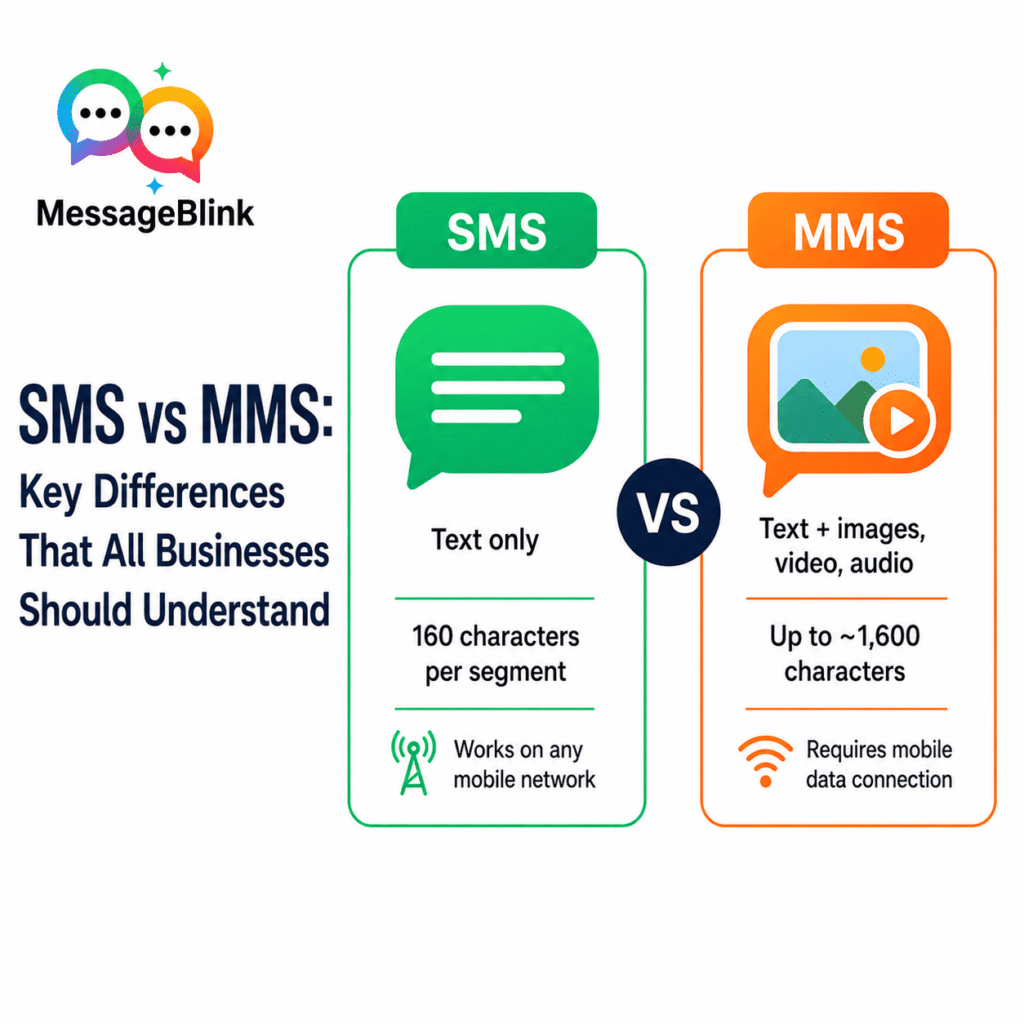
- Max characters per message segment: 160 characters
- Content type: Plain text only
- Network requirement: Cellular service (no internet needed)
- Device compatibility: Compatible with any mobile phone in the world
- Cost: Usually low per message, often included in carrier plans
If it is longer than 160 characters, it will be split into multiple segments, and you will be charged for each one. Most modern carriers concatenate these segments for the recipient so the message reads as one continuous text, but the cost and character count still apply per segment.
For businesses, SMS is the channel of choice for high-volume, time-sensitive communications: OTP codes, delivery alerts, appointment reminders, and short service notifications all live on as SMS messages.
What Is MMS? Definition and How It Works
MMS is the Multimedia Messaging Service. It was developed as an extension to SMS to allow for the transmission of rich media content over cellular networks.
While SMS is restricted to plain text, MMS lets you include images, GIFs, short videos, audio files, and even vCards (contact cards) in your message. MMS was designed to complement SMS, to use the same carrier infrastructure, and to build multimedia support on top.
Important MMS Features
- Content types: Images (JPEG, PNG, GIF), audio, short videos, vCards
- File size limit: Up to 300 KB (carrier and recipient device dependent)
- Network requirement: Cellular data connection needed
- Number of characters: Up to 1,600 characters of text (platform-dependent)
- Cost: More expensive per message than SMS; usually 2–3× the SMS rate
MMS requires a data connection and may have issues delivering messages on devices with limited data plans or in areas with poor coverage. High-resolution images are usually compressed to meet carrier file size requirements before being sent.
SMS vs MMS: Side-by-Side Comparison
| Feature | SMS | MMS |
|---|---|---|
| Full Form | Short Message Service | Multimedia Messaging Service |
| Content | Text only | Text + images, video, audio |
| Character Limit | 160 per segment | ~1,600 characters |
| File Attachments | None | Up to ~300 KB |
| Network Required | Cellular signal | Mobile data connection |
| Cost Per Message | Lower | Higher (usually 2–3×) |
| Deliverability | Highest | Slightly lower |
| Best For | Alerts, OTPs, reminders | Visual content, onboarding, promotions |
When to Use SMS for Your Business
Use SMS when speed, reliability, and reach are the utmost priorities. SMS has a near-universal open rate because it requires only a basic cellular connection and works on every device, no exceptions.
Best SMS Business Use Cases
Transactional messaging is where SMS excels. This category should include messages that are time sensitive and require immediate attention, such as authentication codes, order confirmations, payment alerts, or booking confirmations.
Appointment reminders sent via SMS have consistently lowered no-show rates across a range of industries, including healthcare, field services, and financial advisory. A short, to-the-point text is harder to ignore than an email.
Operational notifications such as shipping updates, support ticket status changes, or SLA alerts are ideally suited to SMS. These are short, factual, and expected by the recipient.
High-volume outreach campaigns where the cost-per-message is relevant are well suited to SMS, especially when the message isn’t visual in nature.
If you’re a Salesforce user, you can trigger SMS through directly from workflows, flows, and process builders—keeping all of your message data inside your CRM without switching tools.
When Should Companies Use MMS?
If you want to add meaningful visual enhancement to the message, MMS is the way to go. Sometimes a picture really is worth more than 160 characters of text, and that’s when the higher per-message cost of MMS is justified.
MMS Business Use Cases at a Glance
Promotional campaigns in retail, real estate, and hospitality benefit from MMS, where a product image, offer graphic, or property photo is the core value of the message. Visual content drives higher click-through rates in promotional situations.
Branded onboarding messages can leverage MMS to send a logo-branded welcome card, visual product guide, or how-to GIF—creating a richer first impression than plain text.
Event and announcement messaging where a branded flyer or visual asset has already been created for other channels can be efficiently repurposed as an MMS.
Customer service follow-ups that require a visual confirmation — such as a preview of a signed document, a photo of a completed service, or a screenshot with annotations — are ideal for MMS delivery.
If you’re sending MMS at scale, carrier filtering and file optimization are important. Keep images under 300 KB and test on major devices before launching a campaign.
MessageBlink for Salesforce: SMS and WhatsApp Messaging
Most SMS and MMS platforms require businesses to send messages via a third-party interface and then manually sync data back into Salesforce. That leaves holes in the log, context that is missed, and a compliance risk.
MessageBlink is built natively on the Salesforce platform. That means every SMS and WhatsApp message your team sends and receives is automatically logged against the right Contact, Lead, Case, or Opportunity record—with no manual effort.
What This Means for Your Team
Sales teams can send personalized SMS follow-ups directly from a lead or opportunity record, with full conversation history visible inside Salesforce.
Support teams can respond to inbound WhatsApp messages—such as a customer photo of a damaged product sent over WhatsApp—right from a case record, escalating or resolving without leaving the CRM.
Marketing teams can initiate SMS and WhatsApp sends via Salesforce Flows, Journeys, or custom automations and capture delivery status, open tracking, and reply data natively.
Operations and field service teams can automate high-volume SMS notifications—confirmation messages, scheduling alerts, and SLA reminders—triggered entirely based on Salesforce record changes.
Is MMS More Expensive Than SMS?
Yes. MMS messages are typically 2–3× the cost of a regular SMS message, depending on your messaging provider and volume tier. That’s because MMS needs carrier data routing instead of just sending text, and the infrastructure to deliver the files is more resource-intensive.
This cost differential is important for businesses evaluating messaging costs at scale. A smart messaging strategy carefully segments use cases: reserve MMS for moments where visual content drives measurable outcomes (conversion, engagement, or resolution rate), and default to SMS for transactional and operational messages.
MessageBlink offers transparent per-message pricing with volume discounts, and all cost data is trackable inside Salesforce dashboards.
Which Has Better Deliverability? SMS or MMS
SMS deliverability rates are consistently higher than MMS. Since SMS is pure cellular signaling (not data), it’s less likely to be filtered, have data connection issues, or be blocked at the device level.
Several things can impact the deliverability of MMS, including the recipient’s carrier, their data plan, device compatibility, and file size. Carriers often reject MMS files that are too large without notification, so it’s important to stay under the recommended 300 KB threshold.
For compliance-sensitive industries—healthcare, finance, and real estate—SMS is often the preferred default due to a more predictable delivery pathway and an easier audit trail to maintain.
Ready to add SMS and WhatsApp messaging directly inside Salesforce?