


 ChatGPT
 Perplexity
 Claude
 Google AI
SMS Analytics The Complete Guide to Measuring What Really Matters
Here’s What You Need to Know About SMS Analytics to Turn Your SMS Campaign Data into Decisions That Drive Real Revenue
What Are SMS Analytics?
Most companies text-message. Even fewer actually know if those messages are effective.
SMS analytics is the science of collecting, measuring and interpreting data from your text message campaigns. Stop guessing, start growing. It shows how many messages you sent and how recipients actually acted after receiving them.
Did they open it up? Click on the link? Convert? Stop receiving this newsletter?
This is what SMS analytics answers, and this data is non-negotiable for any business running SMS as a marketing or transactional channel.
Why SMS Analytics Deserves More Attention Than You’re Giving It
SMS is arguably the highest attention channel available to marketers today. Text messages always have open rates that dwarf email — and they get read within minutes, not hours.
But here’s the rub: high open rates don’t always equal high ROI.
Without analytics, you’re in the dark about:
Messages resulting in purchases vs. messages that are opened and ignored
Which parts of the audience respond vs. which parts quietly check out
Whether your sending frequency is building loyalty or burning your list.
In a world where SMS marketing is getting crowded, the winners are not the ones sending the most messages, but the ones sending the right messages to the right people at the right time. That precision comes only from analytics.”
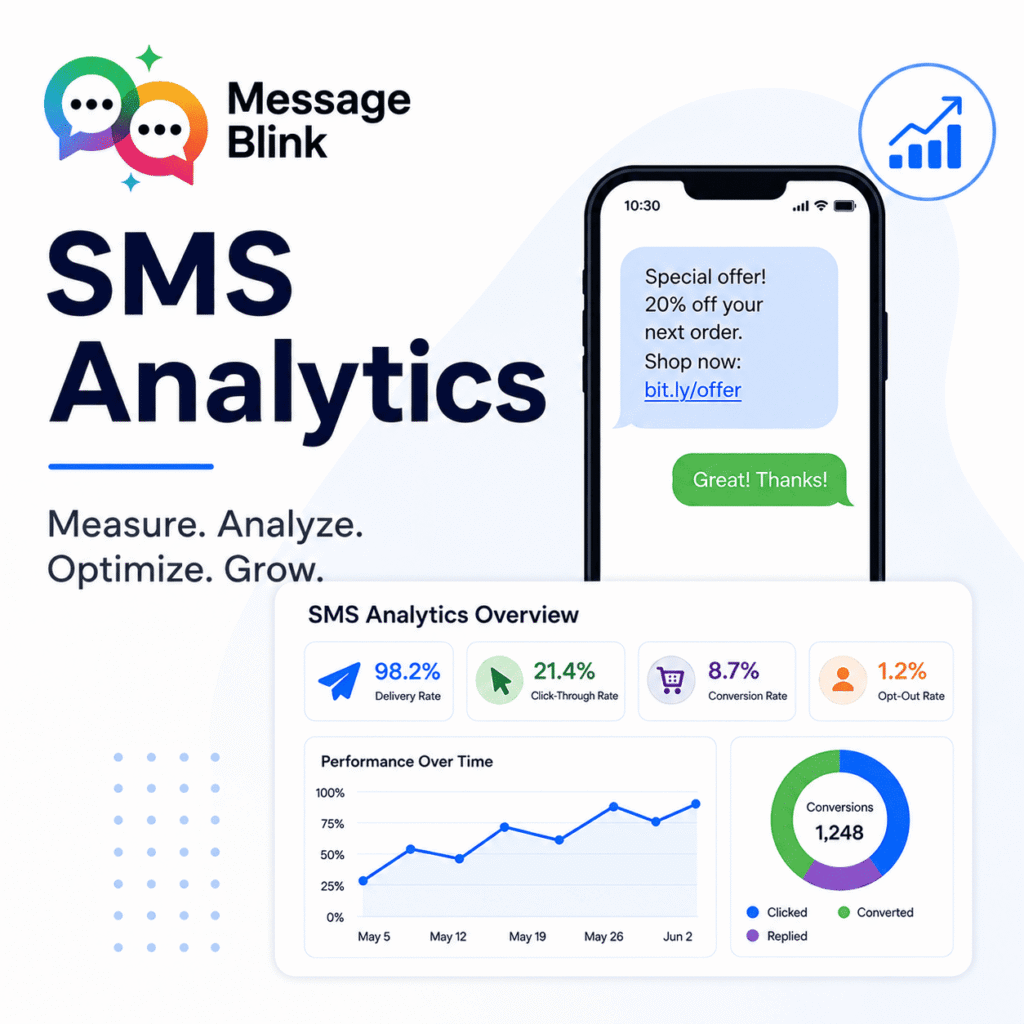
Important SMS Analytics Metrics All Marketers Should Monitor
1. Rate of delivery
The foundation of any campaign. Your delivery rate is the percentage of messages that successfully arrived at recipient’s device.
Why it’s important: “If messages aren’t delivered, nothing else matters.” A decrease in delivery rate is often the first sign of a technical problem, a carrier filtering problem or a list quality problem.
What to strive for Healthy delivery rates are above 95%. Any consistently lower ones should be looked at immediately.
2. Click-Through Rate (CTR)
CTR is the percentage of delivered messages in which the recipient clicked your link or CTA.
Formula: (Unique Clicks / Delivered Messages) * 100
Why it matters: CTR distinguishes between passive opens and active interest. A low CTR and a high delivery means the problem is probably your offer or CTA copy, not your list.
Benchmark: SMS CTR is typically between 10–30% much higher than email.
3. Rate of Conversion
The metric that’s directly tied to revenue. Conversion rate is the number of recipients who took a defined action – purchase, sign-up, booking, demo request.
Formula: (Delivered Messages / Conversions) x 100
Why it matters: That’s the figure your CFO cares about. Everything else in SMS analytics comes down to whether or not your campaign converted.
4. Response Rate
For two-way SMS campaigns, the response rate is the percentage of recipients who replied to your message.
Formula: (Messages Sent / Replies Received) x 100
Why it matters: High response rate shows your messaging is relevant and your audience is engaged – not just passively consuming. This is particularly critical in transactional or support-centric SMS flows.
5. Opt-Out Rate
Opt-out rate This metric tells you how many of your recipients unsubscribed after receiving a given message.
Why it’s important: One of the clearest signs that something is amiss is a sudden surge in opt-outs, be it because of message frequency, bad targeting or content that feels intrusive. This metric is tracked to protect your sender reputation and list health.
6. GROWTH RATE OF LIST
Your SMS subscriber list net growth rate – number of new opt-ins minus number of opt-outs over a given period of time.
Why it’s important: More and more people are opting in to your SMS program, which is a good sign that it’s providing value. Even if individual campaign stats look OK, a shrinking list is a warning sign.
7. Revenue Per Message
A potent but overlooked metric: revenue generated per SMS sent.
Formula: (Total Revenue Linked to SMS / Total Messages Sent)
Why it matters: It puts all other metrics in perspective. A campaign with lower CTR but higher average order value could beat out a higher volume campaign with cheaper conversions.
How to Effectively Use SMS Analytics to Enhance Campaign Performance
Tracking numbers are simple. The trouble is that most teams do nothing with them. A practical framework is as follows:
Audit Your Timing
Day of week and time of day pulls delivery and CTR data. You’ll see patterns. Your audience may respond much better to Tuesday afternoon sends vs. Monday morning—and you’ll only know this if you’re measuring.
Segment Before You Send
Analytics is not just a post-campaign activity. Segment your audience with historic data and hit send Each message should be tailored for your high-engagement subscribers, first-time converters, and lapsed customers.
A/B Test Consistently
Test one variable at a time: subject, CTA, offer type, message length, send time. Let the data pick the winner and roll it out. The brevity of SMS means small copy changes can have a large impact.
Opt-Out Trend Tracking in Real Time
Don’t wait until the end of the campaign to check your opt-out rate. If you see a batch of messages triggering unusual unsubscribes in real time, you want to know immediately — before it hurts your sender reputation or list size.
Connecting SMS Data to The Full Funnel
SMS is not a standalone channel. Connect your SMS analytics with your CRM, E-Commerce platform or marketing automation stack to understand the place of SMS in the overall customer journey – from first touch to purchase to retention.
SMS Analytics for Teams with Salesforce
The analytics opportunity is even bigger for businesses on Salesforce. With native SMS integration with your CRM, like MessageBlink built-in, your data doesn’t get stuck in a silo. It plugs right into your existing customer records, campaign reporting and automation workflows.
That implies:
Each SMS delivery, click and reply is logged against the correct contact record
Sales and marketing teams are looking at the same real-time data
You can set up triggers to automatically act on SMS behavior — a click launches a follow-up, a reply routes to a rep, an opt-out instantly updates consent preferences
Campaign attribution is clean, accurate, not fractured across disconnected platforms
This is the difference between SMS analytics as a standalone report and SMS analytics as a living layer of your customer intelligence.
Where the future of SMS analytics will take us
AI-optimized: Predictive analytics will move from descriptive (“here’s what happened”) to prescriptive (“here’s what to do next”). Get smart advice on when to send, how to segment your audience, and what to say.
Cross-channel attribution: SMS analytics will start to be measured alongside email, WhatsApp and push more regularly, providing marketers with a true multi-channel view of the customer journey rather than per-channel metrics in isolation.
Measurement built on privacy: As the data regulations tighten around the world, SMS analytics platforms will need to support consent management, opt-in tracking and compliance reporting as built-in features—not afterthoughts.
Make Smarter SMS Decisions with MessageBlink
Data is only useful when it’s actionable. MessageBlink provides real-time SMS analytics right inside your Salesforce-native teams – no third-party integrations, no data lag, no siloed reports.
Track every delivery, click, reply and conversion. Know your audience at the segment level. Link SMS performance to the customer records that count.
Ready to take your SMS campaigns from sent to strategic? Download MessageBlink today from AppExchange or Talk with Expert.