


 ChatGPT
 Perplexity
 Claude
 Google AI
When Three Campuses Send Three Different Texts: The Automated Student Communication Problem Nobody Talks About
Automated Student Communication Solutions for Multi-Campus Institutions
A potential student completes the inquiry process on a Tuesday. And by Friday, they have gotten a message from the central campus admissions department, a text from the regional campus outreach coordinator, and a financial aid request from a department that didn’t know the other two departments had contacted them.
And they ignore all three.
This isn’t an issue of student engagement. This is an issue of communications architecture – and at a multi-campus institution, it becomes a silent issue that grows and manifests itself when it comes to enrollment yield.
The truth about the operations at universities with regional campuses, satellite campuses, or blended online and ground cohorts is that every department operates independently.
Admissions has its method of communication.
The financial aid office has its approach.
And then there’s the regional campus, sending texts to potential students.
No communication between the departments means that they all contact the student at once, with mixed messaging, repeated asks, and no coordination at all.
Students won’t complain. They will just disappear.
The Radio Station Problem Is Getting Worse
The average email open rate across institutions is less than 30%. This has been true for a long time, but most universities design their messaging systems based on email broadcasts anyway. Passive. Scheduled. One-way only.
It’s not that students are not interested in deadlines or financial aid. It’s that they’ve learned to tune out emails that all look the same – automated sending, no-reply capabilities, nothing personalized. SMS, on the other hand, breaks through. Average response rates are well above 90%. But without coordination, SMS becomes a problem in itself.
The Compliance Trap Hiding Inside Multi-Campus Texting
Violations of the TCPA are not merely theoretical; with potential fines for each violation ranging between $500 and $1,500, even one failed opt-out process within a system made up of five campuses and four messaging applications constitutes a liability.
The problem faced by multi-campus institutions? A student opts out of future texts by sending STOP to one campus phone number. The opted-out status is recorded within that particular campus’s application. This status does not transfer to the messaging application used by the regional coordinator; nor does it transfer to the financial aid SMS application, or to the other institution’s automated messaging program. Weeks later, the student receives a text from yet another campus department.
This isn’t an unlikely situation; in fact, this describes precisely the way that institutional exposure to TCPA risks occurs — not through malicious intent, but rather through disjointed systems that lack any unified compliance framework.
Then there is FERPA. Anytime student data passes through a secondary messaging application outside of your main system of record, you are placing yourself at increased data governance risk, a risk that your legal team will surely ask questions about.
The channel fragmentation problem and the compliance problem are the same problem. They both trace back to the same root cause: the communication layer is disconnected from where the student record actually lives.
The Structural Fix Before You Touch Any Software
Multi-campus institutions trying to solve this by adding another point solution are making the problem worse. The solution does not lie in finding a new SMS provider. The solution lies in an entirely different architecture choice.
The communication layer needs to exist within the CRM. Not connected to it. Not synced with it once every fifteen minutes. Within it – where the student record already exists, the history of enrollment, where the advisor notes are located, and where the financial aid status updates live in real-time.
The moment that the messaging layer is powered from the same database as the student record itself, a transformation occurs. Opt-outs become global, the message history is available across the entire organization, and automation is able to trigger on true CRM data and not something that was downloaded last Thursday.
The next critical transformation: from announcements to conversations. The organizations that have achieved higher yields and retention rates haven’t done it through increased volume, but increased responsiveness.
How MessageBlink Executes This Inside Salesforce
This is where architecture becomes operational reality.
One Source of Truth Across Every Campus
Since MessageBlink is built for Salesforce, there is only one student record for every campus. So, the counselor at Campus A can see all conversations that the financial aid counselors at Campus B have been having with the students. There are no duplicate blast emails, no conflicting communications, no “didn’t we already tell them that?”
Automation That Respects Time Zones and Enrollment Triggers
Time zone aware automation and scheduling is a must-have when dealing with organizations that span multiple states or countries. MessageBlink’s automatic messaging uses triggers, which are set according to certain events on Salesforce records such as enrollment status change, FAFSA application discrepancies, and registration deadlines. It wouldn’t be helpful for a message about a possible dropout intervention strategy to come at 11 PM. A yield generation nudge sent mid-dead week will have different effects compared to one sent mid-active period.
The smart triggers used by MessageBlink are able to do this thanks to their access to real-time data within Salesforce.
Two-Way Conversations From a Single Contact Record
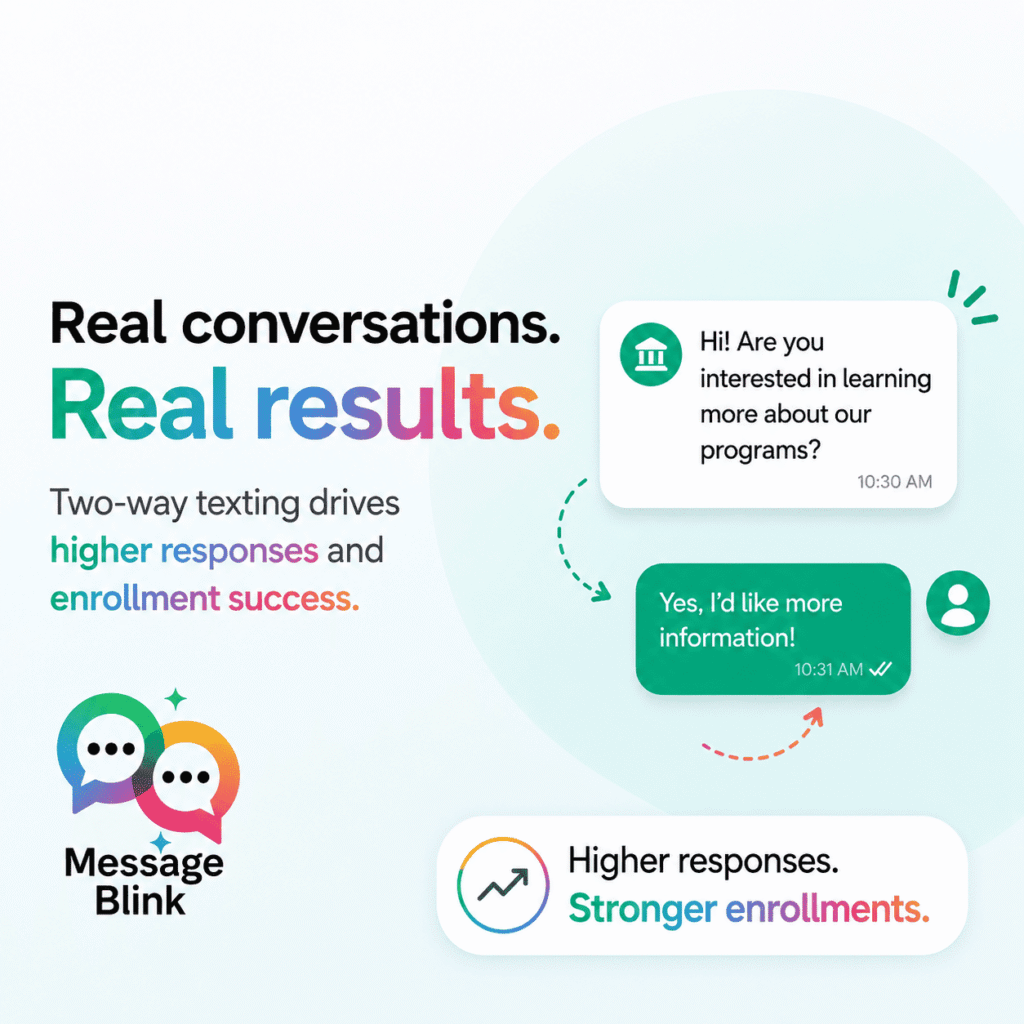
“If I may, I have a question regarding my financial aid,” comes back. This reply goes directly into a live Salesforce inbox viewable by the owner of the student’s data. It is not another app. It is not another forwarded email. The message appears as part of the thread on the contact record itself, this is MessageBlink’s two-way sms.
The coordinator can immediately respond. They can use a personalized template for a frequently asked question. They can also route to another department, all from within that contact record. This is no longer bulk messaging. This is advising at scale.
SMS + WhatsApp for Domestic and International Cohorts
Retention through domestic messaging happens via SMS. Recruiting international students happens more and more frequently via WhatsApp. Each channel is operated as two different workflows by most schools, which means different vendors, separate reports, no integration.
At MessageBlink, domestic SMS and international WhatsApp are managed from the same Salesforce mailbox. International campaigns, local health messaging, cross-border follow-up of enrollments — all managed through one single CRM channel.
Opt-Out Management That Actually Protects the Institution
Once your students have opted out through MessageBlink, the opt-out is reflected in Salesforce across all campuses, all departments, and all automation processes. We never miss a compliance requirement because it was in another system.
Audit trail creation happens seamlessly for you. It’s automatic and there’s no reconciling.
Your Communication Architecture Is Either Working for Enrollment — or Against It
Multi-campus organizations don’t lose their students because of rival universities with better programs; they lose them due to friction. Due to unresolved questions. Due to the fact that three emails from three different departments feel like background noise.
And the solution to the problem is not about more outreach; rather, it’s about native CRM two-way communication that sees each touchpoint as a continuum, not a collection of disjointed broadcasts.
MessageBlink can give you exactly that.
Schedule a 30-minute institutional demo — or install directly from AppExchange and see it inside your Salesforce org today.