Cold Email Templates: The Complete Guide to Writing Emails That Get Replies in 2026
If you’ve sent a cold email in the last year, you know the odds aren’t great. 95.9% of cold emails go unanswered. The average cold email conversion rate is only 0.2% — one deal for every 500 emails sent. That’s the sobering part.
The good news is that the senders who get it right aren’t performing any magic. Emails referencing specific buying signals such as funding rounds, leadership changes, or hiring surges have response rates of 15-25%—several times the average. A good cold email template isn’t a shortcut around work; it’s a framework that helps you stay consistent while personalizing the parts that actually move the needle.
In this guide, you’ll learn what a cold email template really is, the data behind why some templates perform better than others, 17 ready-to-use templates for different sales scenarios, the mistakes quietly killing your reply rate, and how to extend your outreach beyond the inbox for even better results.
What’s a Cold Email Template?
A cold email template is a reusable email framework used for prospecting when there is no existing relationship with the recipient. It is designed to do three things quickly: grab attention, establish relevance, and generate a response—typically a reply, a click, or a meeting request.
The term “template” can sometimes be stigmatized because people imagine cookie-cutter, copy-and-pasted pitches. But a good cold email template is really a skeleton, not a script. The framework (subject line, opening hook, value prop, CTA) is consistent; the elements within it (name, company, pain point, recent trigger event) are unique to each recipient. That difference is precisely what separates a 2% reply rate from a 20% reply rate.
Does Cold Email Still Work in 2026?
Short answer: yes. The game has changed.
The average cold email reply rate, according to recent benchmark data, has fallen to 3.43%. Only about 8.5% of outreach emails get any response at all. Spray-and-pray sending is dying, and for good reason—large, poorly targeted campaigns of 500+ recipients average just 2.1% response rates.
But zoom in on targeted, timely outreach, and the picture changes. Companies that focus on quality over quantity send far fewer emails and get far more replies in proportion than mass-blast senders. The sender’s winning in 2026 isn’t just sending more emails; they’re sending smarter emails—research-backed, well-timed emails with a template designed for personalization, not mass copying.
What Actually Works in a Cold Email Template
It helps to understand the mechanics behind why some perform and others get deleted in two seconds before diving into templates.
Subject lines are more important than you realize. Subject lines with 21 to 40 characters receive an average open rate of almost 49%. Subject lines with numbers have a 113% higher open rate than those without. A question in the subject line increases opens by about 21%, but mentioning something timely about the recipient’s company works even better.
No longer is personalization optional. About 5% of senders personalize every single email, and they get 2-3 times the reply rate of generic senders. This is the biggest lever in the whole template.
The shorter one nearly always wins. Short emails without large attachments consistently outperform longer emails with lots of attachments on both engagement and deliverability. The top campaigns keep their messaging under 80 words.
Follow-ups do a lot of the heavy lifting. Here’s a big one that catches a lot of people off-guard: 58% of all replies come from the very first email in a sequence, but the other 42% come from follow-ups—meaning nearly half of your results are sitting in messages most people never send. 70% of salespeople give up after one email, yet 42% of all responses come on follow-up emails.
Timing is more important than we think. Reply rates are highest on Tuesday and Wednesday, with the best overall day being Wednesday.
17 Cold Email Templates for Any Sales Situation
Here are proven cold email templates you can copy, tweak, and send. Maintain the structure and substitute it with your own research.
1. Referral to the Mutual Contact
Use when you have a common connection with your prospect. First thank the connector for something specific, then ask for an introduction.
Subject: Quick favor, [FIRST NAME]?
Hi [FIRST NAME],
It was a pleasure working with you on [PROJECT/DEAL]. Hope all is well at [MUTUAL CONNECTION’S COMPANY].
Small ask—I saw you’re connected to [PROSPECT NAME] at [PROSPECT COMPANY]. I’d love to get in front of them about [BRIEF REASON]. Mind if I do a quick intro?
No worries if not—that’s fine too.
Thanks,
[YOUR NAME]
2. The Cold Intro Request
No mutual connection? Reference why you found the prospect and ask a third party to make the connection for you.
Subject: Introduction to [PROSPECT NAME]?
Hello [FIRST NAME],
I came across [PROSPECT NAME] at [PROSPECT COMPANY] through [CONTEXT — article, LinkedIn post, mutual industry group] and wondered if you might be the right person to ask.
I help [TARGET AUDIENCE] with [ONE-LINE VALUE PROP], and I think there’s a really interesting fit for what [PROSPECT COMPANY] is doing right now.
Would you be open to a quick intro? Completely understand if the timing’s not right.
Best,
[YOUR NAME]
3. The “Not Sure Who to Contact” Email
Sent when you’re not sure who should be making the decision. State your value quickly, and ask a simple yes/no question.
Subject: Quick one — right person?
Dear [FIRST NAME],
Recently we helped [SIMILAR COMPANY] get [SPECIFIC RESULT] with [PRODUCT/SERVICE].
Are you the right person who handles [SPECIFIC FUNCTION] at [PROSPECT COMPANY]? If not, can you point me to someone who is?
Either way, I appreciate it.
[YOUR NAME]
4. The Direct Meeting Request
Skip the fluff. State the specific goal you can help achieve, then offer two concrete time options.
Subject: Helping [PROSPECT COMPANY] with [SPECIFIC GOAL]
Hello [FIRST NAME],
[SELLER COMPANY] partners with teams like yours to [SPECIFIC OUTCOME] — we recently helped [SIMILAR COMPANY] achieve [SPECIFIC RESULT/METRIC].
Worth a quick 15-minute call to see if this is relevant for [PROSPECT COMPANY]?
I’m available [TIME OPTION 1] or [TIME OPTION 2] — or whatever works for you.
[YOUR NAME]
5. The Prospecting Follow-Up
Sent 3-5 business days after initial attempt. Don’t just say “checking “in”—briefly restate the value.
Subject: Re: Helping [PROSPECT COMPANY] achieve [SPECIFIC GOAL]
Hi [FIRST NAME],
Just wanted to check back in case this got buried—still feel there’s a good fit between what we do at [SELLER COMPANY] and [SPECIFIC GOAL] at [PROSPECT COMPANY].
Would [TIME OPTION 1] or [TIME OPTION 2] work for a quick call? Happy to work around your schedule.
[YOUR NAME]
6. The Pre-Meeting Confirmation
Sent the day before a scheduled call. Reconfirms the meeting and provides a proof point.
Subject: Quick prep — [TIME] tomorrow
Hello [FIRST NAME],
Looking forward to our call tomorrow at [TIME]. We’ll talk about how [SELLER COMPANY] can help [PROSPECT COMPANY] achieve [SPECIFIC GOAL].
A quick example before we chat: [ONE-LINE CASE STUDY OR RESULT FOR SIMILAR COMPANY]
[TEAMMATE NAME], our [ROLE], will join too. Here’s the link: [CALL LINK]
See you then,
[YOUR NAME]
7. The Post-Meeting Recap
Sent within 24 hours of a call. Summarizes key points and next steps.
Subject: Recap — [SELLER COMPANY] x [PROSPECT COMPANY]
Hi [FIRST NAME],
It was good to talk today. Quick recap of what we covered:
- [KEY POINT 1]
- [KEY POINT 2]
- [KEY POINT 3]
Next step: I’ll [YOUR NEXT ACTION] by [DATE]. Would you be able to [THEIR NEXT ACTION] on your end by then?
Resource I referenced: [LINK]
Let me know if anything’s unclear.
[YOUR NAME]
8. The Recent Event / Trigger-Based Email
Sent after a funding round, award, or leadership change. Trigger-event subject lines have open rates as high as 54.7%, higher than many other types of subject lines.
Subject: Congrats on [ACHIEVEMENT/EVENT], [FIRST NAME]
Hello [FIRST NAME],
Saw the news about [PROSPECT COMPANY]’s [ACHIEVEMENT/EVENT]—congrats, that’s a huge milestone!
After something like this, companies usually face [SPECIFIC CHALLENGE]. That’s the very problem we helped [SIMILAR COMPANY] solve with [PRODUCT/SERVICE].
Can we quickly chat next week? [TIME OPTION 1] or [TIME OPTION 2]?
Congrats again!
[YOUR NAME]
9. The Pain-Point-After-Event Email
Similar to the trigger email, but leads with the challenge directly.
Subject: [PROSPECT COMPANY] + [SELLER COMPANY]
Hello [FIRST NAME],
Congratulations on [ACHIEVEMENT/EVENT]. A lot of teams run into this—for example, [2-3 SIMILAR COMPANIES], whom we helped solve [SPECIFIC PAIN POINT] with [SPECIFIC RESULT].
What’s the biggest challenge you’re facing right now? Happy to share what’s worked elsewhere.
Are you available for a quick call at [TIME OPTION 1] or [TIME OPTION 2]?
[YOUR NAME]
10. The B2B Value-First Email
Starts with a tangible result for a comparable company.
Subject: How [COMPETITOR] achieved [SPECIFIC RESULT]
Hi [FIRST NAME],
Got an idea that helped [PROSPECT COMPANY’S COMPETITOR] achieve [SPECIFIC RESULT] — takes about 10 minutes to walk through.
Worth a quick call this week? [TIME OPTION 1] or [TIME OPTION 2]?
[YOUR NAME]
11. The No-Ask Value Email
No CTA except a reply. Offer something useful, no pressure.
Subject: Mentioned you in a piece we wrote
Hello [FIRST NAME],
We just published something on [TOPIC] and highlighted [PROSPECT COMPANY] as a great example of [WHAT THEY’RE DOING WELL]: [LINK]
No asking; I just wanted you to see it. Happy to update it if you want to add anything.
[YOUR NAME]
12. The Industry Trend Email
Opens with a trend affecting the prospect’s industry.
Subject: Heads up on a shift in [INDUSTRY]
Hello [FIRST NAME],
Recently saw [SPECIFIC INDUSTRY TREND] gaining traction in [INDUSTRY]. Companies like [SIMILAR COMPANY] are already making the switch with [PRODUCT/SERVICE BENEFIT] and seeing [SPECIFIC RESULT].
Happy to share what we’re seeing work—[TIME OPTION 1] or [TIME OPTION 2]?
[YOUR NAME]
13. The PAS Email (Problem-Agitate-Solution)
Identify the problem, raise the cost of ignoring it, then offer the solution.
Subject: Losing customers over [SPECIFIC PROBLEM]?
Hi [FIRST NAME],
Read some reviews mentioning [SPECIFIC PROBLEM] at [PROSPECT COMPANY]. That sort of thing gradually eats away at retention over time.
[SELLER COMPANY] solves exactly this by [BRIEF SOLUTION DESCRIPTION].
Want to hear how [SIMILAR COMPANY] turned it around?
[YOUR NAME]
14. The AIDA Email (Awareness-Interest-Desire-Action)
Moves from observation to a clear action.
Subject: Tired of [PAIN POINT]?
Hello [FIRST NAME],
[SHORT BACKGROUND ON HOW YOU FOUND THEM]. Curious whether [PAIN POINT] is something [PROSPECT COMPANY] is facing too.
We built [PRODUCT/SERVICE] to help [TARGET DEPARTMENT] with:
- [BENEFIT 1]
- [BENEFIT 2]
- [BENEFIT 3]
Free for a quick call [TIME OPTION 1] or [TIME OPTION 2]?
[YOUR NAME]
15. The Negotiation/Evaluation-Stage Email
Used when a prospect is thinking over your offer. Keep it short, low-friction.
Subject: Quick pricing call, [FIRST NAME]?
Hello [FIRST NAME],
I completely understand where you’re coming from on budget. Let’s jump on a quick call to align on pricing that makes sense for [PROSPECT COMPANY]—it shouldn’t take more than 7 minutes.
[TIME OPTION 1] or [TIME OPTION 2] work?
[YOUR NAME]
16. The Exclusive/Time-Limited Offer
Sent to a warmer segment with a genuine expiration date.
Subject: A limited-time offer for [PROSPECT COMPANY]
Hello [FIRST NAME],
Wanted to make you aware that we’re offering [SPECIAL TERMS] on [PRODUCT/SERVICE] for [GROUP/INDUSTRY] through [EXPIRATION DATE].
Includes: [BRIEF DESCRIPTION]
Want a quick walkthrough before it closes out?
[YOUR NAME]
17. The Closing / Next-Steps Email
Sent once a prospect verbally agrees, to keep things moving.
Subject: Proposal + next steps
Hi [FIRST NAME],
Great catching up. Here’s the proposal we discussed: [LINK]
Also sent an invite for [DATE/TIME] to go through the contract and answer any last questions.
Talk soon,
[YOUR NAME]
Cold Email Template Strategies: Which One Is Right for You
| Template Style | Best For | Typical Reply Rate Behavior | Effort to Personalize |
|---|---|---|---|
| Trigger-event based | Warm, timely outreach | ✔ Highest average open/reply rates | ✔ Higher upfront research |
| Direct/no-frills ask | Fast-moving sales cycles | ✔ Clear ICP, good fit | ✔ High volume, low effort |
| Value-first, no-ask | Cold, unfamiliar audiences | ✔ Builds trust over time | ✗ Slower to convert |
| Mass generic template | Broad, low-intent lists | ✗ Consistently underperforms | ✗ High volume, low return |
Common Cold Email Mistakes That Quietly Kill Your Reply Rate
Even a well-written template will underperform if these mistakes slip in.
Starting an email with “I hope this email finds you well” or “We’re the best at what we do” shows you haven’t done your research and gets deleted almost immediately. Leading with yourself instead of the prospect’s situation instantly reveals that you haven’t done your homework—most people see it coming in the first line.
Another costly habit is giving up after one try. Over 70% of positive responses occur after the third touchpoint, but roughly 44% of salespeople quit reaching out after one attempt. Most senders are quitting right before outreach starts working.
A quieter killer is skipping the authentication setup. No template saves an email that lands in spam. With current Google and Microsoft deliverability rules, cold emails without proper SPF, DKIM, and DMARC authentication are increasingly likely to never even reach the inbox.
And, ironically, trying too hard to sound persuasive can backfire too. Spam-trigger language does boost short-term engagement, but it comes with significantly higher bounce rates, which hurts sender reputation in the long run.
Beyond the Inbox: Why the Best Cold Outreach Isn’t Just Email Anymore
Email remains the backbone of cold outreach, but in 2026 it rarely wins alone. SMS works best as a follow-up channel after an email or call attempt, not as a standalone first touch, and it carries notably high response rates in the 10-15% range when compliance and consent frameworks are handled correctly. Automatically triggering a WhatsApp or text message when an email goes unopened or unanswered is one of the best ways sales teams are closing the “sent” to “replied” gap in 2026 sequences.
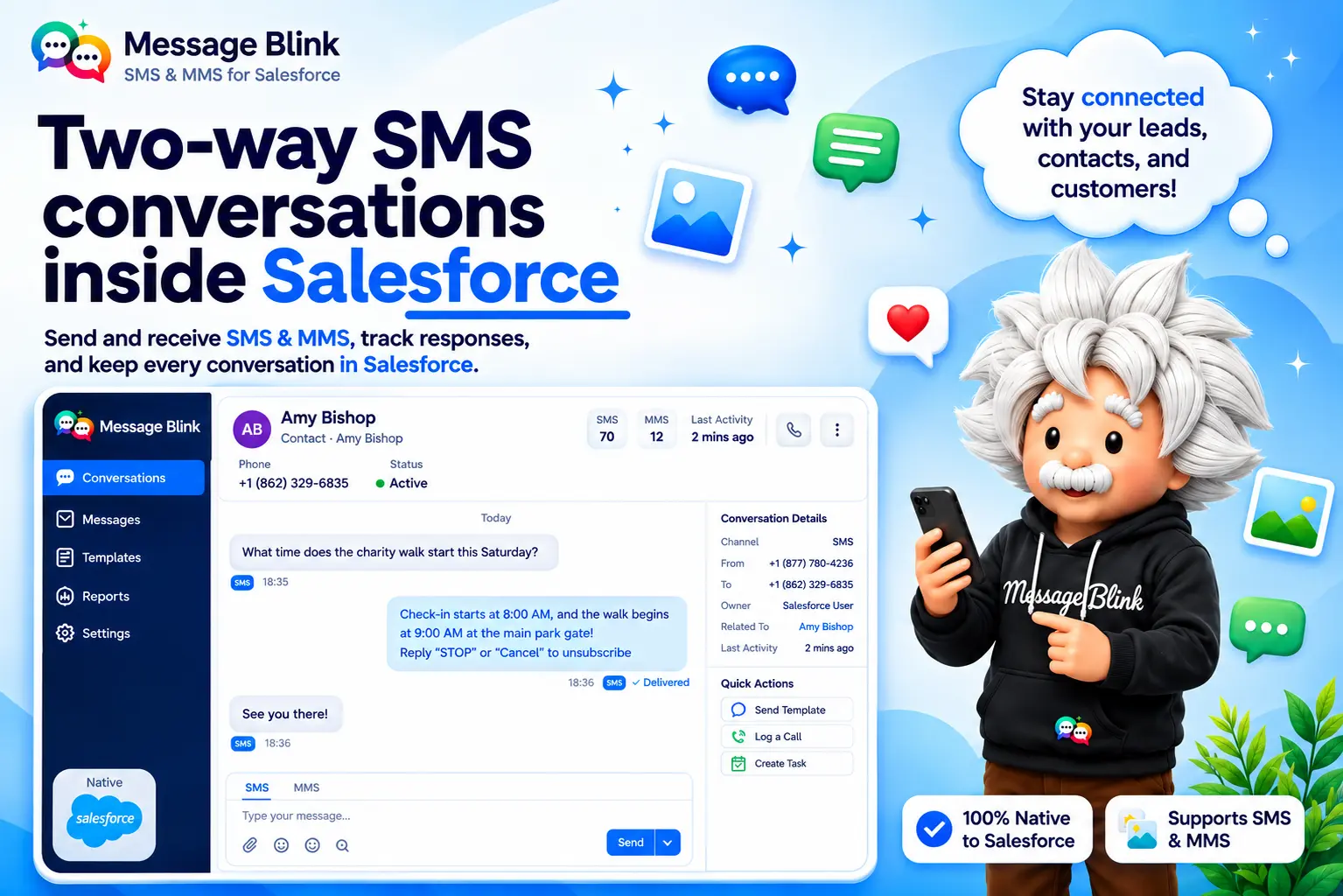
That’s the gap MessageBlink was built to fill for Salesforce teams. MessageBlink lives natively inside Salesforce, so cold email sequences you build in your CRM can automatically trigger an SMS or WhatsApp follow-up the moment a prospect goes cold on email — no separate app, no exporting contacts, no manual handoff between tools. If you’re not getting a response after two or three attempts with your Instantly. An AI or Salesforce email sequence or a two-line SMS often reopens the conversation because it lands somewhere your prospect actually checks within minutes, not days. That means one connected outreach engine instead of three disconnected ones for sales and marketing teams already living inside Salesforce.
Building a Cold Email Template That Actually Converts
A cold email template isn’t about finding the one perfect script—it’s about having a reliable structure you can personalize quickly and consistently, backed by data on what recipients actually respond to: sharp subject lines, real research, brevity, and follow-through. The senders getting 15-25% reply rates aren’t lucky; they’re doing the unglamorous work of researching triggers, writing tight copy, and following up when everyone else gives up.
And when email alone isn’t cutting through, extending that same sequence into SMS or WhatsApp—automatically, from inside Salesforce—is often the difference between a cold lead going quiet and a cold lead booking a call.