


 ChatGPT
 Perplexity
 Claude
 Google AI
What Are SMS Quiet Hours
What are SMS quiet hours? SMS quiet hours are legally defined time windows during which businesses are prohibited from sending marketing or promotional text messages to consumers. The goal is simple: no one should be disturbed by brand messages in the middle of the night or early in the morning.
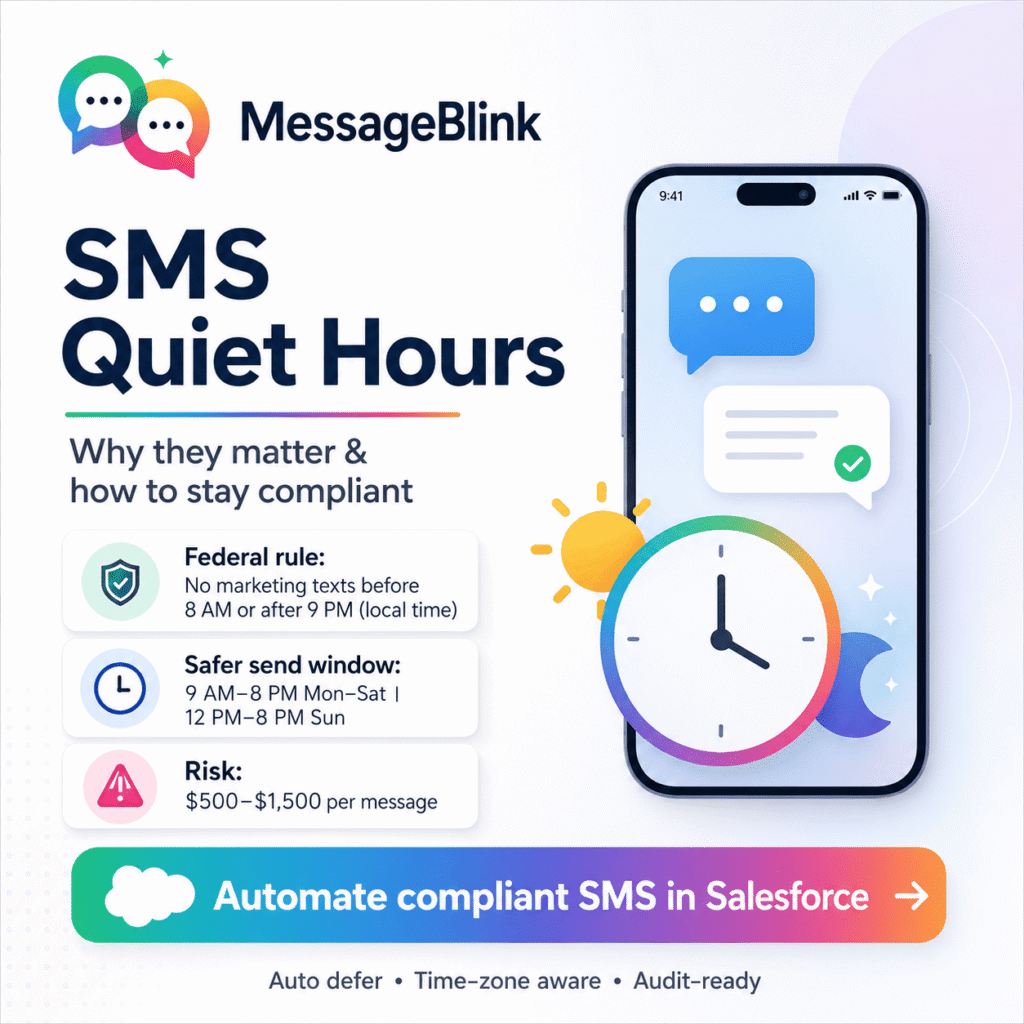
Under federal law (the Telephone Consumer Protection Act, or TCPA), the default quiet period is 8:00 PM to 8:00 AM in the recipient’s local time zone. In reality, a lot of compliance-focused platforms are going to use this more conservative 8 PM cutoff (versus the federal 9 PM ceiling) to give users an extra margin of safety.
Breaking the SMS quiet hours isn’t a technicality. TCPA penalties can be anywhere from $500 to $1,500 per message, and there has been a recent uptick in quiet-hours class-action filings since 2025, with one law firm filing more than 100 lawsuits in a few weeks targeting brands that sent marketing texts outside of allowable windows.
If you’re sending SMS via Salesforce, this is an area of compliance you cannot simply leave on autopilot.
Federal vs. State Quiet Hours: Know the Difference
The TCPA sets the federal baseline, but several states have passed their own “mini-TCPA” laws with stricter time restrictions. Here’s the current landscape:
| Jurisdiction | SMS Quiet Hours | Notes |
|---|---|---|
| Federal (TCPA) | Before 8 AM / After 9 PM local | Baseline for all US senders |
| Florida (FTSA) | Before 8 AM / After 8 PM local | Also limits to 3 texts per campaign per 24 hrs |
| New Jersey | Before 8 AM / After 8 PM local | Must include mailing address in each message |
| Maryland | Before 8 AM / After 8 PM local | Mirrors Oklahoma-style restrictions |
| Texas (SB 140, eff. Sept 1 2025) | Mon–Sat: Before 9 AM / After 9 PM; Sunday: Before 12 PM / After 8 PM | Expanded to explicitly cover SMS |
Key takeaway: The strictest combination (Florida/NJ/Maryland 8 PM cutoff + Texas Sunday restrictions) effectively narrows your safe sending window to 9 AM–8 PM Monday through Saturday, and 12 PM–8 PM on Sundays if you’re broadcasting to a nationwide US audience and want to stay safe across all jurisdictions.
Why Obeying SMS Quiet Hours Is Getting Tougher
This has become more complicated because of a few regulatory changes in 2024–2025:
1. The Location Issue
Under the TCPA, compliance is based on the recipient’s local time — but thanks to today’s number portability, a Texas area code could actually belong to someone who now lives in Oregon. In fact, businesses really can’t always know where a contact is at send time—carrier access to real-time location data was restricted by the FCC itself in April 2024. The industry workaround of using area codes (NPA-NXX) as a proxy for time zones is the most defensible position in litigation today, but not guaranteed.
2. New Litigation Theories
A flurry of lawsuits in early 2025 alleged that even broad prior express written consent doesn’t include messages sent during quiet hours — that brands need express written consent specifically to text outside of business hours. The courts have not universally accepted this theory, but it has fueled TCPA filings to near-record volumes.
3. FCC Deference Reduced by Supreme Court
District courts are not required to defer to FCC interpretations, Loper Bright (2024), McLaughlin v. McKesson (2025). That means compliance guidance that used to be settled is now subject to judicial challenge—making a consistent, conservative approach more important than ever.
The bottom line: Even if you have a signed opt-in from that subscriber, you can now be sued for sending at 8:01 PM.
Salesforce SMS Senders: The Effects of SMS Quiet Hours
If you are sending SMS campaigns directly from Salesforce—whether in individual sends or via Salesforce Flow automations—SMS quiet hours enforcement needs to be built into your sending platform, not done manually.
This is what good quiet-hours management looks like:
- Automatic deferral: Messages triggered or scheduled during the quiet hours are held and delivered after the quiet window closes—not dropped, not failed, just deferred.
- Time zone detection: The platform determines the recipient’s local time zone based on the information it has (ideally, the information in the CRM record; if that doesn’t exist, then the area code).
- Default fallback: When no time zone is known, the platform defaults to the strictest US window — typically 8:00 PM Eastern to 8:00 AM Pacific — ensuring maximum compliance coverage.
- Workflow compliance: SMS from Flow or journeys are automated and follow the same quiet hours as manual sends. A Flow which triggers at 2 AM, should not trigger an SMS at 2 AM.
- Override visibility: Any ability to override quiet hours should be surfaced clearly with a compliance warning, not buried in settings.
With MessageBlink, it’s all native inside of Salesforce. MessageBlink is 100% Salesforce-native (no middleware, no third-party routing layer), so it reads time zone data directly from your Salesforce contact or lead records and applies quiet-hours logic at send time. Messages scheduled to send during restricted windows are deferred automatically. The same rules apply whether you manually send one message or trigger thousands with a Salesforce Flow.
This is important because many SMS tools that “integrate with Salesforce” are really just syncing data between two separate systems. If the send logic is external to Salesforce, compliance gaps can arise at every sync point. The compliance layer and the CRM live in the same environment with a native tool — no handoff where things can go wrong.
SMS Quiet Hours Compliance Best Practices 2025–2026
Populate your CRM record with time zones. The better your location or time zone data at the contact level, the better. Make time zone required or auto populate it during lead capture and form fills.
And when in doubt, go with the most restrictive window. If you don’t have reliable location data, send between 10 AM and 7 PM local time. This gives you buffer on both ends of the federal 8 AM–9 PM range and accounts for stricter state rules.
Do not ever turn off quiet-hours settings for bulk sends. The ability to override quiet hours is available for edge cases — not campaigns. Turning it off to get a higher send count in a single window puts brands into class-action territory.
Apply quiet hours to automated flows as well. One common mistake is teams implement quiet hours for their broadcast campaigns, but not for Flow-triggered messages. If a purchase confirmation or a drip step fires at 11 PM, it’s still subject to the same rules.
Know your audience’s geography. If you are heavy on Florida, New Jersey, Maryland, or Texas in your SMS list, use the more stringent windows in those states as your baseline — not just the federal standard.
Audit your consent language. Given the emerging litigation theory around quiet-hours-specific consent, some legal teams are adding explicit language to opt-in forms to specify the hours during which a brand may send messages.
The Bottom Line
SMS quiet hours aren’t a platform setting you configure once and forget. These are live compliance requirements that involve federal law, state-specific rules, evolving litigation risk and your own CRM data quality.
The businesses caught in TCPA quiet hours lawsuits aren’t always the ones with bad intent—they’re often the ones using disconnected tools, incomplete location data, or platforms where compliance logic isn’t enforced at the source.
If you’re using Salesforce for SMS, the easiest way to be compliant with quiet hours is with a tool that enforces it natively—the CRM data, the send logic, and the compliance rules are all in the same system.
MessageBlink is designed that way. MessageBlink App on AppExchange is a 100% A Salesforce-native SMS and WhatsApp messaging platform that automatically enforces quiet hours based on your existing Salesforce contact data for manual sends and automations triggered by Flow. All messages are logged back to the CRM record, providing you with a clear audit trail if compliance is ever questioned.