


 ChatGPT
 Perplexity
 Claude
 Google AI
Chain Text Messages: What They Are and What to Do With One
A chain text message is a text that tells you to forward it to other people, backed by a threat or a promise. Don’t forward it, don’t tap any link inside it, and delete it. The rest of this guide covers why they exist, how to recognise one fast, and where to report the dangerous ones.
(If you searched “text message chain” because you meant a group thread of replies, that’s something else. This page is about messages built to be passed along.)
The two hooks
Almost every chain text pulls one of two levers.
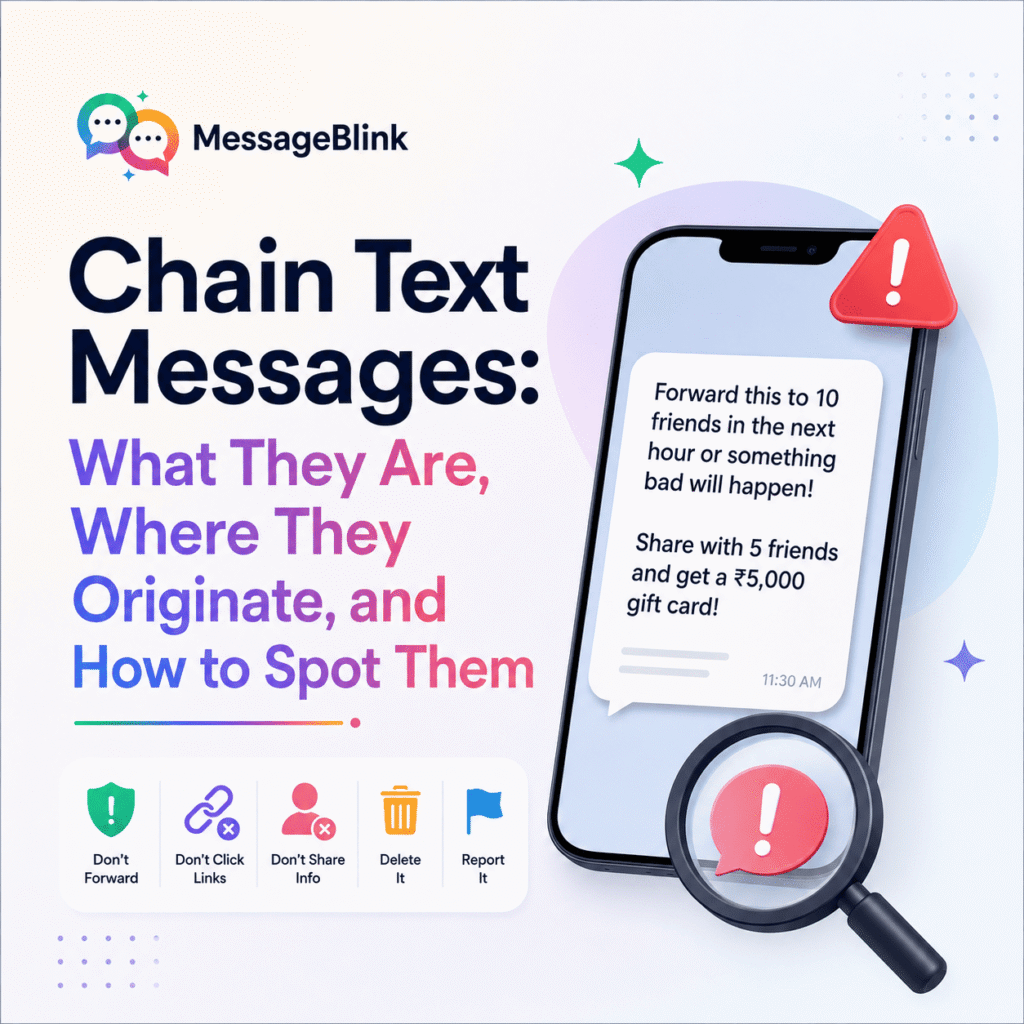
- Fear: “Send this to 10 people in the next hour or something bad will happen to you.”
- Reward: “Share with 5 friends and get a ₹5,000 gift voucher.”
Neither promise is real. The message exists to be copied, and what it carries on the way is usually a hoax, bad health advice or a link that leads somewhere unsafe.
This trick is much older than phones
Chain letters existed long before mobile phones. Europe had “Heaven letters” (Himmelsbrief) that promised blessings or curses to anyone who copied them, with examples traced as far back as the 6th century. The money version came later. In 1888, a Chicago woman mailed out 1,500 letters asking recipients to send her a dime and pass the letter on to three friends. The best-known craze followed in the Great Depression. In April 1935, the Denver post office handled around 67,000 “Send-a-Dime” chain letters in a single day. Chain letters moved online in the 1980s, and then to SMS, WhatsApp and every other app with a forward button Chain letter.
So the format hasn’t changed in a century. Only the postage has gotten cheaper.
Why people forward them anyway
It takes two seconds, so forwarding feels free. Add a little fear (“just in case”), a little hope (“what if it’s real”), a countdown (“within 24 hours”) and a claim that millions have already shared it, and most people stop thinking.
Messaging apps know this. WhatsApp, for one, labels forwarded messages and limits how widely they can be re-sent, which is a direct response to chain messages.
What a chain text can cost you
- Misinformation. False health tips and rumours travel fastest in this format.
- Phishing. A link inside can lead to a page designed to collect passwords, OTPs or card details.
- Personal details. Some chains ask you to reply with your name, address or photos.
- Pressure on vulnerable people. Children and older relatives often take the threats seriously.
Spot one in 30 seconds
Ask these in order. One “yes” is enough to stop.
- Does it tell you to forward or share it?
- Does it promise a prize or threaten bad luck?
- Is there a deadline?
- Is the sender a random number or has no clear name?
- Does it contain a shortened or odd-looking link?
Chain text vs. real business text
| Chain text | Real business text | |
|---|---|---|
| Asks you to forward it | Usually, and it’s the point | Rarely |
| Sender | Unknown or hidden | A named sender you can check |
| The offer | Vague and unverifiable | Checkable on the official site |
| Threats | Common | Never |
| Opt-out | None | A clear way to stop (e.g. STOP) |
| Links | Odd or shortened | The company’s own domain |
One honest caveat: genuine brands do sometimes run “refer a friend” offers by text. Those come from a named sender, give you a code or link on the official domain, and let you opt out. A chain text has none of that.
What to do when you get one
- Don’t forward it. That’s what it wants.
- Don’t tap any link or reply with personal details.
- Delete it.
- If it looks like a scam, report it.
Where to report it in India
- Unwanted commercial messages: use your operator’s app or website, the TRAI DND app, or call or text 1909. esaf
- Suspected fraud: report any suspected fraud message received in the last 30 days through the Chakshu facility on the government’s Sanchar Saathi portal. Reports there have led to action against mobile connections, handsets, bulk senders and WhatsApp accounts. esafcommunicationstoday
- If you’ve already lost money: call 1930 or file a complaint at cybercrime.gov.in. esaf
In the US, forward spam texts to 7726 (SPAM) and report fraud to the FTC at reportfraud.ftc.gov.
For businesses: don’t look like a chain text
If you text customers, a few habits keep you on the right side of that comparison table: send from a clearly identified sender, only message people who opted in, honor opt-outs, and never ask recipients to forward your message.
MessageBlink, a Salesforce-native SMS and WhatsApp app, helps with the record-keeping side. Consent, opt-outs and message history are stored on the contact record in Salesforce. Compliance still depends on how you set it up and what you send, so check your local rules, such as TRAI’s sender and template registration in India or the TCPA in the US.