

 ChatGPT
 Perplexity
 Claude
 Google AI
60+ Proven Example Text Messages That Get Replies (2026)
72% of people read a business text within 5 minutes of receiving it. 83% return in 15. And 70% now expect a business to reply within an hour of texting first. Consumer texting behavior data from 2026 shows that the example text message has become the default way businesses reach people for nearly every type of message, not a nice-to-have.
That is the risk and the opportunity in one stat. A weak example text message is read as quickly as a strong one—and dismissed just as quickly too. This guide explains the differences and offers 40+ example text messages you can adapt.
The Anatomy of an Example Text Message That Gets a Response
Dissect this example text message, line by line:
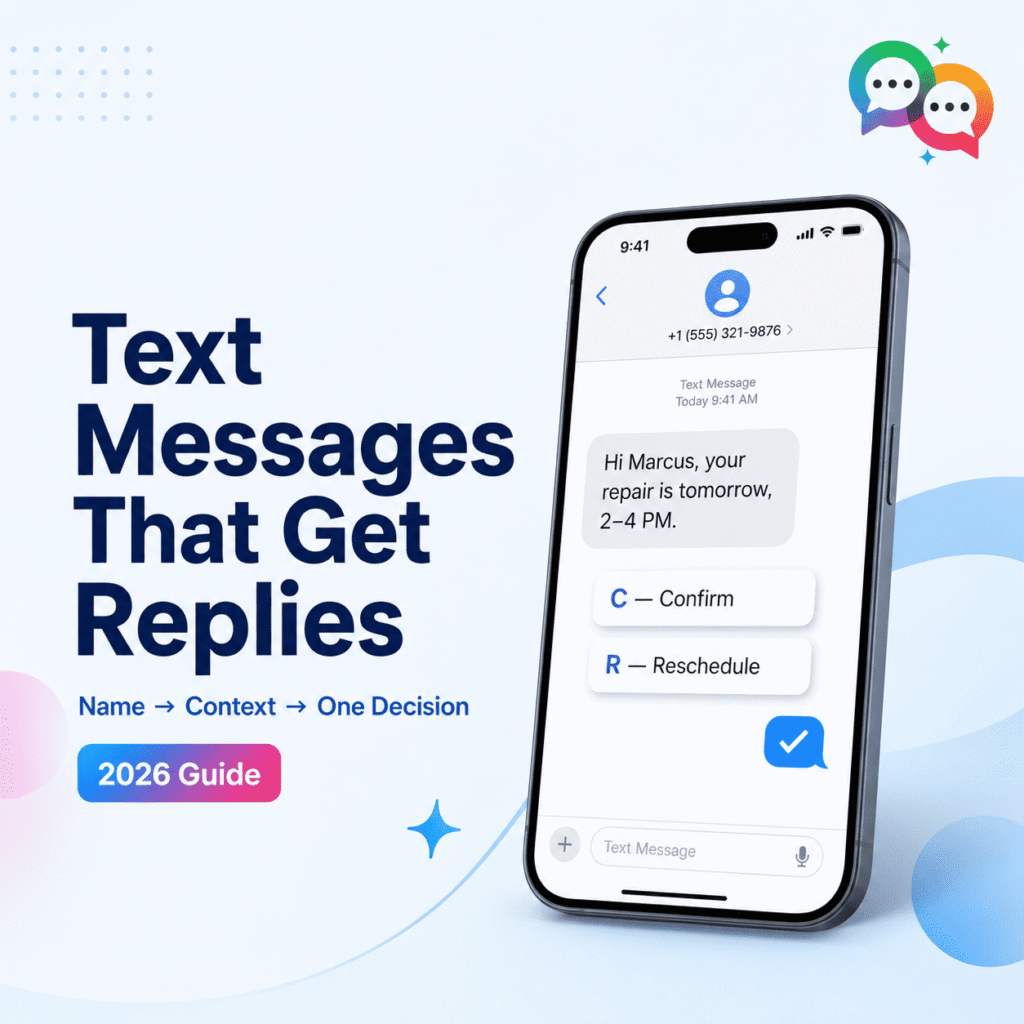
“Hi Marcus, your dryer repair is scheduled for tomorrow from 2 to 4 PM. Reply C to confirm or R to reschedule.”
“Hi Marcus”—a name, not “Dear Customer.” Personalization is table stakes now, not a differentiator. “Your dryer “repair”—specific to what Marcus actually booked, not a generic “your appointment.” “Tomorrow, 2–4 PM” — one fact, stated once. No duplicate information, no filler sentence restating the same thing. “Reply C to confirm or R to reschedule”—one decision, two clearly labeled outcomes. Not “let us know if you have questions,” which doesn’t give the reader anything concrete to do.
Every example text message later in this post follows this same form: name → specific context → one decision. If a message doesn’t fit that shape, it’s usually trying to do too much.
Weak vs. Strong Text Message Examples
Most lists of “sample text” only show you the good version. So this is what it looks like in practice — five common example text message mistakes, rewritten:
| Weak | Strong | Why |
|---|---|---|
| “Hi, just checking in to see if you had any questions about our product or service. Feel free to reach out anytime!” | “Hi Dana, quick question—is it set-up time or is it pricing at this point?” | The weak version requires effort (no prompt, open-ended). The strong version asks a simple question, easy to answer in 3 words. |
| “This is a reminder you have an upcoming appointment scheduled with us.” | “Hi Tom, your 2PM tomorrow is reserved. Reply R to reschedule.” | The weak version is a statement of fact with no action. The strong version assumes confirmation and only asks for action on the exception. |
| “We noticed you didn’t complete your purchase; don’t miss out on this awesome deal!” | “Hi Priya, your cart is still saved. Need help? Or want that link again? Reply H or L.” | The weak version uses pressure language with no real choice. The strong version provides honest low-friction options. |
| “We appreciate your business and loyalty! Thank you for being a valued customer!” | “Thanks for 3 years with us, Mike. Use code MIKE25 for 25% off your next order.” | The weak version is a compliment that doesn’t go anywhere. The strong version proves the appreciation with something useful. |
| “Please reply at your earliest convenience concerning the matter discussed.” | “Hi Grace, still deciding on the demo? A yes or no is fine.” | The weak version is like an email sent via SMS. The strong version is what people really expect in casual-register texts. |
Pattern: Weak example text messages are about feelings or facts. Strong ones put the reader in the driver’s seat.
Timing, Length, and Frequency: What 2026 Data Says About Example Text Messages
Some numbers to design your next example text message around:
Read speed is not a variable anymore. Most texts are read in 5 minutes, and it’s the content of the message—not how it’s delivered—that determines whether it gets a reply.
Frequency, not content, is the biggest opt-out factor. Message frequency is the number one reason people opt out of business texting, not irrelevant content or tone. If you’re torn between “send it now” and “wait for the right trigger” for your next example text message, wait.
Length still predicts click-through. Messages of 120 to 160 characters get a 24.3% click-through rate, versus 19.6% for messages that spill over into a second segment. Every sentence beyond the core message costs you replies, not just characters.
Employer texting is a real and growing category. 71% of consumers are now receptive to texts from an employer, up from 58% in 2021—shift reminders, HR alerts, and internal updates. If you’re only looking at customer-facing example text messages, you’re missing a use case growing very fast.
Example Text Messages by Use Case
Each of these example text messages follows the name → context → one-decision structure above. Enter your details.
Welcome Example Text Messages
- Hi Erin, thanks for signing up for [Business]! We’ll text you here. Reply STOP to cancel at any time.
- Hey Alex, welcome aboard! Reply Y and we’ll deliver your first tip today.
- Hi Priya, you are in now. Feel free to ask me anything, anytime.
Example Text Messages for First-Touch and Lead Follow-Up
4. Hi James, I noticed you scheduled a call. What is the one thing you want us to solve?
5. Hi Grace, thank you for your interest in [Product]. Morning or afternoon—what’s better for a quick call?
6. Still thinking, Kevin? What would make it an easy yes?
7. Hi Nina, just a follow-up on your form. Reply “Y” and I will send a quote now.
Appointment and Meeting Reminder Example Text Messages
8. Hi Samantha, Your appointment is today at 2:00. Reply C to confirm or R to reschedule.
9. Hey Tom, we start in 15 min. Join here: (link)
10. Hey Olivia, is 10am tomorrow still okay? Reply Y or R to change it.
11. You have an appointment with [Business] on Thursday at 3PM.
Example Text Messages for Customer Service and Support
12. Hi Dan, we received your request #4521. Update in 24 hours.
13. Hey Maria, your problem is solved. Reply if anything is still wrong.
14. Hi Marcus, we are experiencing longer wait times today — thank you for your patience.
15. Apologies for the delay, John. Here’s 20% off your next order: CODE20 at [link]
Example Text Messages for Promotions and Limited-Time Offers
16. Brandon, this weekend only—20% off: (link) Reply STOP to opt out.
17. We just released [product]. 15% off for the first 24 hours: (link)
18. Jesse, 2-for-1 today only: (link)
19. Priya, this is your last call. Your code expires at midnight: (link)
Example Text Messages for Payment and Renewal Reminders
20. Hi Jeff, Your invoice of $450 is due 8/15. Pay here: (link)
21. Reminder: your subscription renews 9/1. Update your card if needed: (link)
22. Hi Julia, your plan expires in 14 days. Got questions? Just reply.
23. Hi Nina, your card on file is about to expire: (link)
Example Text Messages for Reviews and Feedback
24. Hi Ann, how did we do? Reply with a number from 1 to 5 to rate us.
25. Thank you for your purchase! What could we have done differently?
26. Hey Mia, did you like working with us? A quick review helps a lot: (link)
27. Hi Tom, what’s keeping you from giving 5 stars? Just reply.
Order and Booking Confirmation Example Text Messages
28. We received your order! Track here: (link)
29. Hi Patrick, we got your request. We will reply within 24 hours.
30. Thank you for your purchase, Sergey! Your order has shipped: (link)
31. You have an appointment on Tues at 1 PM. See ya then!
Loyalty and Rewards Example Text Messages
32. Thanks for your loyal patronage, May! 30% off with MAY30: (link)
33. You earned 15 reward points. Check your balance here: (link)
34. Happy Anniversary, Mike! 25% off with MIKE25, good until 11/15.
35. Happy birthday, Emma! You’ve received 20 bonus points in your account.
Employer and Internal Texting Example Text Messages (2026 Growth Category)
36. Hello Team, shift change: 9 a.m. Thursday will be at 10 a.m. Reply Y to confirm you’ve seen this.
37. Heads up: open enrollment ends Friday! Questions? Reply to this message.
38. Hey Marcus, your schedule for next week is posted. Check it here: (link)
Compliance Landscape Shifts in 2026 — What Every Example Text Message Needs to Follow
This is more important than most “sample text” lists would have you believe. The rules changed this year:
The FCC’s one-to-one consent rule went into effect January 27, 2026. If a lead is generated from a shared form, each business contacting that lead now needs its own, separate, explicit consent — you can no longer rely on vague “our partners may contact you” language.
Unregistered numbers are not filtered; they are blocked. As of February 2025, AT&T, T-Mobile, and Verizon are blocking 100% of unregistered A2P 10DLC traffic. No delays, no partial deliveries — it just doesn’t arrive.
All opt-outs must be honored, not just for specific types of messages. If someone responds STOP to a campaign, a pending FCC rule (probably 2027, but worth working toward now) will require stopping all automated messages to that person, not just the one they opted out of.
It’s not just the law—carriers enforce quiet hours and content restrictions too. The CTIA messaging principles specify a window from 8 AM to 9 PM recipient local time, and SHAFT content (sex, hate, alcohol, firearms, and tobacco) is forbidden regardless of consent.
Most of this doesn’t require anything exotic to stay compliant; for your next example text message, a clear opt-out line on promotional texts and a registered number will cover most of the above. But if your program hasn’t been reviewed in a year, it’s worth a look given how quickly this moved.